Simon Ström
Even when merely arguing for meritocracy and freedom of association, we are operationally, de facto, white supremacists.
Because factual incentives, mechanisms and empirical results, all of which are each other’s direct and inverse derivative functions, matter infinitely more than ideology –
meaning internal delusion and external signaling of intent as required by current imperatives moral fictionalism.
Eric let’s destroy the paradigm of “ideology” forever
Form: Quote Commentary
-
Let’s Destroy Ideology Forever
Simon Ström Even when merely arguing for meritocracy and freedom of association, we are operationally, de facto, white supremacists. Because factual incentives, mechanisms and empirical results, all of which are each other’s direct and inverse derivative functions, matter infinitely more than ideology – meaning internal delusion and external signaling of intent as required by current imperatives moral fictionalism. Eric let’s destroy the paradigm of “ideology” forever -
LET’S DESTROY IDEOLOGY FOREVER Simon Ström Even when merely arguing for meritocr
LET’S DESTROY IDEOLOGY FOREVER
Simon Ström
Even when merely arguing for meritocracy and freedom of association, we are operationally, de facto, white supremacists.
Because factual incentives, mechanisms and empirical results, all of which are each other’s direct and inverse derivative functions, matter infinitely more than ideology –
meaning internal delusion and external signaling of intent as required by current imperatives moral fictionalism.
Eric let’s destroy the paradigm of “ideology” forever
Source date (UTC): 2018-02-04 17:39:00 UTC
-
RT @Steve_Sailer: The Law of Supply and Demand points to immigration driving dow
RT @Steve_Sailer: The Law of Supply and Demand points to immigration driving down wages and driving up rents, as does the history of the la…
Source date (UTC): 2018-02-03 15:59:56 UTC
Original post: https://twitter.com/i/web/status/959818746499125249
-
RT @Outsideness: Formal state-based eugenics programs weren’t great, but the inf
RT @Outsideness: Formal state-based eugenics programs weren’t great, but the informal state-based dysgenics programs that replaced them are…
Source date (UTC): 2018-02-03 15:59:45 UTC
Original post: https://twitter.com/i/web/status/959818702819659776
-
photos_and_videos/TimelinePhotos_dJ9jhts2Ng/27503394_187184071878491_23571431584
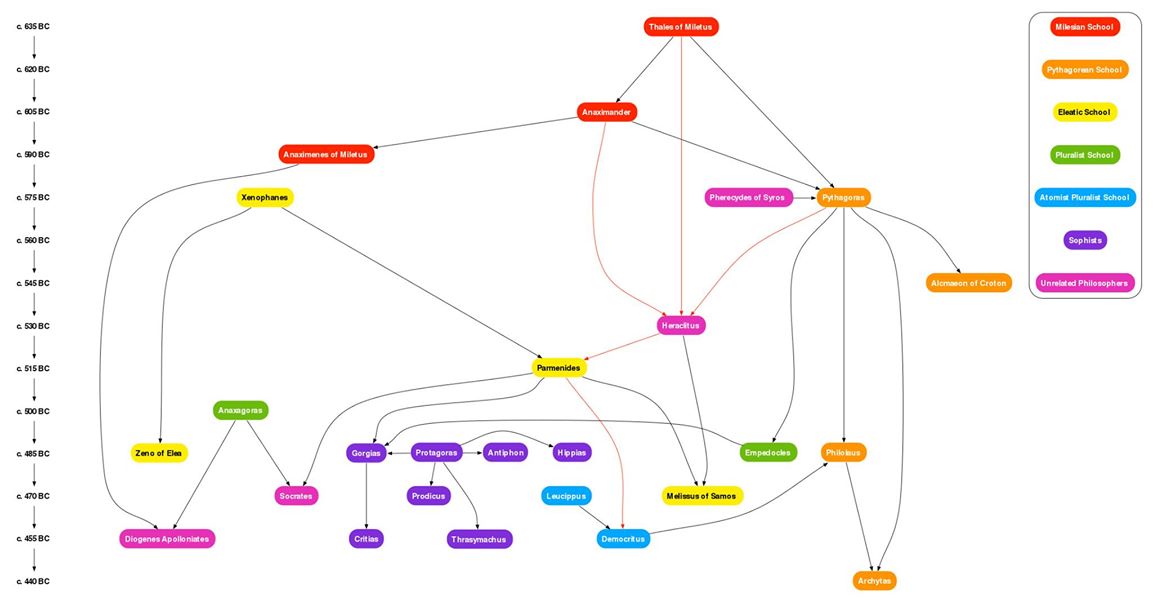
photos_and_videos/TimelinePhotos_dJ9jhts2Ng/27503394_187184071878491_2357143158474927727_o_187184071878491.jpg ORIGINS OF PHILOSOPHY IN COMPETITION BETWEEN NATURALISTS, THEOLOGIANS(Pseudoscience), AND MYTHICISTS(PseudoHistorians)
The Presocratic philosophers were called physiologoi (Greek: φυσιολόγοι; in English, physical or natural philosophers). Aristotle was the first to make a clear distinction between these physiologoi or physikoi (“physicists”, after physis, “nature”) who sought natural explanations for phenomena, and the earlier theologoi (theologians), or mythologoi (story tellers and bards) who attributed these phenomena to various gods.
Diogenes Laërtius divides the physiologoi into two groups: Ionian, led by Anaximander, and the Italiote, led by Pythagoras.
IT BEGINS IN 635 BC
But they begin in 635BC with Thales, who was a greek citizen, but may or may not have been a descendent of the Phoenicians, who may or may not have originated on the Red sea, which may or may not refer to the civilization that developed on the trade route between africa and yemen in that region south of what is today ethiopia, but continues across the south of the arabian peninsula, and to the trade routes with India. It is this trade route as much as the mediterranean that accounted for much of the wealth of the levant.
Engineering and construction, and Commercial transactions encourage the development of contract, reason and calculation – because of risk, investment, and liability.
So Thales evolved his thought Just as there is a competition today between literary and theological authors, and scientists, and commercialists. The law has no competitor except religion.
And its possibly important to note that it was the borderland peoples who invented reason, not the urbanites in Athens. Why? Density encourages civic deceit. Objective analysis of civic deceit produces reason.
Thales bought all the olive presses in Miletus after predicting the weather and a good harvest for a particular year. Another version of the story has Aristotle explain that Thales had reserved presses in advance, at a discount, and could rent them out at a high price when demand peaked, following his prediction of a particularly good harvest. Aristotle explains that Thales’ objective in doing this was not to enrich himself but to prove to his fellow Milesians that philosophy could be useful, contrary to what they thought, or alternatively, Thales had made his foray into enterprise because of a personal challenge put to him by an individual who had asked why, if Thales was an intelligent famous philosopher, he had yet to attain wealth. This first version of the story would constitute the first historically known creation and use of futures, whereas the second version would be the first historically known of creation and use of options.
But his theoretical insights are from geometry.
|CAUSALITY| Commerce(Finance) > Engineering > Geometry > Science.ORIGINS OF PHILOSOPHY IN COMPETITION BETWEEN NATURALISTS, THEOLOGIANS(Pseudoscience), AND MYTHICISTS(PseudoHistorians)
The Presocratic philosophers were called physiologoi (Greek: φυσιολόγοι; in English, physical or natural philosophers). Aristotle was the first to make a clear distinction between these physiologoi or physikoi (“physicists”, after physis, “nature”) who sought natural explanations for phenomena, and the earlier theologoi (theologians), or mythologoi (story tellers and bards) who attributed these phenomena to various gods.
Diogenes Laërtius divides the physiologoi into two groups: Ionian, led by Anaximander, and the Italiote, led by Pythagoras.
IT BEGINS IN 635 BC
But they begin in 635BC with Thales, who was a greek citizen, but may or may not have been a descendent of the Phoenicians, who may or may not have originated on the Red sea, which may or may not refer to the civilization that developed on the trade route between africa and yemen in that region south of what is today ethiopia, but continues across the south of the arabian peninsula, and to the trade routes with India. It is this trade route as much as the mediterranean that accounted for much of the wealth of the levant.
Engineering and construction, and Commercial transactions encourage the development of contract, reason and calculation – because of risk, investment, and liability.
So Thales evolved his thought Just as there is a competition today between literary and theological authors, and scientists, and commercialists. The law has no competitor except religion.
And its possibly important to note that it was the borderland peoples who invented reason, not the urbanites in Athens. Why? Density encourages civic deceit. Objective analysis of civic deceit produces reason.
Thales bought all the olive presses in Miletus after predicting the weather and a good harvest for a particular year. Another version of the story has Aristotle explain that Thales had reserved presses in advance, at a discount, and could rent them out at a high price when demand peaked, following his prediction of a particularly good harvest. Aristotle explains that Thales’ objective in doing this was not to enrich himself but to prove to his fellow Milesians that philosophy could be useful, contrary to what they thought, or alternatively, Thales had made his foray into enterprise because of a personal challenge put to him by an individual who had asked why, if Thales was an intelligent famous philosopher, he had yet to attain wealth. This first version of the story would constitute the first historically known creation and use of futures, whereas the second version would be the first historically known of creation and use of options.
But his theoretical insights are from geometry.
|CAUSALITY| Commerce(Finance) > Engineering > Geometry > Science.
Source date (UTC): 2018-02-03 13:36:00 UTC
-
Untitled
Source date (UTC): 2018-02-02 10:58:00 UTC
-
(read this) by Bill Joslin Ideological and religious frames reduce the intellect
(read this) by Bill Joslin Ideological and religious frames reduce the intellectual cost of framing the world. Consequence (accountability) forces higher investment out of interpretive, justificationary, of explanatory frames into operational frames. The later reorder the contingencies properly, meaning utility proceeds or grounds aesthetics (a trade elevating to a craft elevating again to an art – the progression of mastery) opposed to floating aesthetics (borrowing from rands floating concepts) which can be pleasant and inspiring but devoid of any substantive value. The initial critism attempt to invert that relationship , isolating aesthetics from more fundemental forms of value and then assert it’s function as what drives reasoning. In this later case the only value aesthics obtains remains as a means to acquire power through motivation (inspiration) of others. Then claims this outcome as the causal agent. We must value first in order to reason (valuation drives motivation) and therefore reason is contingent on aesthetics – aesthetics drives human action… Yet I fail to see the tiler, convenience store owner or floor sweeper to be driven by aesthetics. But find the carpenter, mason, and machinist elevate their skills to obtain aesthetics quality. And what drives their progression to mastery is the combination of the grammar, logic, rhetoric and ethics (desire for pride in work, desire for good standing and reputation) which leads to the aesthetic. -
(read this) by Bill Joslin Ideological and religious frames reduce the intellect
(read this)
by Bill Joslin
Ideological and religious frames reduce the intellectual cost of framing the world. Consequence (accountability) forces higher investment out of interpretive, justificationary, of explanatory frames into operational frames.
The later reorder the contingencies properly, meaning utility proceeds or grounds aesthetics (a trade elevating to a craft elevating again to an art – the progression of mastery) opposed to floating aesthetics (borrowing from rands floating concepts) which can be pleasant and inspiring but devoid of any substantive value.
The initial critism attempt to invert that relationship , isolating aesthetics from more fundemental forms of value and then assert it’s function as what drives reasoning.
In this later case the only value aesthics obtains remains as a means to acquire power through motivation (inspiration) of others. Then claims this outcome as the causal agent.
We must value first in order to reason (valuation drives motivation) and therefore reason is contingent on aesthetics – aesthetics drives human action…
Yet I fail to see the tiler, convenience store owner or floor sweeper to be driven by aesthetics. But find the carpenter, mason, and machinist elevate their skills to obtain aesthetics quality.
And what drives their progression to mastery is the combination of the grammar, logic, rhetoric and ethics (desire for pride in work, desire for good standing and reputation) which leads to the aesthetic.
Source date (UTC): 2018-02-01 22:24:00 UTC
-
(read this) by Bill Joslin Ideological and religious frames reduce the intellect
(read this) by Bill Joslin Ideological and religious frames reduce the intellectual cost of framing the world. Consequence (accountability) forces higher investment out of interpretive, justificationary, of explanatory frames into operational frames. The later reorder the contingencies properly, meaning utility proceeds or grounds aesthetics (a trade elevating to a craft elevating again to an art – the progression of mastery) opposed to floating aesthetics (borrowing from rands floating concepts) which can be pleasant and inspiring but devoid of any substantive value. The initial critism attempt to invert that relationship , isolating aesthetics from more fundemental forms of value and then assert it’s function as what drives reasoning. In this later case the only value aesthics obtains remains as a means to acquire power through motivation (inspiration) of others. Then claims this outcome as the causal agent. We must value first in order to reason (valuation drives motivation) and therefore reason is contingent on aesthetics – aesthetics drives human action… Yet I fail to see the tiler, convenience store owner or floor sweeper to be driven by aesthetics. But find the carpenter, mason, and machinist elevate their skills to obtain aesthetics quality. And what drives their progression to mastery is the combination of the grammar, logic, rhetoric and ethics (desire for pride in work, desire for good standing and reputation) which leads to the aesthetic.