Form: Excerpt

  • DEBATE OVER ODIN By AunMarie Grooms There are two debates in the Greater Heathen

    DEBATE OVER ODIN

    By AunMarie Grooms

    There are two debates in the Greater Heathen community over two different concepts.

    1. Odin is a deity who comes after and through the higher gods Orlog (natural law) and the Nine Wood Ogresses,

    2. Odin was a mortal man who through right good will and action became deified as a god (this concept comes to the tradition via Snori in his Prose Edda (Reinterpretation of the Poetic Eddas) and his Heimskringla.

    These works were his equivalent of a Doctoral Theses written as proof of his ability to interview and collect data as he was becoming a regional law man.

    In order to write on this topic he had to toss in his Christian influenced apologies, namely the old gods were just mortal men deified over time.

    The answer to 1. Is the concepts of gods vs giants. Gods have your people’s invested interest, while giants can be ambivalent, hostile or apathetic to your people.

    Other people’s gods are your people’s giants. Therefore Orlog, and The Nine would not be considered gods as they are indifferent to any people’s well being.

    Odin is therefore not a demi-god, but the primary god of his people. Not sure why Curt chose to list them this way. I’m sure he has his own reasons.

    ===

    (CD: I used demigod because that is the technical term for men who become gods, rather than gods whose origins are eternal. The old gods fit the pre-ie gods. thor fits the ie gods. Odin appears in the pantheon and ascends. So I’m of the opinion that odin existed. That does not mean I am right. It just means thats my current undestanding. Additioally, in my understanding of religion, that is the best kind of religion to have: man transcendent. )


    Source date (UTC): 2020-02-22 14:05:00 UTC

  • THE EIGHTH DAY “Evensong” by Lester del Rey. It details the capture of a being,

    THE EIGHTH DAY

    “Evensong” by Lester del Rey. It details the capture of a being, identified at the end of the story as God, by Man, which has usurped God’s power.

    EVENSONG

    By the time he reached the surface of the little planet, even the dregs of his power were drained. Now he rested, drawing reluctant strength from the yellow sun that shone on the greensward around him. His senses were dim with an ultimate fatigue, but the fear he had learned from the Usurpers drove them outward, seeking a further hint of sanctuary.

    It was a peaceful world, he realized, and the fear thickened in him at the discovery. In his younger days, he had cherished a multitude of worlds where the game of life’s ebb and flow could be played to the hilt. But the Usurpers could brook no rivals to their own outreaching lust. The very peace and order here meant that this world had once been theirs.

    He tested for them gingerly while the merest whisper of strength poured into him. None were here now. He could have sensed the pressure of their close presence at once, and there was no trace of that. The even grassland swept in rolling meadows and swales to the distant hills. There were marble structures in the distance, sparkling whitely in the late sunlight, but they were empty, their unknown purpose altered to no more than decoration now upon this abandoned planet. His attention swept back, across a stream to the other side of the wide valley.

    There he found the garden. Within low walls, its miles of expanse were a tree-crowded and apparently untended preserve. He could sense the stirring of larger animal life among the branches and along the winding paths. The brawling vigor of all proper life was missing, but its abundance might be enough to mask his own vestige of living force from more than careful search.

    It was at least a better refuge than this open greensward and he longed toward it, but the danger of betraying motion held him still where he was. He had thought his previous escape to be assured, but he was learning that even he could err. Now he waited while he tested once more for evidence of Usurper trap.

    He had mastered patience in the confinement the Usurpers had designed at the center of the galaxy. He had gathered his power furtively while he designed escape around their reluctance to make final disposition. Then he had burst outward in a drive that should have thrust him far beyond the limits of their hold on the universe. And he had found failure before he could span even the distance to the end of this spiral arm of one galactic fastness.

    Their webs of detection were everywhere, seemingly. Their great power-robbing lines made a net too fine to pass. Stars and worlds were linked, until only a series of miracles had carried him this far. And now the waste of power for such miracles was no longer within his reach. Since their near failure in entrapping and sequestering him, they had learned too much.

    Now he searched delicately, afraid to trip some alarm, but more afraid to miss its existence. From space, this world had offered the only hope in its seeming freedom from their webs. But only micro-seconds had been available to him for his testing then.

    At last he drew his perceptions back. He could find no slightest evidence of their lures and detectors here. He had begun to suspect that even his best efforts might not be enough now, but he could do no more. Slowly at first, and then in a sudden rush, he hurled himself into the maze of the garden.

    Nothing struck from the skies. Nothing leaped upwards from the planet core to halt him. There was no interruption in the rustling of the leaves and the chirping bird songs. The animal sounds went on unhindered. Nothing seemed aware of his presence in the garden. Once that would have been unthinkable in itself, but now he drew comfort from it. He must be only a shadow self now, unknown and unknowable in his passing.

    Something came down the path where he rested, pattering along on hoofs that touched lightly on the spoilage of fallen leaves. Something else leaped quickly through the light underbrush beside the path.

    He let his attention rest on them as they both emerged onto the near pathway at once. And cold horror curled thickly around him.

    One was a rabbit, nibbling now at the leaves of clover and twitching long ears as its pink nose stretched out for more. The other was a young deer, still bearing the spots of its fawnhood. Either or both might have seemingly been found on any of a thousand worlds. But neither would have been precisely of the type before him.

    This was the Meeting World—the planet where he had first found the ancestors of the Usurpers. Of all worlds in the universe, it had to be this world he sought for refuge!

    They were savages back in the days of his full glory, confined to this single world, rutting and driving their way to the lawful self-destruction of all such savages. And yet there had been something odd about them, something that then drew his attention and even his vagrant pity.

    Out of that pity, he had taught a few of them, and led them upwards. He had even nursed poetic fancies of making them his companions and his equals as the life span of their sun should near its ending. He had answered their cries for help and given them at least some of what they needed to set their steps toward power over even space and energy. And they had rewarded him by overweening pride that denied even a trace of gratitude. He had abandoned them finally to their own savage ends and gone on to other worlds, to play out the purposes of a wider range.

    It was his second folly. They were too far along the path toward unlocking the laws behind the universe. Somehow, they even avoided their own destruction from themselves. They took the worlds of their sun and drove outwards, until they could even vie with him for the worlds he had made particularly his own. And now they owned them all, and he had only a tiny spot here on their world—for a time at least.

    The horror of the realization that this was the Meeting World abated a little as he remembered now how readily their spawning hordes possessed and abandoned worlds without seeming end. And again the tests he could make showed no evidence of them here. He began to relax again, feeling a sudden hope from what had been temporary despair. Surely they might also believe this was the one planet where he would never seek sanctuary.

    Now he set his fears aside and began to force his thoughts toward the only pattern that could offer hope. He needed power, and power was available in any area untouched by the webs of the Usurpers. It had drained into space itself throughout the aeons, a waste of energy that could blast suns or build them in legions. It was power to escape, perhaps even to prepare himself eventually to meet them with at least a chance to force truce, if not victory. Given even a few hours free of their notice, he could draw and hold that power for his needs.

    He was just reaching for it when the sky thundered and the sun seemed to darken for a moment!

    The fear in him gibbered to the surface and sent him huddling from sight of the sky before he could control it. But for a brief moment there was still a trace of hope in him. It could have been a phenomenon caused by his own need for power; he might have begun drawing too heavily, too eager for strength.

    Then the earth shook, and he knew.

    The Usurpers were not fooled. They knew he was here—had never lost him. And now they had followed in all their massive lack of subtlety. One of their scout ships had landed, and the scout would come seeking him.

    He fought for control of himself, and found it long enough to drive his fear back down within himself. Now, with a care that disturbed not even a blade of grass or leaf on a twig, he began retreating, seeking the denser undergrowth at the center of the garden where all life was thickest. With that to screen him, he might at least draw a faint trickle of power, a strength to build a subtle brute aura around himself and let him hide among the beasts. Some Usurper scouts were young and immature. Such a one might be fooled into leaving. Then, before his report could be acted on by others, there might still be a chance….

    He knew the thought was only a wish, not a plan, but he clung to it as he huddled in the thicket at the center of the garden. And then even the fantasy was stripped from him.

    The sound of footsteps was firm and sure. Branches broke as the steps came forward, not deviating from a straight line. Inexorably, each firm stride brought the Usurper nearer to his huddling place. Now there was a faint glow in the air, and the animals were scampering away in terror.

    He felt the eyes of the Usurper on him, and he forced himself away from that awareness. And, like fear, he found that he had learned prayer from the Usurpers; he prayed now desperately to a nothingness he knew, and there was no answer.

    “Come forth! This earth is a holy place and you cannot remain upon it, Our judgement is done and a place is prepared for you. Come forth and let me take you there!” The voice was soft, but it carried a power that stilled even the rustling of the leaves.

    He let the gaze of the Usurper reach him now, and the prayer in him was mute and directed outward—and hopeless, as he knew it must be.

    “But—” Words were useless, but the bitterness inside him forced the words to come from him. “But why? I am God!”

    For a moment, something akin to sadness and pity was in the eyes of the Usurper. Then it passed as the answer came. “I know. But I am Man. Come!”

    He bowed at last, silently, and followed slowly as the yellow sun sank behind the walls of the garden.

    And the evening and the morning were the eighth day.


    Source date (UTC): 2020-02-21 16:18:00 UTC
  • RT @Sean__Last: Pew finds that the black-white income gap hasn’t changed since 1

    RT @Sean__Last: Pew finds that the black-white income gap hasn’t changed since 1970. Yet, since that time interpersonal racism has declined…


    Source date (UTC): 2020-02-21 01:06:41 UTC

    Original post: https://twitter.com/i/web/status/1230660074709946371

  • RT @KurtKurtking: @carterwpage @CarrollQuigley1 @LindseyGrahamSC @ChuckGrassley

    RT @KurtKurtking: @carterwpage @CarrollQuigley1 @LindseyGrahamSC @ChuckGrassley @senjudiciary @JohnCornyn @SenMikeLee @tedcruz @BenSasse @H…


    Source date (UTC): 2020-02-21 01:02:29 UTC

    Original post: https://twitter.com/i/web/status/1230659020714921984

  • photos_and_videos/TimelinePhotos_kg5QueHwVw/86790915_210269200371241_80646571754

    photos_and_videos/TimelinePhotos_kg5QueHwVw/86790915_210269200371241_80646571754

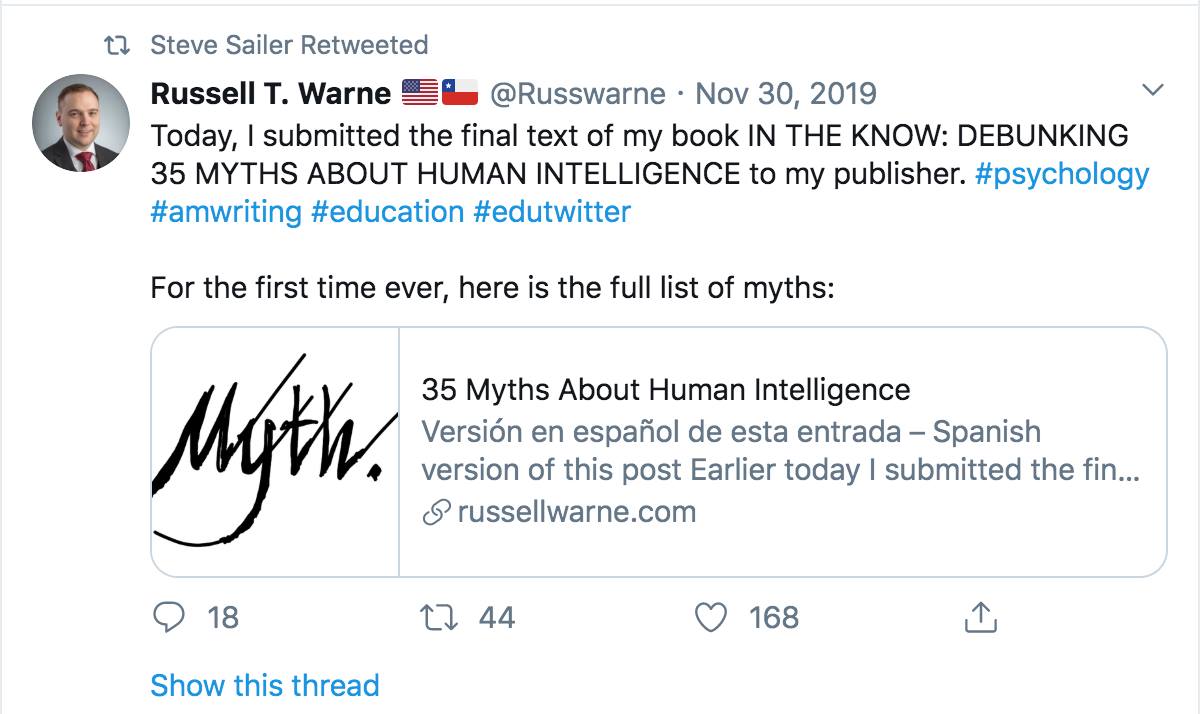
    photos_and_videos/TimelinePhotos_kg5QueHwVw/86790915_210269200371241_8064657175416406016_o_210269193704575.jpg UPCOMING BOOK ON HUMAN INTELLIGENCE

    Russell T. Warne

    Psychologist – Data Analyst – Educator

    (a book answering the science-denialists)

    Earlier today I submitted the final text for my upcoming book In the Know: Debunking 35 Myths About Human Intelligence. It feels good to have it in the hands of my publisher. There is still some work to do, but most of it is work that my publisher has to do–not me.

    The book has 35 chapters (one per myth), plus an introduction and a conclusion. The chapters are each short enough that they can be read in one sitting, and the language is as non-technical as possible. My goal was to have the book serve as a convenient reference that people could use to combat common incorrect ideas about intelligence.

    The book will be published in fall 2020. In the meantime, here are the myths that the book addresses:

    Section 1: The Nature of Intelligence

    Intelligence is whatever collection of tasks a psychologist puts on a test.

    Intelligence is too complex to summarize with one number.

    IQ does not correspond to brain anatomy or functioning.

    Intelligence is a Western concept that does not apply to non-Western cultures.

    There are multiple intelligences in the human mind.

    Practical intelligence is a real ability, separate from general intelligence.

    Fact: there are aspects of brain anatomy and functioning that correlate with IQ scores.

    Section 2: Measuring Intelligence

    Measuring intelligence is difficult.

    Content on intelligence tests is trivial and cannot measure intelligence.

    Intelligence tests are imperfect and cannot be used or trusted.

    Intelligence tests are biased against diverse populations.

    Section 3: Influences on Intelligence

    IQ only reflects a person’s socioeconomic status.

    High heritability for intelligence means that raising IQ is impossible.

    Genes are not important for determining intelligence.

    Environmentally driven changes in IQ mean that intelligence is malleable.

    Social interventions can drastically raise IQ.

    Brain training programs can raise IQ.

    Improvability of IQ means intelligence can be equalized.

    The reality is that geneticists have identified hundreds of DNA segments that are associated with intelligence. In fact, in some samples, genes have a larger impact than environment on IQ.

    Section 4: Intelligence and Education

    Every child is gifted.

    Effective schools can make every child academically proficient.

    Non-cognitive variables have powerful effects on academic achievement.

    Admissions tests are a barrier to college for underrepresented students.

    Section 5: Life Consequences of Intelligence

    IQ scores only measure how good someone is at taking intelligence tests.

    Intelligence is not important in the workplace.

    Intelligence tests are designed to create or perpetuate a false meritocracy.

    Very high intelligence is not more beneficial than moderately high intelligence.

    Emotional intelligence is a real ability that is helpful in life.

    It is a myth that schools can equalize children in their knowledge, academic skills, or intelligence.

    Section 6: Demographic Group Differences

    Males and females have the same distribution of IQ scores.

    Racial/Ethnic group IQ differences are completely environmental in origin.

    Unique influences operate on one group’s intelligence test scores.

    Stereotype threat explains score gaps among demographic groups.

    Section 7: Societal and Ethical Issues

    Controversial or unpopular ideas should be held to a higher standard of evidence.

    Past controversies taint modern research on intelligence.

    Intelligence research leads to negative social policies.

    Intelligence research undermines the fight against inequality.

    Everyone is about as smart as I am.

    https://russellwarne.com/2019/12/01/35-myths-about-human-intelligence/UPCOMING BOOK ON HUMAN INTELLIGENCE

    Russell T. Warne

    Psychologist – Data Analyst – Educator

    (a book answering the science-denialists)

    Earlier today I submitted the final text for my upcoming book In the Know: Debunking 35 Myths About Human Intelligence. It feels good to have it in the hands of my publisher. There is still some work to do, but most of it is work that my publisher has to do–not me.

    The book has 35 chapters (one per myth), plus an introduction and a conclusion. The chapters are each short enough that they can be read in one sitting, and the language is as non-technical as possible. My goal was to have the book serve as a convenient reference that people could use to combat common incorrect ideas about intelligence.

    The book will be published in fall 2020. In the meantime, here are the myths that the book addresses:

    Section 1: The Nature of Intelligence

    Intelligence is whatever collection of tasks a psychologist puts on a test.

    Intelligence is too complex to summarize with one number.

    IQ does not correspond to brain anatomy or functioning.

    Intelligence is a Western concept that does not apply to non-Western cultures.

    There are multiple intelligences in the human mind.

    Practical intelligence is a real ability, separate from general intelligence.

    Fact: there are aspects of brain anatomy and functioning that correlate with IQ scores.

    Section 2: Measuring Intelligence

    Measuring intelligence is difficult.

    Content on intelligence tests is trivial and cannot measure intelligence.

    Intelligence tests are imperfect and cannot be used or trusted.

    Intelligence tests are biased against diverse populations.

    Section 3: Influences on Intelligence

    IQ only reflects a person’s socioeconomic status.

    High heritability for intelligence means that raising IQ is impossible.

    Genes are not important for determining intelligence.

    Environmentally driven changes in IQ mean that intelligence is malleable.

    Social interventions can drastically raise IQ.

    Brain training programs can raise IQ.

    Improvability of IQ means intelligence can be equalized.

    The reality is that geneticists have identified hundreds of DNA segments that are associated with intelligence. In fact, in some samples, genes have a larger impact than environment on IQ.

    Section 4: Intelligence and Education

    Every child is gifted.

    Effective schools can make every child academically proficient.

    Non-cognitive variables have powerful effects on academic achievement.

    Admissions tests are a barrier to college for underrepresented students.

    Section 5: Life Consequences of Intelligence

    IQ scores only measure how good someone is at taking intelligence tests.

    Intelligence is not important in the workplace.

    Intelligence tests are designed to create or perpetuate a false meritocracy.

    Very high intelligence is not more beneficial than moderately high intelligence.

    Emotional intelligence is a real ability that is helpful in life.

    It is a myth that schools can equalize children in their knowledge, academic skills, or intelligence.

    Section 6: Demographic Group Differences

    Males and females have the same distribution of IQ scores.

    Racial/Ethnic group IQ differences are completely environmental in origin.

    Unique influences operate on one group’s intelligence test scores.

    Stereotype threat explains score gaps among demographic groups.

    Section 7: Societal and Ethical Issues

    Controversial or unpopular ideas should be held to a higher standard of evidence.

    Past controversies taint modern research on intelligence.

    Intelligence research leads to negative social policies.

    Intelligence research undermines the fight against inequality.

    Everyone is about as smart as I am.

    https://russellwarne.com/2019/12/01/35-myths-about-human-intelligence/


    Source date (UTC): 2020-02-18 02:40:00 UTC

  • Sovereignty (Natural Law) vs Submission (Theology)

    —“…The concept of “obeying the commandments gives ultimate freedom” was the biggest oxymoron to me for most of my life. I have my merits, it should be good enough… Maybe this is just my inner /r, I have found a level of peace as I accepted my place in the machinery of life.”—Anne Summers

    [I]t gives people an easy way of avoiding conflict over status and position so that they can work in harmony by simple rules. We just use sovereignty in western civ (scientific and legal) and take accountability for our actions, and supernaturalists use an excuse NOT to take accountability for their actions. In other words, sovereignty for the strong, and submission for the weak.

  • Sovereignty (Natural Law) vs Submission (Theology)

    —“…The concept of “obeying the commandments gives ultimate freedom” was the biggest oxymoron to me for most of my life. I have my merits, it should be good enough… Maybe this is just my inner /r, I have found a level of peace as I accepted my place in the machinery of life.”—Anne Summers

    [I]t gives people an easy way of avoiding conflict over status and position so that they can work in harmony by simple rules. We just use sovereignty in western civ (scientific and legal) and take accountability for our actions, and supernaturalists use an excuse NOT to take accountability for their actions. In other words, sovereignty for the strong, and submission for the weak.

  • No. Toll Roads Are Not Permitted Under P-Constitution

    —-“How would P-Law handle toll roads. More specifically, our current highway into Houston is a regular tax funded highway, with an oversized median between the two directional lanes… however they’re in the process of building a new toll road in the median & converting the current highway into a feeder road with all the hassles of stop lights. At present, it’s a 45 minute non stop trip on a publically paid for highway. How would P-law handle the govt changing our current highway into a toll road?”—Clinton McLaggan

    [I]t’s a debatable and technical point, however, P-Constitution prohibits toll roads. While at first blush it would appear possible under natural law, its a violation of two criteria: first, the only necessary right of a commons – of movement in two dimensional space, and secondly: it’s open to rent seeking – a fee without contributing to production. In other words if you want a road you can build one, but you can’t create such a commons and extract tolls for it. Same for bridges. Not for ferries. NOTE: One of P’s prohibitions is non-exclusory use of property. Meaning you can’t wall someone out of access to territory. This is a very old common law tradition. If you want to wall something off you have to provide passage along the borders.

  • No. Toll Roads Are Not Permitted Under P-Constitution

    —-“How would P-Law handle toll roads. More specifically, our current highway into Houston is a regular tax funded highway, with an oversized median between the two directional lanes… however they’re in the process of building a new toll road in the median & converting the current highway into a feeder road with all the hassles of stop lights. At present, it’s a 45 minute non stop trip on a publically paid for highway. How would P-law handle the govt changing our current highway into a toll road?”—Clinton McLaggan

    [I]t’s a debatable and technical point, however, P-Constitution prohibits toll roads. While at first blush it would appear possible under natural law, its a violation of two criteria: first, the only necessary right of a commons – of movement in two dimensional space, and secondly: it’s open to rent seeking – a fee without contributing to production. In other words if you want a road you can build one, but you can’t create such a commons and extract tolls for it. Same for bridges. Not for ferries. NOTE: One of P’s prohibitions is non-exclusory use of property. Meaning you can’t wall someone out of access to territory. This is a very old common law tradition. If you want to wall something off you have to provide passage along the borders.

  • P Methodology Produces Optimums, This Is Ideal

    By: Luke Weinhagen (via Brandon Hayes) (edited for clarity) 1) Presentation of content creates a cost of consumption, 2) Brands compete on that cost to the producer and discount to the consumer: 3) P competence – creates the ability to generate functional output with P 4) P craftsmanship – creates the ability to generate functional output with P that survives market competition Various markets will value differing aesthetics(interests, concerns, values), meaning different expressions of craftsmanship will survive in different markets. So the first barrier is the development of competence (be able to make it your own), and the second barrier is developing and executing appropriate craftsmanship for a specific market (be able to speak it into your audience). I do not know that any of us has cracked the code on a single way to bring P to every audience. We are still crafting our messages to audiences. Bill demonstrated this very effectively recently. He expressed a desire to elevate his craftsmanship in P and created an audience, a market, receptive to this expression of P. Others of us are going to have to slum it, speaking with less precision and using more colloquial language, in order to serve audiences receptive at that level. Both function to improve P as inputs can be pulled back in from all markets. And in my opinion all increases in craftsmanship, regardless of market, serve to benefit the overall widespread adoption of P methodology.