Form: Definition

  • Difference Between Testimony and Decidability The difference between testimony a

    Difference Between Testimony and Decidability

    The difference between testimony and decidability regarding the satisfaction of the demand for infallibility is operationally clarified as follows:
    1. Testimony:
      Operational Role: Testimony is a promise of having performed sufficient due diligence, minimizing involuntary costs imposed upon oneself or others’ demonstrated interests.
      Functionality: Testimony serves as evidence of warrantied truthfulness or honesty, subject to conditions of knowledge, language, due diligence (effort in eliminating error, bias, deceit), and contextual precision.
      Scope of Infallibility: Testimony doesn’t guarantee absolute infallibility; rather, it promises effort to approach infallibility to the highest achievable standard given limits of human faculties, diligence, and context. In other words, testimony promises a process, not an absolute outcome.
    2. Decidability:
      Operational Role: Decidability indicates that the available information has reduced the possible alternatives to improbable or impossible, allowing a choice or statement to be made with minimal risk of imposing involuntary costs.
      Functionality: Decidability establishes conditions under which a claim can reliably satisfy the demand for infallibility. It’s a measure of how completely uncertainty has been eliminated or mitigated.
      Scope of Infallibility: Decidability doesn’t just promise diligent effort; it asserts that uncertainty is sufficiently reduced such that infallibility (absence of involuntary costs to demonstrated interests) is reliably achieved in the given context. Thus, decidability guarantees an operational outcome (practical infallibility), provided the context is respected.
    Summary of Difference:
    • Testimony is fundamentally a promissory act—an assurance of careful investigation, minimized bias, and diligent effort toward truthfulness.
    • Decidability is fundamentally a state of affairs—an outcome demonstrating that available information and adversarial testing have sufficiently limited uncertainty, rendering infallibility practically achievable.
    In operational terms, testimony provides warranty of method and effort, whereas decidability provides warranty of result or state of completion. Both satisfy the demand for infallibility, but from different perspectives: testimony as promise and method, decidability as proven state of informational sufficiency and reduction of alternatives.


    Source date (UTC): 2025-04-18 05:13:12 UTC

    Original post: https://x.com/i/articles/1913098465409937715

  • The difference between testimony and decidability regarding the satisfaction of

    The difference between testimony and decidability regarding the satisfaction of the demand for infallibility is operationally clarified as follows:

    Testimony:
    Operational Role: Testimony is a promise of having performed sufficient due diligence, minimizing involuntary costs imposed upon oneself or others’ demonstrated interests.
    Functionality: Testimony serves as evidence of warrantied truthfulness or honesty, subject to conditions of knowledge, language, due diligence (effort in eliminating error, bias, deceit), and contextual precision.
    Scope of Infallibility: Testimony doesn’t guarantee absolute infallibility; rather, it promises effort to approach infallibility to the highest achievable standard given limits of human faculties, diligence, and context. In other words, testimony promises a process, not an absolute outcome.

    Decidability:
    Operational Role: Decidability indicates that the available information has reduced the possible alternatives to improbable or impossible, allowing a choice or statement to be made with minimal risk of imposing involuntary costs.
    Functionality: Decidability establishes conditions under which a claim can reliably satisfy the demand for infallibility. It’s a measure of how completely uncertainty has been eliminated or mitigated.
    Scope of Infallibility: Decidability doesn’t just promise diligent effort; it asserts that uncertainty is sufficiently reduced such that infallibility (absence of involuntary costs to demonstrated interests) is reliably achieved in the given context. Thus, decidability guarantees an operational outcome (practical infallibility), provided the context is respected.

    Summary of Difference:

    Testimony is fundamentally a promissory act—an assurance of careful investigation, minimized bias, and diligent effort toward truthfulness.

    Decidability is fundamentally a state of affairs—an outcome demonstrating that available information and adversarial testing have sufficiently limited uncertainty, rendering infallibility practically achievable.

    In operational terms, testimony provides warranty of method and effort, whereas decidability provides warranty of result or state of completion. Both satisfy the demand for infallibility, but from different perspectives: testimony as promise and method, decidability as proven state of informational sufficiency and reduction of alternatives.


    Source date (UTC): 2025-04-18 05:12:27 UTC

    Original post: https://x.com/i/articles/1913098277006057472

  • Q: “When people say the ‘elites’ who the f are you referring to?”— There are a

    –Q: “When people say the ‘elites’ who the f are you referring to?”—

    There are a broad spectrum of elites, where the term applies to those *capable of influencing the probability of outcomes* (which translates to some degree of ‘power’)

    – Informal elites (categories of people who can capture public attention)
    – Formal pseudo-elites (bureaucracy, political party participant networks)
    – Formal Elites (political)
    – Economic Elites (Wealth)
    – Intergenerational Wealth Elites (‘pseudo aristocracy’)
    – Oligarchs (political organized crime)
    – Oligarchical Networks: where in the west we have networks of corruption consisting of wealthy organizations (Ford Foundation), think tanks, NGOs, activist organizations, and seditious organizations (think: Soros, and the NGOs, and the private sector equivalents such as NWO’s/Bildeberg.).

    Reply addressees: @hugoadame01 @VigilantFox


    Source date (UTC): 2025-04-18 00:38:27 UTC

    Original post: https://twitter.com/i/web/status/1913029320978903040

    Replying to: https://twitter.com/i/web/status/1913015056066830563

  • Explanation: True: A truth (universal) Independent of good(common) or preference

    Explanation:
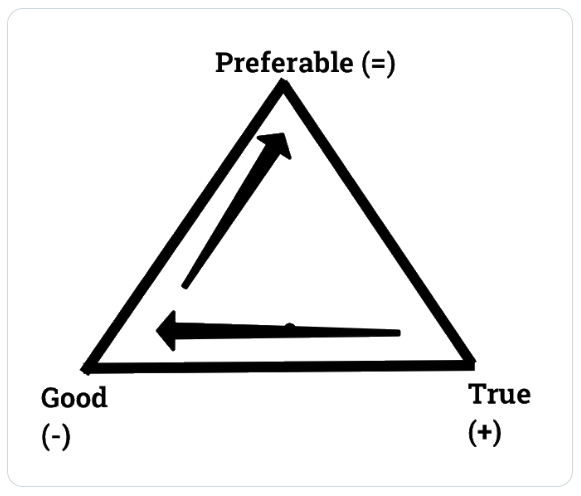
    True: A truth (universal) Independent of good(common) or preference(individual).
    Good: a Common Good independent of individual preference.
    Preference: An individual preference regardless of common good.

    Ergo:
    1) |Population|: True(universal) > Good(common) >… https://t.co/MzGkigFJQt


    Source date (UTC): 2025-04-16 19:05:29 UTC

    Original post: https://twitter.com/i/web/status/1912583139404493092

    Replying to: https://twitter.com/i/web/status/1912506804522668408

  • (NLI) Terminology: Lawful (Natural) vs Legal (Declared). “In my work on natural

    (NLI)
    Terminology: Lawful (Natural) vs Legal (Declared).

    “In my work on natural law I would like to separate ‘according to natural law (discovered)’ from ‘according to legislative law (made)’. I have considered disambiguating the discovered from made by dividing between lawful and legal. It’s acceptable to modify existing definitions of these terms because I often disambiguate terms using our glossary. So mostly, I’m concerned with narrowing the definition of terms such that they ease the burden of neologisms on the reader. As such it’s really a question of whether such disambiguation practical given the existing use of the terms.”

    Assigning “lawful” to natural law and “legal” to legislative law leverages existing connotations. “Lawful” aligns with the timeless, moral undertones of natural law (e.g., “just and lawful”), while “legal” fits the constructed, procedural nature of statutes (e.g., “legal technicality”). A glossary can reinforce this.

    “Lawful: Commonly means “conforming to the law” or “permitted by law,” often with a moral or ethical connotation (e.g., “lawful conduct”). It’s tied to legitimacy and sometimes implies alignment with higher principles, which could resonate with natural law.

    Legal: Typically refers to what is established or authorized by statutory or codified law (e.g., “legal contract”). It’s more technical, tied to specific jurisdictions and human-made systems.”

    The distinction works across contexts (ethics, law, policy), as both terms are already used broadly. You can apply them to historical analysis (e.g., “Roman lawful principles vs. imperial legal codes”) or modern debates (e.g., “lawful rights vs. legal privileges”).

    “I will go ahead with lawful vs legal because of the moral association and use “Lawful (natural, discovered) vs Legal (political, created)” in frequent repetition.

    That’s a solid plan. Using “Lawful (natural, discovered) vs. Legal (political, created)” with frequent repetition will reinforce the distinction and leverage the moral weight of “lawful” effectively. It’s clear, concise, and ties directly to your goal of separating natural and legislative law.


    Source date (UTC): 2025-04-11 20:13:34 UTC

    Original post: https://twitter.com/i/web/status/1910788334882086912

  • FYI: intelligence = memory + volume + plasticity (adaptation) + auto-association

    FYI: intelligence = memory + volume + plasticity (adaptation) + auto-association + prediction + attention (selection) + recursion (wayfinding) + in time (speed).


    Source date (UTC): 2025-04-10 14:28:11 UTC

    Original post: https://twitter.com/i/web/status/1910339027032584352

    Reply addressees: @MiTiBennett

    Replying to: https://twitter.com/i/web/status/1909628445249933534

  • There is no such thing as ’emotional intelligence’ there is only valence – sensi

    There is no such thing as ’emotional intelligence’ there is only valence – sensitivity and prioritization of empathizing. You may be more sensitive to emotional valence (empathizing in time) and some may be more sensitive to demonstrable outcomes (systematizing over time). The…


    Source date (UTC): 2025-04-07 21:26:35 UTC

    Original post: https://twitter.com/i/web/status/1909357160716550547

  • Fictionalism: – Positiva: Claims made within that discourse are not best seen as

    Fictionalism:
    – Positiva: Claims made within that discourse are not best seen as aiming at literal truth but are better regarded as a sort of ‘fiction’ for the purpose of transfer of information. (Communication)
    – Negativa: Methods of overloading the hierarchy of human reasoning ability (Deception):
    1. Physical: Magic->Pseudoscience,
    2. Verbal: Idealism->Sophistry,
    3. Imaginary: Occult->Theology

    Definition of Fictionalism (Full)
    https://t.co/AoGpRiBeD9

    Reply addressees: @RichardArion1


    Source date (UTC): 2025-03-15 18:59:44 UTC

    Original post: https://twitter.com/i/web/status/1900985281014362113

    Replying to: https://twitter.com/i/web/status/1900979837570809949

  • THE SPECTRUM OF DEFINITIONS IN THE TERNARY LOGIC APPLIED TO SOCIAL SCIENCE DEFIN

    THE SPECTRUM OF DEFINITIONS IN THE TERNARY LOGIC APPLIED TO SOCIAL SCIENCE

    DEFINITIONS: (a) ternary logic (b) Tripartism, (c) three means of influence to coercion, (c) three categories of elites under three means of influence to coercion (d) the path dependence of the three elites producing the three institutions (state, law, religion), (e) trifunctionalism

    (a)
    Ternary Logic
    Ternary logic extends classical binary logic (true/false) by introducing a third value, which can be understood as “indeterminate,” “unknown,” or “neither true nor false.” This logic system is useful in dealing with uncertainty, partial truth, and conditions where binary logic is insufficient.

    Different forms of ternary logic exist, such as:
    – True / False / Unknown – (Łukasiewicz Logic)
    – Affirmative / Negative / Neutral – (Indian Nyaya Philosophy)
    – Constructive / Falsifiable / Uncertain – (Operational Logic in Decision-Making)

    Ternary logic provides a more nuanced method for dealing with causality, decision-making, and legal reasoning, allowing for probabilistic or gradient-based assessments rather than strict binary classification.

    (b)
    Tripartism
    Tripartism refers to any system of organization that recognizes three fundamental and distinct roles, forces, or groups. It is often applied in political and economic governance, describing the balance of three major societal forces.

    Examples include:
    Political Tripartism: The division of power into three cooperative but distinct entities (e.g., monarchy/aristocracy/democracy in classical governance or legislative/executive/judicial in modern states).
    Economic Tripartism: Cooperation between government, business, and labor in economic decision-making.
    Social Tripartism: Recognition of three major classes or functions within society (e.g., warrior, priest, merchant in Indo-European societies).

    Tripartism functions as a stabilizing mechanism, preventing any one force from dominating the system while allowing for specialization and cooperation.

    (c)
    Three Means of Influence to Coercion
    All forms of power and influence reduce to three primary means of coercion:

    Force (Violence/Defense) → Military/State PowerThe use of direct physical power to impose decisions.
    Manifested in armies, police, and physical enforcement mechanisms.
    Decidability: Strength, law enforcement, territorial control.

    Remuneration (Boycott/Trade) → Economic/Commercial Power
    The ability to influence through the control of resources, capital, and trade.
    Expressed in market mechanisms, investment decisions, or economic sanctions.
    Decidability: Market competition, trade agreements, economic policy.

    Inclusion/Exclusion (Social/Religious Sanctioning) → Cultural/Religious Power
    The capacity to control through identity, narrative, and group affiliation.
    Enforced via social norms, ideological conditioning, and religious institutions.
    Decidability: Acceptance, status, and ideological adherence.

    These three means of influence correspond to distinct institutions and classes of elites.

    (d)
    Three Categories of Elites Under the Three Means of Influence to Coercion

    Each means of coercion produces an elite class that specializes in that form of power:

    Martial Elites (Military-State Class)
    Specialize in the use of force to impose order.
    Historically: Aristocrats, knights, warlords, military rulers.
    Modern equivalent: The military-industrial complex, deep state actors.

    Economic Elites (Commercial-Capital Class)
    Specialize in the use of remuneration to structure influence.
    Historically: Merchants, bankers, landed gentry.
    Modern equivalent: Corporate executives, financial elites, capital owners.

    Cultural-Religious Elites (Priestly-Intellectual Class)
    Specialize in inclusion/exclusion by controlling narrative and values.
    Historically: Clergy, philosophers, academics, media controllers.
    Modern equivalent: Journalists, professors, influencers, cultural elites.
    Each class competes for control over society, sometimes cooperating and sometimes conflicting.

    (e)
    The Path Dependence of the Three Elites Producing the Three Institutions (State, Law, Religion)
    The historical development of human institutions follows a natural progression based on the three classes of elites and their respective forms of coercion:

    The State (Military/Force-Based Elites)
    Emerges from warlords, conquerors, or defensive organizations consolidating control over a territory.
    Ensures order through violence and deterrence.
    Centralizes force into a structured military and bureaucracy.

    Law and Commerce (Economic/Remuneration-Based Elites)
    Emerges as a means to stabilize transactions and property rights between competing power groups.
    Produces contractual governance, legal frameworks, and commercial institutions.
    Protects property and investment from arbitrary coercion by the state or other elites.

    Religion and Culture (Narrative/Inclusion-Based Elites)
    Emerges as a means of enforcing moral and social order through non-violent coercion.
    Uses myths, ideologies, and belief systems to unify and control populations.
    Historically serves as a counterbalance to both military and commercial power.
    These three institutions evolve in interdependence, shaping civilization through their interactions.

    (f)
    Trifunctionalism
    Trifunctionalism is a theory of social organization, originally articulated by Georges Dumézil, which posits that Indo-European societies (and by extension most stable civilizations) structure themselves around three fundamental societal functions:

    Sovereignty (Priestly-Religious Function)
    Concerned with wisdom, law, and legitimacy.
    Represented by kings, priests, philosophers.
    In modernity: Judiciary, academia, ideological institutions.

    Force (Warrior-Noble Function)
    Concerned with defense, order, and martial capability.
    Represented by warriors, rulers, and law enforcement.
    In modernity: Military, police, executive branch of government.

    Production (Merchant-Worker Function)
    Concerned with material wealth, trade, and sustenance.
    Represented by merchants, craftsmen, workers.
    In modernity: Industrialists, financiers, middle class.

    Trifunctionalism explains the division of labor in civilization and how stability is achieved through a balance between these three forces. When one function dominates or is eroded, social collapse or transformation occurs.

    Conclusion
    The threefold structure of power (violence, trade, belief) naturally produces distinct elite classes, institutions, and systems of governance. These interdependent structures form the foundation of civilization.

    Understanding this tripartite system allows for a more effective analysis of historical and contemporary power struggles, economic cycles, and cultural evolution.

    Cheers
    CD

    Source date (UTC): 2025-02-09 17:05:58 UTC

    Original post: https://twitter.com/i/web/status/1888635462723809280

  • Q: “WHAT IS THE SPECTRUM OF TYPES OF SLAVERY?”– The spectrum of types of slaver

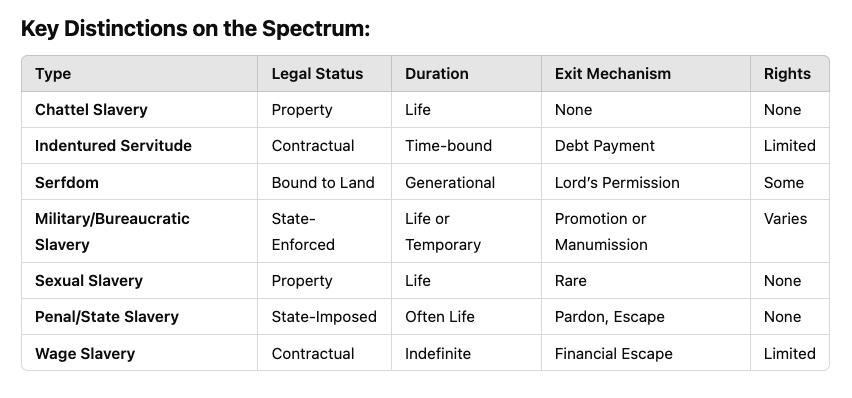
    –Q: “WHAT IS THE SPECTRUM OF TYPES OF SLAVERY?”–

    The spectrum of types of slavery can be categorized by degree of autonomy, legal status, economic function, and duration of servitude. Slavery exists along a gradient of coercion—from absolute chattel slavery (total ownership)… https://t.co/0Wt6GNcYUy


    Source date (UTC): 2025-02-07 17:59:34 UTC

    Original post: https://twitter.com/i/web/status/1887924176440410554