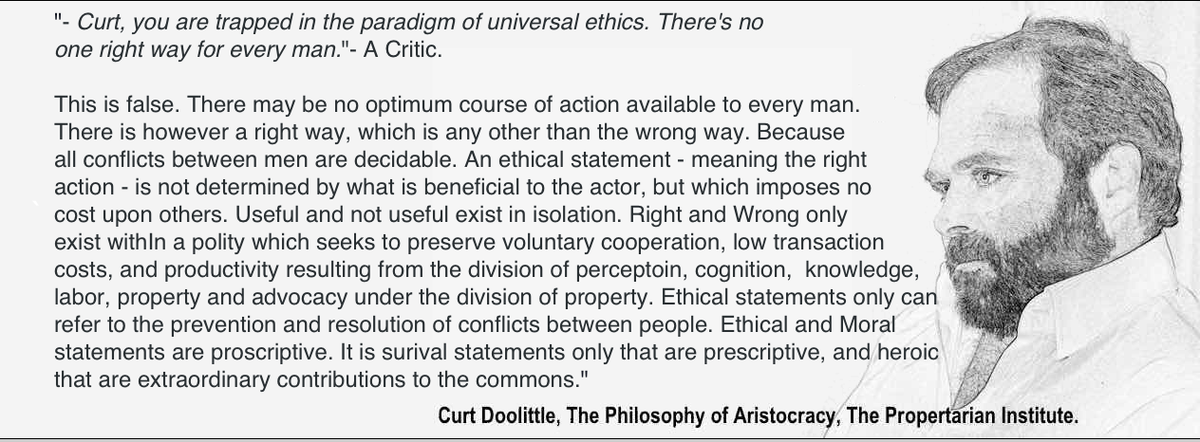
Ethics and Morality are proscriptive (what we shall not do). Not what is optimum for us to do. https://t.co/L9sA3prJkX
Source date (UTC): 2015-11-07 14:09:29 UTC
Original post: https://twitter.com/i/web/status/662995287376568320
Ethics and Morality are proscriptive (what we shall not do). Not what is optimum for us to do. https://t.co/L9sA3prJkX
Source date (UTC): 2015-11-07 14:09:29 UTC
Original post: https://twitter.com/i/web/status/662995287376568320
MORALITY VS LIBERTY
MORALITY: non-imposition of involuntary costs upon other individuals with whom you agree to cooperate.
LIBERTY: non-imposition of involuntary costs upon individuals by members of governments in the construction of commons.
HEROISM: voluntary contribution to the commons in exchange for honor (self assessment of status), and status.
Source date (UTC): 2015-11-07 13:30:00 UTC
TERMS: HYPERTHETICAL AND HYPOTHETICAL
—“Thought experiments have done yeoman’s work in philosophy ever since the tale of the ring of Gyges in Plato’s Republic. There clearly is a place for them in testing our moral intuitions, yet they have been taken too far down the trolley track in contemporary ethical theory. At issue here is modality: the meaning of the possible for making sense of ethical life. Let me suggest two modes of the possible. One is the merely conceivable, which involves science fiction elements or extraordinarily rare circumstances, things that are not logically impossible or outright violations of the laws of nature. The other mode is the genuinely plausible, scenarios that are either actually possible (because they have happened) or feasible given a reasonable construal of existing realities. I would like to narrow the use of hypothetical to the latter set of plausible cases and coin a new term, hyperthetical, for the merely conceivable.”— Michael Philip
Excellent reframing. I would suggest you take my approach of a minimum three points to make an argumentative line, and follow your own sentence structure: 1-Conceivable, 2-Plausible, and 3-Feasible. (I am going to steal it. thanks. )
Source date (UTC): 2015-11-01 14:34:00 UTC
Essence: the combination of existential properties with the contents of our memories producing resulting imagination, and the feelings that accompany them.
Source date (UTC): 2015-11-01 05:19:00 UTC
FWIW: Anarchy = Rule of Law(“Nomocracy”). Rule of law, under natural law, meaning the necessity of property rights, creates moral order. Anarchy is an absence of authority that retains decidability over rule of law. Unfortunately, the difference between anarchism and nomocracy is in the production of commons. The west’s competitive advantage is high trust enables the competitive construction of commons. So anarchism is less defensible from conquest than nomocracy. For this reason, nomocracy may be anarchic, but it is also survivable, where anarchy may or many not be nomocratic, and cannot survive competition. Rule of law is to anarchy as guns germs and steel are to luddites.
Source date (UTC): 2015-10-31 06:17:00 UTC
MEANING VS TRUTH VS LAW
The difference between Meaning, Truth, Morality and Law is profound.
We learn and teach through meaning.
We seek improvement and advantage with Truth.
We cooperate using Morality.
We resolve our conflicts by Law.
There are those who are learning;
Those who are refining;
Those who are seeking to cooperate;
And those of us resolving conflict when meaningful, truthful and moral intentions fail.
There are those who need virtue ethics;
Those who need rule ethics;
Those who need outcome ethics;
And those who need objectively resolve conflicts in ethics.
There are those of us seeing sustenance
Those of us seeking reproduction
Those of us seeking experiences
And those of us seeking transformation
Warriors pay costs
Producers reap profits
Priests and Politicians seek rents
And those of us who seek to limit parasitism.
Source date (UTC): 2015-10-27 09:27:00 UTC
STUPID: “We found that people use the label stupid for three separate types of situation: (1) violations of maintaining a balance between confidence and abilities; (2) failures of attention; and (3) lack of control. So, we call people stupid when they aren’t using their given cognitive abilities. We don’t call people with low cognitive abilities stupid.”
Source date (UTC): 2015-10-26 14:52:00 UTC
capitalism: the voluntary organization of production and consumption. Socialism the involuntary organization of both.
Source date (UTC): 2015-10-25 22:48:03 UTC
Original post: https://twitter.com/i/web/status/658414750754320384
Reply addressees: @David_Boaz @pbump
Replying to: https://twitter.com/i/web/status/658412000784044032
IN REPLY TO:
@David_Boaz
“Defining socialism” w/o mentioning nationalization or centralizing planning? @pbump https://t.co/vofDnqbTqD
Original post: https://twitter.com/i/web/status/658412000784044032
‘SLAVABOO’ n. (slav-ah-booh): (slang). Someone who is a fanboy of Slavic culture but they’re too lazy to actually learn any of the Slavic culture, language , or customs.
i.e., some American neckbeard who thinks Putin is the savior of the white race and posts constant pro Putin propaganda but actually knows nothing of Russia or its customs, policies, or history.
Source date (UTC): 2015-10-23 13:27:00 UTC
CITY (cih-TEE) Original meaning “market”. Current meaning “ghetto”.
Source date (UTC): 2015-10-23 12:08:00 UTC