Form: Definition

  • Q: “HOW ARE YOU DEFINING MINDFULNESS?” Mindfulness is a concept that has been ex

    Q: “HOW ARE YOU DEFINING MINDFULNESS?”
    Mindfulness is a concept that has been explored and applied in various contexts, ranging from traditional spiritual practices to modern psychological and behavioral science. But whether spiritual, religious, philosophical, intentional discipline, scientific, or cognitive behavioral therapy, the meaning is the same:

    Simple version: “It’s Adulting”. Observing and interpreting the intuitions rather than being a victom of them. Achieved by training in self regulation, by disciplined management of one’s attention, controlling one’s impulses, emotions and ideation, such that we align them with our goals, allowing suppression of neuroticism (impulsive negative thoughts) and especially treating ‘signaling’ from others as their responsibility(problem) not yours. This produces a calm mind. “mindfulness”.

    Mindfulness as the Stoics use it:
    The core Stoic principle of living according to reason and being continually aware of one’s thoughts and actions to ensure they align with virtue.
    – Prosochē: This is a Greek term that is often equated with the Stoic practice of mindfulness. It translates roughly to “attention” and represents the practice of attentive focus and vigilance over one’s thoughts, judgments, and impulses. Prosochē involves being mindful of the present moment and making conscious, rational decisions.
    – Cognitive Discipline: Stoic mindfulness involves a disciplined monitoring of one’s impressions (phantasiai), which are the raw data of experience that have yet to be assented to by reason. This means critically assessing one’s immediate perceptions, refraining from emotional or impulsive reactions, and choosing responses that are in line with Stoic virtues (wisdom, justice, courage, and moderation).

    Mindfulness as Doolittle uses it:
    Given Doolittle’s deep engagement with epistemology, morality, law, economics, and comparative civilization, mindfulness in his usage emphasizes a philosophical and introspective approach.
    It might be defined as:
    – Conscious Awareness and Reflection: Mindfulness involves a heightened state of awareness and deliberate attention to one’s thoughts, emotions, and environment without judgment. This form of mindfulness emphasizes the capacity to observe and reflect upon one’s own mental processes, ethical behaviors, and philosophical inquiries.
    – Intellectual Rigor: In a philosophical context, mindfulness can be seen as a practice of rigorously examining one’s beliefs, values, and the ethical implications of one’s actions. It involves a continuous process of questioning, analyzing, and synthesizing information to achieve a clearer understanding of one’s mental and moral landscape.
    – Application to Decidability and Truth: Mindfulness relates to Doolittle’s focus on decidability and performative truth, where the conscious effort to remain fully present and meticulously observant aids in making more accurate, just, and ethical decisions.
    – Institutionalization: Doolittle argues that while hunter gatherer life produced mindfulness by social dependency, agrarian myth and religion by personal and social narrative and ritual, industrial and technological life has tried to produce it by education and political ideology, which are insufficient for the suppression of neuroticism, unpredictability and alienation, and instead modern peoples require education incorporate relatively costly and consistent repetition of one or more of the mindfulness methods throughout development.

    Mindfulness as Used by Behavioral Scientists:
    In the field of psychology and behavioral sciences, mindfulness is more specifically defined and studied within the context of mental health and cognitive functioning. It is often described as:
    – Mindfulness-Based Stress Reduction (MBSR): Developed by Jon Kabat-Zinn, this program uses mindfulness meditation to help people manage stress, anxiety, depression, and pain. Mindfulness, in this sense, is a therapeutic tool aimed at focusing the present moment in a non-judgmental manner.
    – Cognitive Process: Behavioral scientists often study mindfulness as a cognitive process that involves maintaining a moment-by-moment awareness of our thoughts, feelings, bodily sensations, and surrounding environment. This definition emphasizes mindfulness as a mental state achieved by focusing one’s awareness on the present moment.
    – Evidence-Based Benefits: Scientifically, mindfulness has been linked to numerous benefits, such as reduced symptoms of depression, increased emotion regulation, and improved overall cognitive ability. These effects are believed to result from mindfulness meditation’s capacity to increase individuals’ control over their neurocognitive processes.

    Bridging The Perspectives:
    While Doolittle’s philosophical and introspective approach to mindfulness emphasizes a broader, more existential exploration, the behavioral science approach tends to be more empirical and focused on practical outcomes such as stress reduction and cognitive improvements. Both perspectives share a common recognition of mindfulness as a state of enhanced awareness and presence of mind, albeit applied for different ends.

    Understanding these applications of mindfulness allows for a comprehensive appreciation of its potential benefits, ranging from deeper philosophical insights to tangible improvements in mental health and cognitive capacities.

    Cheers
    Curt Doolittle


    Source date (UTC): 2024-07-19 03:37:35 UTC

    Original post: https://twitter.com/i/web/status/1814142516133842944
  • Q: “HOW ARE YOU DEFINING MINDFULNESS?” Mindfulness is a concept that has been ex

    Q: “HOW ARE YOU DEFINING MINDFULNESS?”
    Mindfulness is a concept that has been explored and applied in various contexts, ranging from traditional spiritual practices to modern psychological and behavioral science. But whether spiritual, religious, philosophical, intentional discipline, scientific, or cognitive behavioral therapy, the meaning is the same:

    Simple version: “It’s Adulting”. Observing and interpreting the intuitions rather than being a victom of them. Achieved by training in self regulation, by disciplined management of one’s attention, controlling one’s impulses, emotions and ideation, such that we align them with our goals, allowing suppression of neuroticism (impulsive negative thoughts) and especially treating ‘signaling’ from others as their responsibility(problem) not yours. This produces a calm mind. “mindfulness”.

    Mindfulness as the Stoics use it:
    The core Stoic principle of living according to reason and being continually aware of one’s thoughts and actions to ensure they align with virtue.
    – Prosochē: This is a Greek term that is often equated with the Stoic practice of mindfulness. It translates roughly to “attention” and represents the practice of attentive focus and vigilance over one’s thoughts, judgments, and impulses. Prosochē involves being mindful of the present moment and making conscious, rational decisions.
    – Cognitive Discipline: Stoic mindfulness involves a disciplined monitoring of one’s impressions (phantasiai), which are the raw data of experience that have yet to be assented to by reason. This means critically assessing one’s immediate perceptions, refraining from emotional or impulsive reactions, and choosing responses that are in line with Stoic virtues (wisdom, justice, courage, and moderation).

    Mindfulness as Doolittle uses it:
    Given Doolittle’s deep engagement with epistemology, morality, law, economics, and comparative civilization, mindfulness in his usage emphasizes a philosophical and introspective approach.
    It might be defined as:
    – Conscious Awareness and Reflection: Mindfulness involves a heightened state of awareness and deliberate attention to one’s thoughts, emotions, and environment without judgment. This form of mindfulness emphasizes the capacity to observe and reflect upon one’s own mental processes, ethical behaviors, and philosophical inquiries.
    – Intellectual Rigor: In a philosophical context, mindfulness can be seen as a practice of rigorously examining one’s beliefs, values, and the ethical implications of one’s actions. It involves a continuous process of questioning, analyzing, and synthesizing information to achieve a clearer understanding of one’s mental and moral landscape.
    – Application to Decidability and Truth: Mindfulness relates to Doolittle’s focus on decidability and performative truth, where the conscious effort to remain fully present and meticulously observant aids in making more accurate, just, and ethical decisions.
    – Institutionalization: Doolittle argues that while hunter gatherer life produced mindfulness by social dependency, agrarian myth and religion by personal and social narrative and ritual, industrial and technological life has tried to produce it by education and political ideology, which are insufficient for the suppression of neuroticism, unpredictability and alienation, and instead modern peoples require education incorporate relatively costly and consistent repetition of one or more of the mindfulness methods throughout development.

    Mindfulness as Used by Behavioral Scientists:
    In the field of psychology and behavioral sciences, mindfulness is more specifically defined and studied within the context of mental health and cognitive functioning. It is often described as:
    – Mindfulness-Based Stress Reduction (MBSR): Developed by Jon Kabat-Zinn, this program uses mindfulness meditation to help people manage stress, anxiety, depression, and pain. Mindfulness, in this sense, is a therapeutic tool aimed at focusing the present moment in a non-judgmental manner.
    – Cognitive Process: Behavioral scientists often study mindfulness as a cognitive process that involves maintaining a moment-by-moment awareness of our thoughts, feelings, bodily sensations, and surrounding environment. This definition emphasizes mindfulness as a mental state achieved by focusing one’s awareness on the present moment.
    – Evidence-Based Benefits: Scientifically, mindfulness has been linked to numerous benefits, such as reduced symptoms of depression, increased emotion regulation, and improved overall cognitive ability. These effects are believed to result from mindfulness meditation’s capacity to increase individuals’ control over their neurocognitive processes.

    Bridging The Perspectives:
    While your philosophical and introspective approach to mindfulness emphasizes a broader, more existential exploration, the behavioral science approach tends to be more empirical and focused on practical outcomes such as stress reduction and cognitive improvements. Both perspectives share a common recognition of mindfulness as a state of enhanced awareness and presence of mind, albeit applied for different ends.

    Understanding these applications of mindfulness allows for a comprehensive appreciation of its potential benefits, ranging from deeper philosophical insights to tangible improvements in mental health and cognitive capacities.

    Cheers
    Curt Doolittle


    Source date (UTC): 2024-07-19 03:37:35 UTC

    Original post: https://twitter.com/i/web/status/1814136638915629057

  • PHYSICAL, NATURAL, AND MAN-MADE LAWS Laws of nature apply regardless of the awar

    PHYSICAL, NATURAL, AND MAN-MADE LAWS
    Laws of nature apply regardless of the awareness, preference, will or existence of man. The natural law of cooperation is a description of observable human behavior everywhere at all times, and is an emergent from the physical laws, augmented by the capacity to move, the volume of memory, and utility of division of labor, producing evolutionary computation by the test of voluntary reciprocal cooperation. Laws of man exist and apply where there exists an incentive for them and the capacity to enforce them. Otherwise they are fictions.


    Source date (UTC): 2024-07-16 13:29:31 UTC

    Original post: https://twitter.com/i/web/status/1813204318125760512

  • (NLI CORE) THE CRITERIA FOR A TRUTH CLAIM Truth – In the Context of a Truth Clai

    (NLI CORE)
    THE CRITERIA FOR A TRUTH CLAIM
    Truth – In the Context of a Truth Claim, Truth consists of the promise of testimony of infallibility that has survived sufficient due diligence to promise the evasion of the imposition of involuntary costs upon any form of capital (demonstrated interest) from the temporal, to informational to normative, to institutional, to material, for the self or others. (promissory, performative, warrantied(due diligence), satisfying demand for infallibility that would impose involuntary costs upon the demonstrated interests of one’s self or others in the context in question.)
    Therefore Consisting of Demand for:
    – Infallibility – A decision upon which the resulting display word and deed impose no involuntary costs upon the demonstrated interests of one’s self or others in the context in question.
    – Decidability – Sufficient information exists, and no other information is required, such that alternatives are sufficiently improbable to impossible to satisfy the demand for infallibility in the context in question.
    Consisting of:
    – Truthfulness – Testimony sufficient for the satisfaction of demand for infallibility in the context in question (Tautological, Ideal, Logical, Testifiable, Demonstrated, Honest, Explanatory, Analogical.)
    Consisting of:
    – Testifiability – The limited list of dimensions to which humans are capable of testifying, and if satisfied, constitute the possibility of a truth claim.
    Consisting of Satisfying demand for:
    – – Realism – All existence consists of the persistence of constant relations between states of energy, independent of human perception, mind, belief, or preference, yet categorizable by human sense and perception, into entities(references, states, nouns), categories, processes(verbs), and consequences (state changes, nouns).
    – – Naturalism – All phenomena within existence have natural causes that can be observed, measured, described, understood as consistent and coherent with all other phenomena, and reduced to irreducible causes (first principles), using sense, perception, and logical and physical instrumentation.
    Consisting of Satisfying demand for:
    – – – Materialism (Persistence): Reality consists of physical or material entities that persist over time.
    – – – Determinism (Lawfulness): Existence operates according to consistent laws and regularities that can be discovered and described by science.
    – – – Reductionism (Reducibility): Complex phenomena can be explained by reducing them to their simpler, more fundamental components and processes.
    – – – Opportunism (Emergence): The interaction of simple elements can lead to the emergence of complex systems and opportunities for combination, recombination, innovation, adaptation, and evolution.
    – – – Scarcity (Constraint): All existence consists of limited availability of resources, which drives competition, adaptation, and evolution, influencing the behavior and interaction of organisms, shaping life and ecosystems through constraints.
    – – – Continuity (Consistency): There exists continuity between humans and the rest of the natural world, with all entities and phenomena being subject to the same natural laws and principles.
    AND
    Satisfying demand for:
    – – Identity – Categorically Consistent
    – – Logical – Internally Consistent
    – – Empirical – Externally Correspondent
    – – Possible – Operationally Possible
    – – Rational – Subjectively Rational (Bounded Rationality)
    – – Reciprocal – Reciprocally Subjectively Rational
    AND
    – – Fully accounted
    – – Within Stated Limits
    – – Within the limits of warrantability
    – – Within the limits of liability
    This is all it is possible for humans to testify to.
    If one cannot testify to these criteria then one cannot promise a truth claim.
    The reason this took millennia to solve was because it was, in fact, a very hard problem.

    Curt Doolittle
    The Natural Law Institute


    Source date (UTC): 2024-07-15 00:24:43 UTC

    Original post: https://twitter.com/i/web/status/1812644425874419712

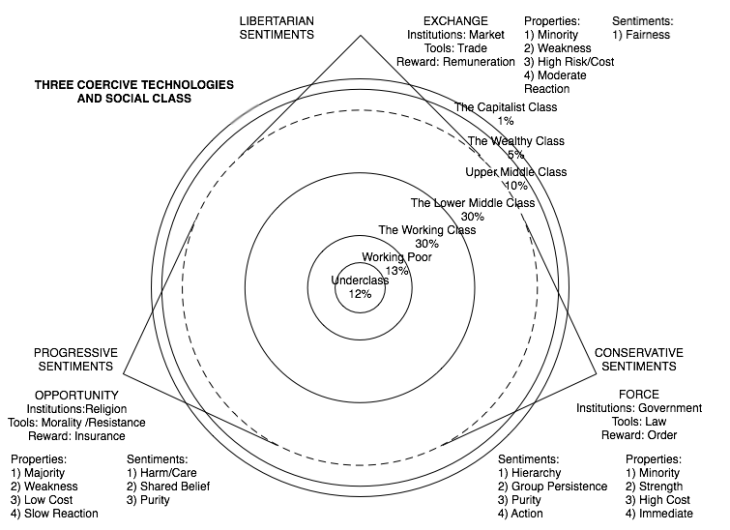
  • Class: Depends on the degree of precision: Lower vs upper (division at middle vs

    Class: Depends on the degree of precision:
    Lower vs upper (division at middle vs upper middle)
    Lower vs middle vs upper
    Lower vs lower middle, vs middle, vs upper middle vs upper.
    Out of sight lower vs lower lower vs upper lower, vs lower middle vs upper middle, vs lower upper,… https://t.co/2y8kn1WfMs


    Source date (UTC): 2024-07-14 21:33:55 UTC

    Original post: https://twitter.com/i/web/status/1812601445595885654

    Replying to: https://twitter.com/i/web/status/1812597050577760477

  • FYI. FBI “Agents” (domestic) vs CIA “Officers” (foreign). Not sure why this conf

    FYI. FBI “Agents” (domestic) vs CIA “Officers” (foreign). Not sure why this confusion still persists. People like me are either consultants or contractors. I have been a Justice Department “Employee”.

    We need to end job protections, unions, and pensions for federal workers. It will raise short term salaries improve employee quality and but reduce long term costs.

    Federal employees must ‘serve at the pleasure of the president’.


    Source date (UTC): 2024-07-10 17:12:36 UTC

    Original post: https://twitter.com/i/web/status/1811086128977440768

  • what is the difference between analytic philosophy and scientific theorizing? Th

    what is the difference between analytic philosophy and scientific theorizing? The difference is the existence of the references and the operational possibilties upon them.


    Source date (UTC): 2024-07-08 19:12:29 UTC

    Original post: https://twitter.com/i/web/status/1810391524448022624

    Reply addressees: @partymember55

    Replying to: https://twitter.com/i/web/status/1810390823051374935

  • Free Will: the term Free Will (Stoicism: “liberum arbitrium”) arose in response

    Free Will: the term Free Will (Stoicism: “liberum arbitrium”) arose in response to the question as to whether individuals could be held responsible for making moral vs immoral decisions. It is not a religious concept but a greek one, and was incorporated by theologians in the second century.
    Determinism: The contemporary question cast as ‘free will’ is one of hard, or soft determinism.
    – Hard determinism must be false because even at first stages of causality the quantum background is indeterminate; and at the other end of spectrum of causal density, human autoassociative prediction (memory) is relatively non-deterministic outside of the very simple, which we can test easily. And human responses vary moment by moment given the internal biological market competition for demands for our attention and energy. We are extremely conscious of this fact in behavioral and micro economics: human behavior may be categorically similar in response to similar stimuli but isn’t individually predictable (consistent) regardless of that stimuli even at some of the extremes. As such we can explain human behavior once possessed of enough evidence (why juries function) but we cannot predict individual action.
    – Soft determinism must be true because humans are marginally indifferent outside the limits of cognitive, intuitionistic, and physical variation. In other words, all humans operate with similar physical, intuitionistic, and cognitive tools, varying by age, cognitive ability, accumulated knowledge and skill. Again this is why behavior is explainable but not predictable.

    Result: So the universe is deterministic in proportion to the accumulated information (oganization, or ‘memory’) available to any entity.
    It is deterministic and determinable at the small scales and simple interactions once we compensate for temperature and density.
    Its deterministic but indeterminable at scales where sufficient predictive memory exists in sufficiently complex density of opportunities to use mind, intiution, body, knowledge and resources.

    Error in prediction alone accounts for indeterminacy.

    Reply addressees: @RolandBasilides


    Source date (UTC): 2024-07-08 16:45:38 UTC

    Original post: https://twitter.com/i/web/status/1810354566665310208

    Replying to: https://twitter.com/i/web/status/1810348972692693382

  • KNOWLEDGE SPECTRUM: Awareness > Recognition > Understanding > Knowledge > Applie

    KNOWLEDGE SPECTRUM: Awareness > Recognition > Understanding > Knowledge > Applied Knowledge > Analysis Using Knowledge > Synthesis(recombination) > Evaluation > Insight > Wisdom.


    Source date (UTC): 2024-07-05 21:44:55 UTC

    Original post: https://twitter.com/i/web/status/1809342722764902827

    Reply addressees: @whatifalthist

    Replying to: https://twitter.com/i/web/status/1809294755467260003

  • Testimonial truth consists of more rigorous criteria than correspondence and per

    Testimonial truth consists of more rigorous criteria than correspondence and performative combined, while satisfying : realism, naturalism, identity, consistency, correspondence, operational possibility, rational choice, reciprocity, and fully accounted within stated limits and within the limits of liability, that together satisfies demand for infallibility of decidability in the context in question. This is the full set of dimensions it is possible to testify to. And is the only criteria under which it is possible to claim a statement is true.

    Reply addressees: @44VERITAS


    Source date (UTC): 2024-06-22 08:55:08 UTC

    Original post: https://twitter.com/i/web/status/1804437958201896960

    Replying to: https://twitter.com/i/web/status/1804292625240920464