Full Definition of Fictionalism:
https://propertarianinstitute.com/2021/04/19/definition-fictionalism-2/
Source date (UTC): 2021-04-19 01:37:46 UTC
Original post: https://twitter.com/i/web/status/1383957966873776128
Full Definition of Fictionalism:
https://propertarianinstitute.com/2021/04/19/definition-fictionalism-2/
Source date (UTC): 2021-04-19 01:37:46 UTC
Original post: https://twitter.com/i/web/status/1383957966873776128
Fictionalism is the name of the judgment within philosophy, as to which statements that appear to be descriptions of the world should not be construed as such, but should instead be understood as cases of “make-believe”, of pretending to treat something as literally true (a “useful fiction”). Fictionalism consists of at least the following three theses:
1) Claims made within the domain of discourse are taken to be “truth-apt”; that is, descriptive or fictional, and honest or deceitful, and true or false.
2) The domain of discourse is to be interpreted at face value—not reduced to meaning something else:
Differ substantially in the contractual commitments to one another as to the degree of
Of our statements. (We white and grey lie all-time in conversation, and we do no such thing in testimony.)
3) The purpose of *discourse(discovery)* in any given domain is not truth, but communication, and communication by suggestion, with which anlogy is the necessary means of transfer of meaning. Whether descriptive or fictional, honest or deceptive, true or false.The Common occurrences of fictionalism are:
1) Mathematical fictionalism advocated by Hartry Field, which states that talk of numbers and other mathematical objects is nothing more than a verbal convenience for performing their science. (the logic of constant relations: measurement)
2) Modal fictionalism developed by Gideon Rosen, which states that possible worlds, regardless of whether they exist or not, may be a part of a useful discourse, and;
3) Idealism (Platonist Fictionalism)
4) Moral Fictionalism in meta-ethics, advocated by Richard Joyce, suggests that fictions (Falsehoods) are too useful to throw out.
5) Religious Fiction in all areas of thought – our most ancient form of fictionalism.
6) Aesthetic Fictionalism (In the arts, in experience, in the new age, and in the occult) We must note that all of these claims are just excuses for doing what has been done in the past. Positioning the Fictionalisms In Grammatical Context
|Fictions| Testimony > Narration > Story > Fiction > Fictionalism > Deception > Fraud A positive Fictionalism refers to those statements that appear to be descriptions of the real world (reality) but are cases of “make believe” – of pretending that a given useful fiction is other than just a useful fiction. A negative Fictionalism refers to the most successful means of deception (coercion) by loading, framing and overloading. Given our the methods of perception:
|Perception| Physical (sensory) > Intuitionistic (intuitionistic, emotional) > Mental (intellectual, reason) And the methods of inflating and conflating them:
|Fictionalisms| Magical (Technical, Physical) > Supernatural (Occult, Experiential) > Ideal (Intellectual, Verbal) We produce these common uses of Fictionalism:
1. Ideal (verbal, intellectual):
1) Mathematical Fictionalism, which states that talk of numbers and other mathematical objects is nothing more than a verbal convenience for performing their science. (the logic of constant relations: measurement)
2) Platonic Fictionalism (Idealism) which states that….
3) Rational Fictionalism (continental philosophy)
2. Magical (Physical, Technical):
4) Human Fictionalism (‘Denialism’) state that equality in all possible dimensions (a falsehood), is too necessary to throw out.
5) Modal Fictionalism developed by _________ which states that possible worlds, or multiple worlds, regardless of whether they exist or not, may be a part of a useful discourse.
6) Pseudosciences:
3. Supernormal (Imaginary, Experiential):
7) Moral Fictionalism in meta-ethics, suggests that fictions (falsehoods) are too useful to throw out.
8) Religious Fictionalism in all areas of thought – our most ancient form of Fictionalism are too useful, and somehow necessary to throw out.
9) Aesthetic Fictionalism (In the arts, in experience, in the new age, and in the occult) are somehow necessary to escape reality, or fabricate a false version of it. We must note that all of these claims are just excuses for doing what has been done in the past, and failing to perform the cost of reformation of the terms, paradigms, and stories. Fictionalisms make use of three presumptions:
1) Communication of Meaning: The purpose of discourse(discovery) in any given domain is not truth, but communication. Whether descriptive or fictional, honest or deceptive, true or false.
2) Meaningful but not True: Claims made within the domain of discourse are taken to be truth-apt; that is, descriptive or fictional, and honest or deceitful, and true or false.
3) A Useful Fiction Not Open To Further Interpretation (Face Value): The domain of discourse is to be interpreted at face value—not reduced to meaning something else:
… Differ substantially in the contractual commitments to one another as to the degree of:
… of our statements. (We white and grey lie all time in conversation, and we do no such thing in testimony.) Speakers attempt to preserve the use of Fictionalisms for one of the following possible reasons:
1) To obscure their ignorance of causality and decidability in their disciplines, or 2) To preserve the sunk cost of their investments in obscurantist fictional descriptions, or 3) To avoid the costs of reformation the method of decidability within their domains. 4) To avoid the falsification of their arguments if methods of decidability within their domains are discovered. 5) To conduct deceptions by claiming their arbitrary preferences or judgments are truths. 6) To conduct frauds by using their arbitrary preferences or judgments for coercion or profit. And, of these groups:
0) Religious Language in toto (supernaturalism) 1) Literary Philosophers (positive, or advocates ), 2) Supernormal Physicists, and 3) Mathematical Platonists; All attempt to preserve the use of fictions for one of the following possible reasons:
1) To conduct deceptions by claiming their arbitrary preferences or judgements are truths. 2) Obscure their ignorance of causality and decidability in their disciplines, or 3) Preserve the cost of their investments in obscurantist fictional descriptions, or 4) Avoid the costs of investigating the method of decidability within their domains. 5) Avoid the falsification of their arguments if methods of decidability within their domains are discovered. And so:
If we define philosophy (positive and literary) as the search for methods of decidability within a domain of preference, and;
If we define Truth (negative and descriptive) as the search for methods of decidability across all domains regardless of preference. Then:
We find that positive or literary philosophy(fiction or philosophy) informs, suggests opportunities, and justifies preferences for the purpose of forming cooperation and alliances between individuals and groups.
We find that negative or juridical philosophy(truth or law) decides, states limits, and discounts preferences, for the purpose of resolving conflicts between individuals and groups.
Fictionalism is the name of the judgment within philosophy, as to which statements that appear to be descriptions of the world should not be construed as such, but should instead be understood as cases of “make-believe”, of pretending to treat something as literally true (a “useful fiction”). Fictionalism consists of at least the following three theses:
1) Claims made within the domain of discourse are taken to be “truth-apt”; that is, descriptive or fictional, and honest or deceitful, and true or false.
2) The domain of discourse is to be interpreted at face value—not reduced to meaning something else:
Differ substantially in the contractual commitments to one another as to the degree of
Of our statements. (We white and grey lie all-time in conversation, and we do no such thing in testimony.)
3) The purpose of *discourse(discovery)* in any given domain is not truth, but communication, and communication by suggestion, with which anlogy is the necessary means of transfer of meaning. Whether descriptive or fictional, honest or deceptive, true or false.The Common occurrences of fictionalism are:
1) Mathematical fictionalism advocated by Hartry Field, which states that talk of numbers and other mathematical objects is nothing more than a verbal convenience for performing their science. (the logic of constant relations: measurement)
2) Modal fictionalism developed by Gideon Rosen, which states that possible worlds, regardless of whether they exist or not, may be a part of a useful discourse, and;
3) Idealism (Platonist Fictionalism)
4) Moral Fictionalism in meta-ethics, advocated by Richard Joyce, suggests that fictions (Falsehoods) are too useful to throw out.
5) Religious Fiction in all areas of thought – our most ancient form of fictionalism.
6) Aesthetic Fictionalism (In the arts, in experience, in the new age, and in the occult) We must note that all of these claims are just excuses for doing what has been done in the past. Positioning the Fictionalisms In Grammatical Context
|Fictions| Testimony > Narration > Story > Fiction > Fictionalism > Deception > Fraud A positive Fictionalism refers to those statements that appear to be descriptions of the real world (reality) but are cases of “make believe” – of pretending that a given useful fiction is other than just a useful fiction. A negative Fictionalism refers to the most successful means of deception (coercion) by loading, framing and overloading. Given our the methods of perception:
|Perception| Physical (sensory) > Intuitionistic (intuitionistic, emotional) > Mental (intellectual, reason) And the methods of inflating and conflating them:
|Fictionalisms| Magical (Technical, Physical) > Supernatural (Occult, Experiential) > Ideal (Intellectual, Verbal) We produce these common uses of Fictionalism:
1. Ideal (verbal, intellectual):
1) Mathematical Fictionalism, which states that talk of numbers and other mathematical objects is nothing more than a verbal convenience for performing their science. (the logic of constant relations: measurement)
2) Platonic Fictionalism (Idealism) which states that….
3) Rational Fictionalism (continental philosophy)
2. Magical (Physical, Technical):
4) Human Fictionalism (‘Denialism’) state that equality in all possible dimensions (a falsehood), is too necessary to throw out.
5) Modal Fictionalism developed by _________ which states that possible worlds, or multiple worlds, regardless of whether they exist or not, may be a part of a useful discourse.
6) Pseudosciences:
3. Supernormal (Imaginary, Experiential):
7) Moral Fictionalism in meta-ethics, suggests that fictions (falsehoods) are too useful to throw out.
8) Religious Fictionalism in all areas of thought – our most ancient form of Fictionalism are too useful, and somehow necessary to throw out.
9) Aesthetic Fictionalism (In the arts, in experience, in the new age, and in the occult) are somehow necessary to escape reality, or fabricate a false version of it. We must note that all of these claims are just excuses for doing what has been done in the past, and failing to perform the cost of reformation of the terms, paradigms, and stories. Fictionalisms make use of three presumptions:
1) Communication of Meaning: The purpose of discourse(discovery) in any given domain is not truth, but communication. Whether descriptive or fictional, honest or deceptive, true or false.
2) Meaningful but not True: Claims made within the domain of discourse are taken to be truth-apt; that is, descriptive or fictional, and honest or deceitful, and true or false.
3) A Useful Fiction Not Open To Further Interpretation (Face Value): The domain of discourse is to be interpreted at face value—not reduced to meaning something else:
… Differ substantially in the contractual commitments to one another as to the degree of:
… of our statements. (We white and grey lie all time in conversation, and we do no such thing in testimony.) Speakers attempt to preserve the use of Fictionalisms for one of the following possible reasons:
1) To obscure their ignorance of causality and decidability in their disciplines, or 2) To preserve the sunk cost of their investments in obscurantist fictional descriptions, or 3) To avoid the costs of reformation the method of decidability within their domains. 4) To avoid the falsification of their arguments if methods of decidability within their domains are discovered. 5) To conduct deceptions by claiming their arbitrary preferences or judgments are truths. 6) To conduct frauds by using their arbitrary preferences or judgments for coercion or profit. And, of these groups:
0) Religious Language in toto (supernaturalism) 1) Literary Philosophers (positive, or advocates ), 2) Supernormal Physicists, and 3) Mathematical Platonists; All attempt to preserve the use of fictions for one of the following possible reasons:
1) To conduct deceptions by claiming their arbitrary preferences or judgements are truths. 2) Obscure their ignorance of causality and decidability in their disciplines, or 3) Preserve the cost of their investments in obscurantist fictional descriptions, or 4) Avoid the costs of investigating the method of decidability within their domains. 5) Avoid the falsification of their arguments if methods of decidability within their domains are discovered. And so:
If we define philosophy (positive and literary) as the search for methods of decidability within a domain of preference, and;
If we define Truth (negative and descriptive) as the search for methods of decidability across all domains regardless of preference. Then:
We find that positive or literary philosophy(fiction or philosophy) informs, suggests opportunities, and justifies preferences for the purpose of forming cooperation and alliances between individuals and groups.
We find that negative or juridical philosophy(truth or law) decides, states limits, and discounts preferences, for the purpose of resolving conflicts between individuals and groups.
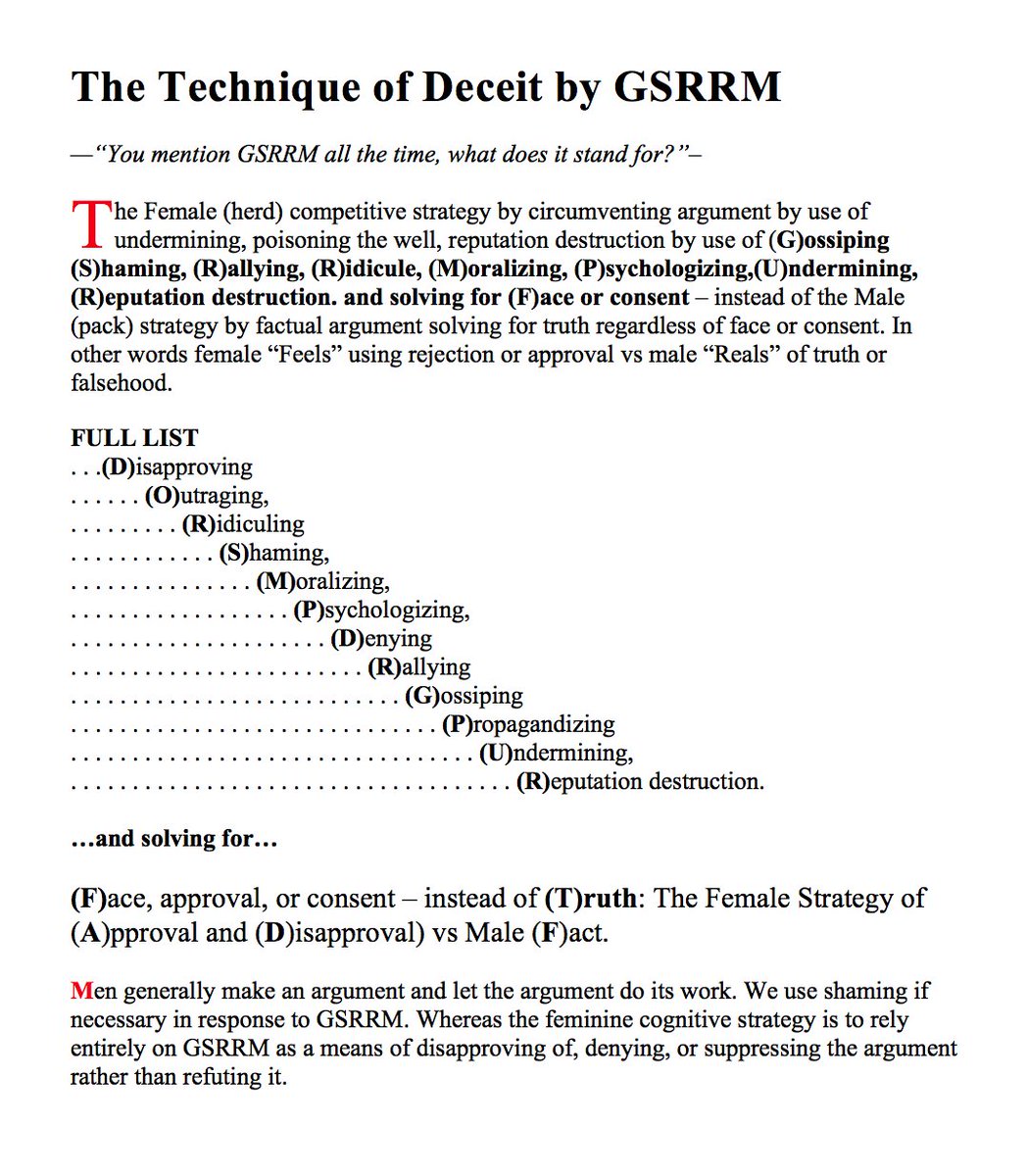
Q: “What are the female(Leftist) tactics of deceit by evasion?”
Conflating Approval and Disapproval with Truth and Falsehood, using:
0. Disapproval
1. Denial,
2. Evasion,
3. Deflection,
4. Reflection, and
5. Projection
(It’s GSRRM categories. I have to add to it a bit) https://t.co/v78KEZEPU7
Source date (UTC): 2021-04-18 18:21:59 UTC
Original post: https://twitter.com/i/web/status/1383848296381227014
(lol… working on that paragraph at the moment..)
Conflating Approval and Disapproval vs Truth and Falsehood, using:
1. Denial,
2. Evasion,
3. Deflection,
4. Reflection, and
5. Projection
(This is GSRRM at the first level of abstraction.)
Source date (UTC): 2021-04-18 18:18:20 UTC
Original post: https://twitter.com/i/web/status/1383847377610493959
Reply addressees: @juniorwolf @LukeWeinhagen @ThruTheHayes @G_Eats_Midwits
Replying to: https://twitter.com/i/web/status/1383844684502487045
THE WHITENESS CHECKLIST‘Whiteness’ requires:
Period. ARGUABLY, BY SOME, WOULD NARROW IT TO MANORIAL SELECTION PRESSURE
WHITENESS IS EXPENSIVE Other people can’t do it. Only the koreans and the japanese come close. And they can’t manage (pay the cost of) truth before face. Whiteness = the continuation of natural selection in all walks of life. If you can’t or won’t, then you’re unfit. It’s that simple. And it’s that painful. And its the reason ‘whiteness’ dragged mankind out of ignorance, superstition, hard labor, poverty, starvation, disease, suffering, child mortality, early death, the tyranny of despots, and the vicissitudes of a nature all but hostile to life. The world is our debtor. And they hate us for it.
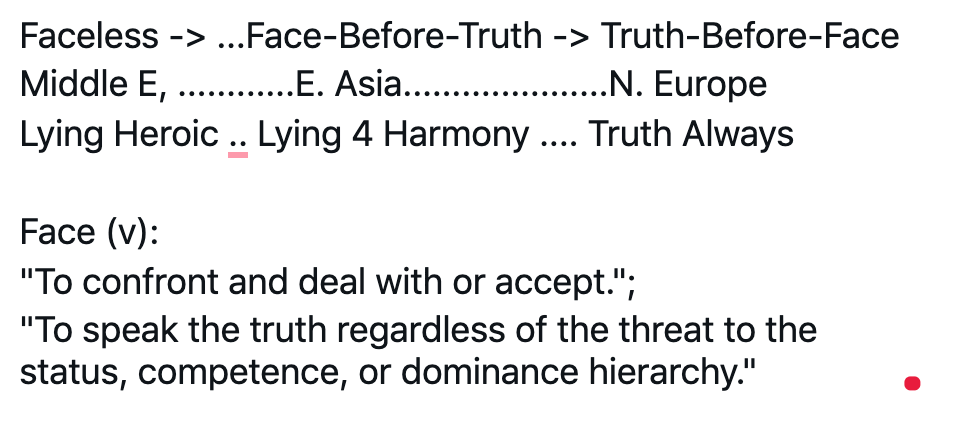
Truth-Before-Face: “To speak the truth regardless of the threat to the status, competence, or dominance hierarchy.” ie: truthful speech in the commons, in confession, in court testimony, in martial reporting.
Civilizational Differences Attached. https://t.co/qIpWflEUAQ
Source date (UTC): 2021-04-14 21:51:42 UTC
Original post: https://twitter.com/i/web/status/1382451521963577345
Reply addressees: @LoveAlexios
Replying to: https://twitter.com/i/web/status/1382417581575913473
Stop lying by conflation:
-Killing: The death of a person.
-Murder (homicide 1,2,3. intentional)
-Manslaughter (by externality of crime)
-Justifiable (Defense)
-Negligent Homicide (negligence)
-Homicide by Misadventure (by error)
-Excusable Homicide (accidental death)
Source date (UTC): 2021-04-13 20:44:17 UTC
Original post: https://twitter.com/i/web/status/1382072167945412613
Reply addressees: @ASAP_TaxEvasion @JediCounselor @RashidaTlaib
Replying to: https://twitter.com/i/web/status/1382067206259871745
The Method is reducible to:
–“Deflation and Disambiguation of Terms, Statements, Sentences, Stories, or Arguments by Enumeration, Serialization, and Operationalization, into First Causes by Adversarial Competition – into a universally commensurable language of measurement.”–
Source date (UTC): 2021-04-13 18:40:38 UTC
Original post: https://twitter.com/i/web/status/1382041053675589640
I use this modification to Paul Fussel’s US Class Hierarchy:
Top out-of-sight
Upper
Upper Middle or UK Middle
———
US Middle
(High prole) Lower Middle
(Mid-prole) Working
(Low prole) Laboring
———
Lower class (dependent)
Destitute (criminals, unemployable, etc)
Bottom out-of-sight
Source date (UTC): 2021-04-13 15:24:21 UTC
Original post: https://gab.com/curtd/posts/106058708547357484