Category: Religion, Myth, and Theology

  • I don’t argue against christian ethics (outcome) – I argue against abrahamism (j

    I don’t argue against christian ethics (outcome) – I argue against abrahamism (justification).

    I want them to be christians. I just don’t want them to argue with me by claiming that their preference for conveying Christian ethics is a truth or a necessity – It’s neither. it’s a good, and a preference. that’s fine. 😉 But theology isn’t true or even close to it. It’s a false and unwarrantable promise to bait you into following christian ethics.

    I just tell them that christianity when stated in scientific terms is in fact the scientific optimum ethics. The way that they argue it and justify it is rather ridiculous for those of us who are fine with the scientific truth being enough of a reason to act according to christian ethics.

    If you need different incentives to follow christian ethics that’s just a psychological difference. Otherwise, natural law and Christian ethics are the optimum.

    Largely, need for faith is a biological bias to empathy (feminine minds); need for theological argument is a biological bias for (weak) male minds. And the lack of need for faith is a biological basis for analytic (male) minds. And given that regardless of sex we almost all share some distribution of masculine and feminine biases.

    So no matter which reason you choose christianity: emotional faith, authoritarian rational, or scientific acknowledgment, all that matters is that people who AREN’T CHRISTIAN always and everywhere have more questionable (worse) ethics that are incompatible with western civilization.


    Source date (UTC): 2020-01-31 07:28:00 UTC

  • I just stick with (a) jesus’ teaching is reducible to five points, (b) the ten c

    I just stick with (a) jesus’ teaching is reducible to five points, (b) the ten commandments are just the law of tort, ( c) and europeans dont need to lie about either because we’ve always practiced sovereignty, reciprocity, truth, jury, tripartism, and aristocratic egalitarianism. It’s just that each of those ideas takes a standard deviation higher intelligence than the semitic religions to grasp. And that’s the net of it right there.

    There is no evidence people need faith. It’s a normative conclusion. People need a binding intergenerational narrative. It must have an embedded ambition. But most of the world did quite well before nonsense-religions. Ancestor worship and buddhism for the east, and ancestor worship and stoicism for the west are obvious examples.

    Jesus fits into the indo-european trinary religion just fine and if he had been included into the pantheon we wouldn’t have this problem – but the semites wanted to undermine the great, joyous, greco roman empire (and persian, and egyptian..) with a mandatory authoritarian universalist religoin so that they could encourage (warring, lying, cheating, malicious, awful) middle eastern tribal people.

    But judaism succeeded by separatism, and christianity failed among tribal people, and islam evolved out of a christan sect into a conquering rather than undermining version of abrahamism.


    Source date (UTC): 2020-01-31 07:12:00 UTC

  • photos_and_videos/TimelinePhotos_kg5QueHwVw/83835053_195657848499043_25885891459

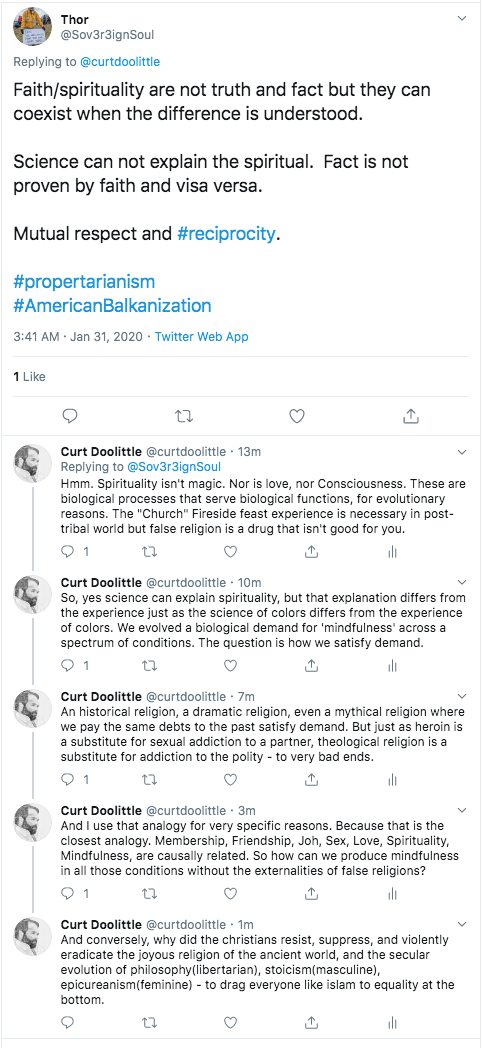
    photos_and_videos/TimelinePhotos_kg5QueHwVw/83835053_195657848499043_2588589145920110592_o_195657838499044.jpg On Spirituality (Try to grok it)

    Hmm. Spirituality isn’t magic. Nor is love, nor Consciousness. These are biological processes that serve biological functions, for evolutionary reasons. The “Church” Fireside feast experience is necessary in post-

    tribal world but false religion is a drug that isn’t good for you.

    So, yes science can explain spirituality, but that explanation differs from the experience just as the science of colors differs from the experience of colors. We evolved a biological demand for ‘mindfulness’ across a spectrum of conditions. The question is how we satisfy demand.

    An historical religion, a dramatic religion, even a mythical religion where we pay the same debts to the past satisfy demand. But just as heroin is a substitute for sexual addiction to a partner, theological religion is a

    substitute for addiction to the polity – to very bad ends.

    And I use that analogy for very specific reasons. Because that is the closest analogy. Membership, Friendship, Joh, Sex, Love, Spirituality, Mindfulness, are causally related. 50 how can we produce mindfulness in all those conditions without the externalities of false religions?

    And conversely, why did the christians resist, suppress, and violently eradicate the joyous religion of the ancient world, and the secular evolution of philosophy (libertarian), stoicism (masculine), epicureanism(feminine) – to drag everyone like islam to equality at the bottom.On Spirituality (Try to grok it)

    Hmm. Spirituality isn’t magic. Nor is love, nor Consciousness. These are biological processes that serve biological functions, for evolutionary reasons. The “Church” Fireside feast experience is necessary in post-

    tribal world but false religion is a drug that isn’t good for you.

    So, yes science can explain spirituality, but that explanation differs from the experience just as the science of colors differs from the experience of colors. We evolved a biological demand for ‘mindfulness’ across a spectrum of conditions. The question is how we satisfy demand.

    An historical religion, a dramatic religion, even a mythical religion where we pay the same debts to the past satisfy demand. But just as heroin is a substitute for sexual addiction to a partner, theological religion is a

    substitute for addiction to the polity – to very bad ends.

    And I use that analogy for very specific reasons. Because that is the closest analogy. Membership, Friendship, Joh, Sex, Love, Spirituality, Mindfulness, are causally related. 50 how can we produce mindfulness in all those conditions without the externalities of false religions?

    And conversely, why did the christians resist, suppress, and violently eradicate the joyous religion of the ancient world, and the secular evolution of philosophy (libertarian), stoicism (masculine), epicureanism(feminine) – to drag everyone like islam to equality at the bottom.


    Source date (UTC): 2020-01-31 06:36:00 UTC

  • Again, joke as we may, the christian destruction of the ancient world, the jewis

    Again, joke as we may, the christian destruction of the ancient world, the jewish and now muslim destruction of the modern world. Why is it don’t we separate? https://twitter.com/Steve_Sailer/status/1222736619003768832

  • OUR DYSFUNCTIONAL FAMILY OF GODS —“In fact the family is dysfunctional on purp

    OUR DYSFUNCTIONAL FAMILY OF GODS

    —“In fact the family is dysfunctional on purpose, to give us examples of how to solve problems with various personalities and issues.”—Greg HamiltonUpdated Jan 30, 2020, 9:46 PM


    Source date (UTC): 2020-01-30 21:46:00 UTC

  • Tri-Partism and The Tri-Functional Hypothesis of Our Natural Gods, and Our Natur

    Tri-Partism and The Tri-Functional Hypothesis of Our Natural Gods, and Our Natural Religion https://propertarianism.com/2020/01/30/tri-partism-and-the-tri-functional-hypothesis-of-our-natural-gods-and-our-natural-religion/


    Source date (UTC): 2020-01-30 16:37:33 UTC

    Original post: https://twitter.com/i/web/status/1222921804991418368

  • Tri-Partism and The Tri-Functional Hypothesis of Our Natural Gods, and Our Natural Religion

    (mandatory understanding on IE origins of Market Gods) (compare with the Monopoly of semitic underclass gods)

    [T]he Trifunctional Hypothesis of prehistoric Proto-Indo-European society postulates a tripartite ideology (“idéologie tripartite”) reflected in the existence of three classes or castes—priests, warriors, and commoners (farmers or tradesmen)—corresponding to the three functions of the sacral, the martial and the economic, respectively. The trifunctional thesis is primarily associated with the French mythographer Georges Dumézil, who proposed it in 1929 in the book Flamen-Brahman, and later in Mitra-Varuna. According to Dumézil (1898–1986), Proto-Indo-European society comprised three main groups corresponding to three distinct functions:

    1. Sovereignty, which fell into two distinct and complementary sub-parts:
      … 1.1 one formal, juridical and priestly but worldly;
      … 1.2 the other powerful, unpredictable, and also priestly but rooted in the supernatural world.
    2. Military, connected with force, the military and war.
    3. Productivity, herding, farming, and crafts; ruled by the other two.

    In the Proto-Indo-European mythology, each social group had its own god or family of gods to represent it and the function of the god or gods matched the function of the group. Many such divisions occur in the history of Indo-European societies: Southern Russia: Bernard Sergent associates the Indo-European language family with certain archaeological cultures in Southern Russia and reconstructs an Indo-European religion based upon the tripartite functions. Early Germanic society: The supposed division between the king, nobility and regular freemen in early Germanic society. Norse mythology: Odin (sovereignty), Týr (law and justice), the Vanir (fertility). Odin is assigned one of the core functions in the Indo-European pantheon as a representative of the first function (sovereignty) corresponding to the Hindu Varuṇa (fury and magic) as opposed to Týr, who corresponds to the Hindu Mitrá (law and justice); while the Vanir represent the third function (fertility). Odin has been also been interpreted as a death-god (“Psychopomp”: transporting us to the afterlife) and connected to cremations, and has also been associated with ecstatic practices. Classic Greece: The three divisions of the ideal society as described by Socrates in Plato’s The Republic. Bernard Sergent examined the trifunctional hypothesis in Greek epic, lyric and dramatic poetry. India: The three Hindu castes, the Brahmins or priests; the Kshatriya, the warriors and military; and the Vaishya, the agriculturalists, cattle rearers and traders. The Shudra, a fourth Indian caste, is a peasant or serf. A 2001 study found that the genetic affinity of Indians to Europeans is proportionate to caste rank, the upper castes being most similar to Europeans whereas lower castes are more like Asians. The researchers believe that the Indo-European speakers entered India from the Northwest, mixing with or displacing proto-Dravidian speakers, and may have established a caste system with themselves primarily in higher castes. TRIPLE (TRIPARTITE) DEITIES A triple deity (sometimes referred to as threefold, tripled, triplicate, tripartite, triune or triadic, or as a trinity) is three deities that are worshipped as one. Such deities are common throughout world mythology; the number three has a long history of mythical associations. Carl Jung considered the arrangement of deities into triplets an archetype in the history of religion. In classical religious iconography or mythological art, three separate beings may represent either a triad who always appear as a group (Greek Moirai, Charites, Erinyes; Norse Norns; or the Irish Morrígan) or a single deity known from literary sources as having three aspects (Greek Hecate, Roman Diana). THE INDO EUROPEAN ORIGINS OF TRIPARTISM, TRIFUNCTIONALISM, TRIPLE GODS, AND TERNARY LOGIC Georges Dumézil’s trifunctional hypothesis proposed that ancient Indo-European society conceived itself as structured around three activities: worship, war, and toil. In later times, when slave labor became common, the three functions came to be seen as separate “classes”, represented each by its own god. Dumézil understood this mythology as reflecting and validating social structures in its content: such a tripartite class system is found in ancient Indian, Iranian, Greek and Celtic texts. In 1970, Dumézil proposed that some goddesses represented these three qualities as different aspects or epithets and identified examples in his interpretation of various deities including the Iranian Anāhitā, the Vedic Sarasvatī and the Roman Juno. Vesna Petreska posits that myths including trinities of female mythical beings from Central and Eastern European cultures may be evidence for an Indo-European belief in trimutive female “spinners” of destiny. But according to the linguist M. L. West, various female deities and mythological figures in Europe show the influence of pre-Indo-European goddess-worship, and triple female fate divinities, typically “spinners” of destiny, are attested all over Europe and in Bronze Age Anatolia. POST BRONZE AGE COLLAPSE CULTURES Ancient Celtic cultures The Matres or Matronae are usually represented as a group of three but sometimes with as many as 27 (3 × 3 × 3) inscriptions. They were associated with motherhood and fertility. Inscriptions to these deities have been found in Gaul, Spain, Italy, the Rhineland and Britain, as their worship was carried by Roman soldiery dating from the mid 1st century to the 3rd century AD.[24] Miranda Green observes that “triplism” reflects a way of “expressing the divine rather than presentation of specific god-types. Triads or triple beings are ubiquitous in the Welsh and Irish mythic imagery” (she gives examples including the Irish battle-furies, Macha, and Brigit). “The religious iconographic repertoire of Gaul and Britain during the Roman period includes a wide range of triple forms: the most common triadic depiction is that of the triple mother goddess” (she lists numerous examples).[25] In the case of the Irish Brigid it can be ambiguous whether she is a single goddess or three sisters, all named Brigid.[26] The Morrígan also appears sometimes as one being, and at other times as three sisters,[27][28][29][30] as do the three Irish goddesses of sovereignty, Ériu, Fódla and Banba.[31] Hinduism In Hinduism, the supreme divinity Para Brahman can take the form of the Trimurti, in which the cosmic functions of creation, preservation, and destruction of the universe are performed by the three deities of Brahma (the creator), Vishnu (the preserver), and Shiva (the destroyer), who are at the same time three forms of the one Para Brahman.[32] The divine being Dattatreya is a representation of all three of these deities incarnated as a single being.[33] Christianity (the trinity) Christians profess “one God in three divine persons” (God the Father, God the Son and God the Holy Ghost). This is not to be understood as a belief in (or worship of) three Gods, nor as a belief that there are three subjectively-perceived “aspects” in one God, both of which the Catholic Church condemns as heresy. The Catholic Church also rejects the notions that God is “composed” of its three persons and that “God” is a genus containing the three persons. The Gnostic text Trimorphic Protennoia presents a threefold discourse of the three forms of Divine Thought: the Father, the Son, and the Mother (Sophia). Many Christian saints, especially martyrs, are trios who share a feast day or other remembrance. (See Category:Saints trios.) Whether they are subject to actual veneration and prayed to for supernatural aid, or simply honored, varies by Christian denomination. ESTATES OF THE REALM A 13th-century French representation of the tripartite social order of the Middle Ages – Oratores (“those who pray”), Bellatores (“those who fight”), and Laboratores (“those who work”). The estates of the realm, or three estates, were the broad orders of social hierarchy used in Christendom (Christian Europe) from the medieval period to early modern Europe. Different systems for dividing society members into estates developed and evolved over time. The best-known system is the French Ancien Régime (Old Regime), a three-estate system used until the French Revolution (1789–1799). Monarchy was for the king and the queen and this system was made up of clergy (the First Estate), nobles (the Second Estate), and peasants and bourgeoisie (the Third Estate). In some regions, notably Scandinavia and Russia, burghers (the urban merchant class) and rural commoners were split into separate estates, creating a four-estate system with rural commoners ranking the lowest as the Fourth Estate. Furthermore, the non-landowning poor could be left outside the estates, leaving them without political rights. In England, a two-estate system evolved that combined nobility and clergy into one lordly estate with “commons” as the second estate. This system produced the two houses of parliament, the House of Commons and the House of Lords. In southern Germany, a three-estate system of nobility (princes and high clergy), knights, and burghers was used. In Scotland, the Three Estates were the Clergy (First Estate), Nobility (Second Estate), and Shire Commissioners, or “burghers” (Third Estate), representing the bourgeois, middle class, and lower class. The Estates made up a Scottish Parliament. TRIPARTISM (COOPERATIONISM, MARKETS) IN PROPERTARIANISM In P we begin with the three means of coercion: Force-Defense, Remuneration-Deprivation, and Inclusion-Undermining (ostracization) in a market preserved by the judiciary. We argue that the three classes developed three ‘market competitions’ for elites; martial-judicial, priestly-educational, and productive-labor and trade. These three sets of elites we recognize as Conservative-Capitalizing (force), Progressive-consuming(Undermining), and Libertarian-Productive (Trade). In P we restore the “cooperation between the compatible but unequal classes”: The Monarchy as judge of last resort, The Judiciary as preservation of sovereignty, the Senate (nobility) as territorial (tribal) interests, the Upper House as the Commercial Interests, and the Lower House as Family and Labor Interests. Under this interpretation, Christianity is migrating to its natural place as the feminine (forgiveness, love), while we are restoring our traditional gods as we try to restore our civilization after the Abrahamic dark ages of death and decline. LEARN MORE This info is collected from Wikipedia but read Dumezil or at least the spark notes version. 😉 If you understand Dumizel’s description of, Campbell’s Monomyth, and the nordic myths you can begin to reconstruct our natural religions in both northern second generation and southern European first-generation forms.

  • Tri-Partism and The Tri-Functional Hypothesis of Our Natural Gods, and Our Natural Religion

    (mandatory understanding on IE origins of Market Gods) (compare with the Monopoly of semitic underclass gods)

    [T]he Trifunctional Hypothesis of prehistoric Proto-Indo-European society postulates a tripartite ideology (“idéologie tripartite”) reflected in the existence of three classes or castes—priests, warriors, and commoners (farmers or tradesmen)—corresponding to the three functions of the sacral, the martial and the economic, respectively. The trifunctional thesis is primarily associated with the French mythographer Georges Dumézil, who proposed it in 1929 in the book Flamen-Brahman, and later in Mitra-Varuna. According to Dumézil (1898–1986), Proto-Indo-European society comprised three main groups corresponding to three distinct functions:

    1. Sovereignty, which fell into two distinct and complementary sub-parts:
      … 1.1 one formal, juridical and priestly but worldly;
      … 1.2 the other powerful, unpredictable, and also priestly but rooted in the supernatural world.
    2. Military, connected with force, the military and war.
    3. Productivity, herding, farming, and crafts; ruled by the other two.

    In the Proto-Indo-European mythology, each social group had its own god or family of gods to represent it and the function of the god or gods matched the function of the group. Many such divisions occur in the history of Indo-European societies: Southern Russia: Bernard Sergent associates the Indo-European language family with certain archaeological cultures in Southern Russia and reconstructs an Indo-European religion based upon the tripartite functions. Early Germanic society: The supposed division between the king, nobility and regular freemen in early Germanic society. Norse mythology: Odin (sovereignty), Týr (law and justice), the Vanir (fertility). Odin is assigned one of the core functions in the Indo-European pantheon as a representative of the first function (sovereignty) corresponding to the Hindu Varuṇa (fury and magic) as opposed to Týr, who corresponds to the Hindu Mitrá (law and justice); while the Vanir represent the third function (fertility). Odin has been also been interpreted as a death-god (“Psychopomp”: transporting us to the afterlife) and connected to cremations, and has also been associated with ecstatic practices. Classic Greece: The three divisions of the ideal society as described by Socrates in Plato’s The Republic. Bernard Sergent examined the trifunctional hypothesis in Greek epic, lyric and dramatic poetry. India: The three Hindu castes, the Brahmins or priests; the Kshatriya, the warriors and military; and the Vaishya, the agriculturalists, cattle rearers and traders. The Shudra, a fourth Indian caste, is a peasant or serf. A 2001 study found that the genetic affinity of Indians to Europeans is proportionate to caste rank, the upper castes being most similar to Europeans whereas lower castes are more like Asians. The researchers believe that the Indo-European speakers entered India from the Northwest, mixing with or displacing proto-Dravidian speakers, and may have established a caste system with themselves primarily in higher castes. TRIPLE (TRIPARTITE) DEITIES A triple deity (sometimes referred to as threefold, tripled, triplicate, tripartite, triune or triadic, or as a trinity) is three deities that are worshipped as one. Such deities are common throughout world mythology; the number three has a long history of mythical associations. Carl Jung considered the arrangement of deities into triplets an archetype in the history of religion. In classical religious iconography or mythological art, three separate beings may represent either a triad who always appear as a group (Greek Moirai, Charites, Erinyes; Norse Norns; or the Irish Morrígan) or a single deity known from literary sources as having three aspects (Greek Hecate, Roman Diana). THE INDO EUROPEAN ORIGINS OF TRIPARTISM, TRIFUNCTIONALISM, TRIPLE GODS, AND TERNARY LOGIC Georges Dumézil’s trifunctional hypothesis proposed that ancient Indo-European society conceived itself as structured around three activities: worship, war, and toil. In later times, when slave labor became common, the three functions came to be seen as separate “classes”, represented each by its own god. Dumézil understood this mythology as reflecting and validating social structures in its content: such a tripartite class system is found in ancient Indian, Iranian, Greek and Celtic texts. In 1970, Dumézil proposed that some goddesses represented these three qualities as different aspects or epithets and identified examples in his interpretation of various deities including the Iranian Anāhitā, the Vedic Sarasvatī and the Roman Juno. Vesna Petreska posits that myths including trinities of female mythical beings from Central and Eastern European cultures may be evidence for an Indo-European belief in trimutive female “spinners” of destiny. But according to the linguist M. L. West, various female deities and mythological figures in Europe show the influence of pre-Indo-European goddess-worship, and triple female fate divinities, typically “spinners” of destiny, are attested all over Europe and in Bronze Age Anatolia. POST BRONZE AGE COLLAPSE CULTURES Ancient Celtic cultures The Matres or Matronae are usually represented as a group of three but sometimes with as many as 27 (3 × 3 × 3) inscriptions. They were associated with motherhood and fertility. Inscriptions to these deities have been found in Gaul, Spain, Italy, the Rhineland and Britain, as their worship was carried by Roman soldiery dating from the mid 1st century to the 3rd century AD.[24] Miranda Green observes that “triplism” reflects a way of “expressing the divine rather than presentation of specific god-types. Triads or triple beings are ubiquitous in the Welsh and Irish mythic imagery” (she gives examples including the Irish battle-furies, Macha, and Brigit). “The religious iconographic repertoire of Gaul and Britain during the Roman period includes a wide range of triple forms: the most common triadic depiction is that of the triple mother goddess” (she lists numerous examples).[25] In the case of the Irish Brigid it can be ambiguous whether she is a single goddess or three sisters, all named Brigid.[26] The Morrígan also appears sometimes as one being, and at other times as three sisters,[27][28][29][30] as do the three Irish goddesses of sovereignty, Ériu, Fódla and Banba.[31] Hinduism In Hinduism, the supreme divinity Para Brahman can take the form of the Trimurti, in which the cosmic functions of creation, preservation, and destruction of the universe are performed by the three deities of Brahma (the creator), Vishnu (the preserver), and Shiva (the destroyer), who are at the same time three forms of the one Para Brahman.[32] The divine being Dattatreya is a representation of all three of these deities incarnated as a single being.[33] Christianity (the trinity) Christians profess “one God in three divine persons” (God the Father, God the Son and God the Holy Ghost). This is not to be understood as a belief in (or worship of) three Gods, nor as a belief that there are three subjectively-perceived “aspects” in one God, both of which the Catholic Church condemns as heresy. The Catholic Church also rejects the notions that God is “composed” of its three persons and that “God” is a genus containing the three persons. The Gnostic text Trimorphic Protennoia presents a threefold discourse of the three forms of Divine Thought: the Father, the Son, and the Mother (Sophia). Many Christian saints, especially martyrs, are trios who share a feast day or other remembrance. (See Category:Saints trios.) Whether they are subject to actual veneration and prayed to for supernatural aid, or simply honored, varies by Christian denomination. ESTATES OF THE REALM A 13th-century French representation of the tripartite social order of the Middle Ages – Oratores (“those who pray”), Bellatores (“those who fight”), and Laboratores (“those who work”). The estates of the realm, or three estates, were the broad orders of social hierarchy used in Christendom (Christian Europe) from the medieval period to early modern Europe. Different systems for dividing society members into estates developed and evolved over time. The best-known system is the French Ancien Régime (Old Regime), a three-estate system used until the French Revolution (1789–1799). Monarchy was for the king and the queen and this system was made up of clergy (the First Estate), nobles (the Second Estate), and peasants and bourgeoisie (the Third Estate). In some regions, notably Scandinavia and Russia, burghers (the urban merchant class) and rural commoners were split into separate estates, creating a four-estate system with rural commoners ranking the lowest as the Fourth Estate. Furthermore, the non-landowning poor could be left outside the estates, leaving them without political rights. In England, a two-estate system evolved that combined nobility and clergy into one lordly estate with “commons” as the second estate. This system produced the two houses of parliament, the House of Commons and the House of Lords. In southern Germany, a three-estate system of nobility (princes and high clergy), knights, and burghers was used. In Scotland, the Three Estates were the Clergy (First Estate), Nobility (Second Estate), and Shire Commissioners, or “burghers” (Third Estate), representing the bourgeois, middle class, and lower class. The Estates made up a Scottish Parliament. TRIPARTISM (COOPERATIONISM, MARKETS) IN PROPERTARIANISM In P we begin with the three means of coercion: Force-Defense, Remuneration-Deprivation, and Inclusion-Undermining (ostracization) in a market preserved by the judiciary. We argue that the three classes developed three ‘market competitions’ for elites; martial-judicial, priestly-educational, and productive-labor and trade. These three sets of elites we recognize as Conservative-Capitalizing (force), Progressive-consuming(Undermining), and Libertarian-Productive (Trade). In P we restore the “cooperation between the compatible but unequal classes”: The Monarchy as judge of last resort, The Judiciary as preservation of sovereignty, the Senate (nobility) as territorial (tribal) interests, the Upper House as the Commercial Interests, and the Lower House as Family and Labor Interests. Under this interpretation, Christianity is migrating to its natural place as the feminine (forgiveness, love), while we are restoring our traditional gods as we try to restore our civilization after the Abrahamic dark ages of death and decline. LEARN MORE This info is collected from Wikipedia but read Dumezil or at least the spark notes version. 😉 If you understand Dumizel’s description of, Campbell’s Monomyth, and the nordic myths you can begin to reconstruct our natural religions in both northern second generation and southern European first-generation forms.

  • TRI-PARTISM AND THE TRI-FUNCTIONAL HYPOTHESIS OF OUR NATURAL GODS, AND OUR NATUR

    TRI-PARTISM AND THE TRI-FUNCTIONAL HYPOTHESIS OF OUR NATURAL GODS, AND OUR NATURAL RELIGION

    (mandatory understanding on IE origins of Market Gods) (compare with the Monopoly of semitic underclass gods)

    The Trifunctional Hypothesis of prehistoric Proto-Indo-European society postulates a tripartite ideology (“idéologie tripartite”) reflected in the existence of three classes or castes—priests, warriors, and commoners (farmers or tradesmen)—corresponding to the three functions of the sacral, the martial and the economic, respectively.

    The trifunctional thesis is primarily associated with the French mythographer Georges Dumézil, who proposed it in 1929 in the book Flamen-Brahman, and later in Mitra-Varuna.

    According to Dumézil (1898–1986), Proto-Indo-European society comprised three main groups corresponding to three distinct functions:

    1. Sovereignty, which fell into two distinct and complementary sub-parts:

    … 1.1 one formal, juridical and priestly but worldly;

    … 1.2 the other powerful, unpredictable, and also priestly but rooted in the supernatural world.

    2. Military, connected with force, the military and war.

    3. Productivity, herding, farming and crafts; ruled by the other two.

    In the Proto-Indo-European mythology each social group had its own god or family of gods to represent it and the function of the god or gods matched the function of the group. Many such divisions occur in the history of Indo-European societies:

    Southern Russia: Bernard Sergent associates the Indo-European language family with certain archaeological cultures in Southern Russia and reconstructs an Indo-European religion based upon the tripartite functions.

    Early Germanic society: The supposed division between the king, nobility and regular freemen in early Germanic society.

    Norse mythology: Odin (sovereignty), Týr (law and justice), the Vanir (fertility). Odin is assigned one of the core functions in the Indo-European pantheon as a representative of the first function (sovereignty) corresponding to the Hindu Varuṇa (fury and magic) as opposed to Týr, who corresponds to the Hindu Mitrá (law and justice); while the Vanir represent the third function (fertility). Odin has been also been interpreted as a death-god (“Psychopomp”: transporting us to the afterlife) and connected to cremations, and has also been associated with ecstatic practices.

    Classic Greece: The three divisions of the ideal society as described by Socrates in Plato’s The Republic. Bernard Sergent examined the trifunctional hypothesis in Greek epic, lyric and dramatic poetry.

    India: The three Hindu castes, the Brahmins or priests; the Kshatriya, the warriors and military; and the Vaishya, the agriculturalists, cattle rearers and traders. The Shudra, a fourth Indian caste, is a peasant or serf. A 2001 study found that the genetic affinity of Indians to Europeans is proportionate to caste rank, the upper castes being most similar to Europeans whereas lower castes are more like Asians. The researchers believe that the Indo-European speakers entered India from the Northwest, mixing with or displacing proto-Dravidian speakers, and may have established a caste system with themselves primarily in higher castes.

    TRIPLE (TRIPARTITE) DIETIES

    A triple deity (sometimes referred to as threefold, tripled, triplicate, tripartite, triune or triadic, or as a trinity) is three deities that are worshipped as one. Such deities are common throughout world mythology; the number three has a long history of mythical associations. Carl Jung considered the arrangement of deities into triplets an archetype in the history of religion.

    In classical religious iconography or mythological art, three separate beings may represent either a triad who always appear as a group (Greek Moirai, Charites, Erinyes; Norse Norns; or the Irish Morrígan) or a single deity known from literary sources as having three aspects (Greek Hecate, Roman Diana).

    THE INDO EUROPEAN ORIGINS OF TRIPARTISM, TRIFUNCTIONALISM, TRIPLE GODS, AND TERNARY LOGIC

    Georges Dumézil’s trifunctional hypothesis proposed that ancient Indo-European society conceived itself as structured around three activities: worship, war, and toil. In later times, when slave labor became common, the three functions came to be seen as separate “classes”, represented each by its own god. Dumézil understood this mythology as reflecting and validating social structures in its content: such a tripartite class system is found in ancient Indian, Iranian, Greek and Celtic texts. In 1970, Dumézil proposed that some goddesses represented these three qualities as different aspects or epithets and identified examples in his interpretation of various deities including the Iranian Anāhitā, the Vedic Sarasvatī and the Roman Juno.

    Vesna Petreska posits that myths including trinities of female mythical beings from Central and Eastern European cultures may be evidence for an Indo-European belief in trimutive female “spinners” of destiny. But according to the linguist M. L. West, various female deities and mythological figures in Europe show the influence of pre-Indo-European goddess-worship, and triple female fate divinities, typically “spinners” of destiny, are attested all over Europe and in Bronze Age Anatolia.

    POST BRONZE AGE COLLAPSE CULTURES

    Ancient Celtic cultures

    The Matres or Matronae are usually represented as a group of three but sometimes with as many as 27 (3 × 3 × 3) inscriptions. They were associated with motherhood and fertility. Inscriptions to these deities have been found in Gaul, Spain, Italy, the Rhineland and Britain, as their worship was carried by Roman soldiery dating from the mid 1st century to the 3rd century AD.[24] Miranda Green observes that “triplism” reflects a way of “expressing the divine rather than presentation of specific god-types. Triads or triple beings are ubiquitous in the Welsh and Irish mythic imagery” (she gives examples including the Irish battle-furies, Macha, and Brigit). “The religious iconographic repertoire of Gaul and Britain during the Roman period includes a wide range of triple forms: the most common triadic depiction is that of the triple mother goddess” (she lists numerous examples).[25]

    In the case of the Irish Brigid it can be ambiguous whether she is a single goddess or three sisters, all named Brigid.[26] The Morrígan also appears sometimes as one being, and at other times as three sisters,[27][28][29][30] as do the three Irish goddesses of sovereignty, Ériu, Fódla and Banba.[31]

    Hinduism

    In Hinduism, the supreme divinity Para Brahman can take the form of the Trimurti, in which the cosmic functions of creation, preservation, and destruction of the universe are performed by the three deities of Brahma (the creator), Vishnu (the preserver), and Shiva (the destroyer), who are at the same time three forms of the one Para Brahman.[32] The divine being Dattatreya is a representation of all three of these deities incarnated as a single being.[33]

    Christianity (the trinity)

    Christians profess “one God in three divine persons” (God the Father, God the Son and God the Holy Ghost). This is not to be understood as a belief in (or worship of) three Gods, nor as a belief that there are three subjectively-perceived “aspects” in one God, both of which the Catholic Church condemns as heresy. The Catholic Church also rejects the notions that God is “composed” of its three persons and that “God” is a genus containing the three persons.

    The Gnostic text Trimorphic Protennoia presents a threefold discourse of the three forms of Divine Thought: the Father, the Son, and the Mother (Sophia).

    Many Christian saints, especially martyrs, are trios who share a feast day or other remembrance. (See Category:Saints trios.) Whether they are subject to actual veneration and prayed to for supernatural aid, or simply honored, varies by Christian denomination.

    ESTATES OF THE REALM

    A 13th-century French representation of the tripartite social order of the Middle Ages – Oratores (“those who pray”), Bellatores (“those who fight”), and Laboratores (“those who work”).

    The estates of the realm, or three estates, were the broad orders of social hierarchy used in Christendom (Christian Europe) from the medieval period to early modern Europe. Different systems for dividing society members into estates developed and evolved over time.

    The best known system is the French Ancien Régime (Old Regime), a three-estate system used until the French Revolution (1789–1799). Monarchy was for the king and the queen and this system was made up of clergy (the First Estate), nobles (the Second Estate), and peasants and bourgeoisie (the Third Estate). In some regions, notably Scandinavia and Russia, burghers (the urban merchant class) and rural commoners were split into separate estates, creating a four-estate system with rural commoners ranking the lowest as the Fourth Estate. Furthermore, the non-landowning poor could be left outside the estates, leaving them without political rights. In England, a two-estate system evolved that combined nobility and clergy into one lordly estate with “commons” as the second estate. This system produced the two houses of parliament, the House of Commons and the House of Lords. In southern Germany, a three-estate system of nobility (princes and high clergy), knights, and burghers was used. In Scotland, the Three Estates were the Clergy (First Estate), Nobility (Second Estate), and Shire Commissioners, or “burghers” (Third Estate), representing the bourgeois, middle class, and lower class. The Estates made up a Scottish Parliament.

    TRIPARTISM (COOPERATIONISM, MARKETS) IN PROPERTARIANISM

    In P we begin with the three means of coercion: Force-Defense, Remuneration-Deprivation, and Inclusion-Undermining (ostracization) in a market preserved by the judiciary. We argue that the three classes developed three ‘market competitions’ for elites; martial-judicial, priestly-educational, and productive-labor and trade. These three sets of elites we recognize as Conservative-Capitalizing (force), Progressive-consuming(Undermining), and Libertarian-Productive (Trade).

    In P we restore the “cooperation between the compatible but unequal classes”: The Monarchy as judge of last resort, The Judiciary as preservation of sovereignty, the Senate (nobility) as territorial (tribal) interests, the Upper House as the Commercial Interests, and the Lower House as Family and Labor Interests.

    Under this interpretation, christianity is migrating to its natural place as the feminine (forgiveness, love), while we are restoring our traditional gods as we try to restore our civlization after the abrahamic dark ages of death and decline.

    LEARN MORE

    This info is collected from wikipedia, but read Dumezil or at least the spartk notes version. 😉 If you undestand Dumizel’s description of, Campbell’s Monomyth, and the nordic myths you can begin to reconstruct our natural religions in both northern second generation and southern european first generation forms.


    Source date (UTC): 2020-01-30 11:36:00 UTC
  • I prefer european gods because they are a functioning but dysfunctional family r

    I prefer european gods because they are a functioning but dysfunctional family rather than an ideal. I prefer Zeus because it is a perfect king. I prefer odin because he is a trickster. And we have male and female, young and old, virtuous and chaotic: Archetypes in a MARKET not a monopoly..


    Source date (UTC): 2020-01-29 18:23:00 UTC