Category: Natural Law and Reciprocity

  • (NLI) European Group Strategy in multiple forms: 1. CURRENT EUROPEAN GROUP STRAT

    (NLI)
    European Group Strategy in multiple forms:
    1. CURRENT EUROPEAN GROUP STRATEGY: TEXT
    2. THE LIST OF PRINCIPLES EXPLAINED
    3. EXPLAINED AS COMMON LAW
    4. AS POETRY BY ALEXANDER POPE šŸ˜‰
    https://naturallawinstitute.com/2024/04/nli-t-shirts-european-group-strategy-in-multiple-forms/


    Source date (UTC): 2024-04-26 14:48:19 UTC

    Original post: https://twitter.com/i/web/status/1783870732197359914

  • RT @AutistocratMS: @FatherIsTalking @LucasBotkin @curtdoolittle @NatLawInstitute

    RT @AutistocratMS: @FatherIsTalking @LucasBotkin @curtdoolittle @NatLawInstitute Rights are a mutual insurance of members of the group agai…


    Source date (UTC): 2024-04-19 22:31:34 UTC

    Original post: https://twitter.com/i/web/status/1781450598077841665

  • “The Oath of Transcendent Man”

    “The Oath of Transcendent Man”
    https://naturallawinstitute.com/docs/the-europeans-lex-europaei/the-natural-law-of-the-european-peoples/the-oath-of-transcendent-man/


    Source date (UTC): 2024-04-18 10:15:58 UTC

    Original post: https://twitter.com/i/web/status/1780903089601445908

    Reply addressees: @JaredAberach

    Replying to: https://twitter.com/i/web/status/1780855448381358252

  • RT @AutistocratMS: @RokoMijic @curtdoolittle Yes and we refer to the work as nat

    RT @AutistocratMS: @RokoMijic @curtdoolittle Yes and we refer to the work as natural law now, propertarianism being only subdiscipline conc…


    Source date (UTC): 2024-04-18 03:36:18 UTC

    Original post: https://twitter.com/i/web/status/1780802509390393798

  • Q:”will someone please explain propertarianism that isn’t a fifty paragraph text

    –Q:”will someone please explain propertarianism that isn’t a fifty paragraph text wall”–

    Just to make the comparison understandable, first, how would. you reduce Plato or Aristotle or Hume? Size matters so to speak. That said this is 17 paragraphs in ordinary language that should get the point across.

    FROM GPT4+
    Curt Doolittle’s work in philosophy and social science primarily revolves around two interconnected frameworks: Propertarianism and his more recent evolution into Formal Operational Natural Law. Both frameworks are part of his broader efforts to establish a scientifically rigorous basis for law and ethics, drawing heavily on economic principles and evolutionary psychology.

    Propertarianism
    Propertarianism, as developed by Curt Doolittle, is a philosophical and legal framework that emphasizes property rights and the necessity of reciprocal exchanges in societal interactions. It is based on the principle that all human rights can be reduced to property rights, which Doolittle argues is the foundation of law and civilization. The core tenets of Propertarianism include:

    Property Rights: Propertarianism extends the definition of property beyond physical objects to include intangible assets like one’s time, relationships, and opportunities. According to Doolittle, recognizing and respecting these broad definitions of property is key to maintaining social harmony and reducing conflict.

    Reciprocity: This principle asserts that for a social transaction to be considered moral or legal, it must be reciprocal and voluntary, meaning all parties involved benefit in some way, and no party incurs undue harm without compensation.

    Transparency and Truthfulness: Doolittle emphasizes the importance of truthful speech and transparent intentions in maintaining social order. He argues that deception undermines trust and is detrimental to the social fabric.

    Reduction of Behavioral Science to Demonstrated Interests: Propertarianism attempts to ground ethical and legal considerations in objectively verifiable interests, advocating that human behavior and social norms can be understood through observable and demonstrable interests.

    Formal Operational Natural Law
    Building on the principles of Propertarianism, Doolittle’s more recent work has focused on developing what he terms “Formal Operational Natural Law.” This framework seeks to create a universally commensurable system of law rooted in the natural sciences, particularly behavioral economics and evolutionary biology. Key aspects include:

    Natural Law: This approach posits that law should be based on the immutable laws of nature, including human nature and biological imperatives. It suggests that laws aligning with natural human behaviors and the physical laws of the universe will be the most effective and just.

    Formal Logic and Operational Language: Doolittle advocates for laws to be expressed in operational language, meaning they should be stated in terms that are empirically testable and operationally definable. This ensures clarity and prevents the manipulation of legal language.

    Focus on Decidability: The system prioritizes clear criteria for deciding legal and ethical disputes, aiming to reduce the ambiguity and subjectivity in legal interpretation and enforcement.

    Rigor
    Doolittle emphasizes a high degree of intellectual rigor, especially in terms of logical consistency and empirical validation. His work aims to apply the precision of mathematics and the natural sciences to social sciences and ethics, which he believes should be grounded in demonstrably true or empirically verifiable statements. Here are key aspects of the rigor in Doolittle’s philosophical work:

    Operational Language
    Doolittle advocates for the use of operational language in philosophical and legal discourse. This approach requires that statements be phrased in such a way that they can be empirically and operationally tested. The idea is to eliminate ambiguity and reduce the susceptibility to manipulation. By insisting that all propositions and legislative items be expressed in terms that can be directly observed, measured, or constructed, Doolittle seeks to ensure clarity and prevent the distortions that can arise from abstract or vague language.

    Scientific Methodology
    Doolittle applies the scientific method to social sciences by emphasizing falsifiability and repeatability. He argues that for any theory to be considered scientifically valid, it must be open to tests that could potentially falsify it, similar to the criteria used in the natural sciences. This methodological rigor is intended to foster a more objective and reliable foundation for understanding human behavior and societal structures.

    Economic and Evolutionary Foundations
    Doolittle’s theories are deeply rooted in economic principles and evolutionary biology, which he uses to explain and justify social, ethical, and legal norms. By grounding his philosophical assertions in well-established scientific theories, he attempts to imbue his philosophical work with the type of rigor typically associated with the hard sciences. This includes an emphasis on concepts such as incentives, competition, cooperation, and fitness, which are derived from economics and evolutionary theory.

    Rigorous Deduction and Empirical Support
    In developing his theories, Doolittle uses rigorous logical deduction and seeks empirical support where possible. This involves not only theoretical formulation but also the practical application of these theories to real-world scenarios. His aim is to build a cohesive and comprehensive system that not only explains but also predicts human behavior within legal and ethical frameworks.

    Critique and Openness to Scrutiny
    Doolittle places a strong emphasis on critical engagement and intellectual scrutiny. He invites criticism and debate over his theories, viewing them as essential parts of the process of scientific inquiry. This openness to scrutiny is a crucial component of the intellectual rigor he advocates, as it ensures that his theories are constantly tested and refined.

    Summary
    Both Propertarianism and Formal Operational Natural Law reflect Doolittle’s ambition to align legal and ethical systems with empirical science and objective truth. By grounding these systems in observable properties and reciprocal relationships, Doolittle seeks to create a more transparent, accountable, and sustainable foundation for law and governance. His work is provocative and has sparked discussion and debate, particularly among those interested in the intersections of law, philosophy, and economics.

    Reply addressees: @GearMentation @sudovatnik @RokoMijic


    Source date (UTC): 2024-04-17 23:57:38 UTC

    Original post: https://twitter.com/i/web/status/1780747479169769472

    Replying to: https://twitter.com/i/web/status/1780740976593740222

  • SO CURT DOOLITTLE, WHAT IS THIS NATURAL LAW? It’s

    SO CURT DOOLITTLE, WHAT IS THIS NATURAL LAW? It’s

    SO CURT DOOLITTLE, WHAT IS THIS NATURAL LAW?
    It’s: https://twitter.com/curtdoolittle/status/1779940094683607400 https://t.co/0Y2dcAT9c0

  • ARISTOTLE’S ORIGINATION OF NATURAL LAW Aristotle’s conception of natural law is

    ARISTOTLE’S ORIGINATION OF NATURAL LAW
    Aristotle’s conception of natural law is integral to his teleological understanding of the universe, emphasizing purpose and natural order rather than a constructed set of legal rules:

    Natural Law in Aristotle’s Thought:
    Aristotle defines natural law not as explicit statutes but as an inherent order discernible through reason. This law is constant and universal, guiding both natural phenomena and human conduct, unlike human-made laws which are variable and context-dependent.

    In works like “Nicomachean Ethics” and “Politics,” he elucidates that natural justice and law possess a universal power of decidability that does not depend on human perception or societal convention. He argues that aspects of justice are embedded in nature and thus hold universal validity.

    Causal Foundations of Natural Law:
    Aristotle’s natural law emerges from his view that everything in nature is directed towards a purpose or end (telos). Natural law stems from this purposeful existence and the rational capacities inherent in humans, who are naturally equipped to discern and align with these universal principles.

    The capacity for human reasoning and virtue is in alignment with the cosmic order. Aristotle’s virtue ethics, detailed in his philosophical works, advocates living in accordance with this natural law, pursuing the ‘good life’ or ‘eudaimonia,’ achieved by fulfilling one’s natural purpose.

    Implications for Human Law:
    Aristotle distinguishes between justice by nature and justice by convention, recognizing that while natural law is immutable, its application through human laws must adapt to societal variations. Ideally, human laws should extend natural law, tailored to specific community needs but ultimately reflecting universal justice principles.

    In essence, Aristotle’s natural law represents the rational and purposive structure of the universe, accessible through human reason and central to achieving the highest form of good through a life of virtue. It serves both as a description of the world’s inherent order and as the cause for humans to act in harmony with this order, realizing their true nature and potential.

    Result
    In other words, without knowing of evolution, Aristotle is attributing causality and natural law to evolutionary consequence, and in his general counsel, that man should live according to nature not according to Ideals, fictions and lies.

    What is Not in Aristotle That Was Added by Christians?
    The Christian adaptation of natural law significantly diverges from Aristotle’s formulation by embedding theological elements that Aristotle’s philosophy omits:

    Divine Origin and Authority: Christianity posits that natural law is authored by God, thus divine will becomes the source of natural law. In contrast, Aristotle sees natural law as emerging from the inherent purposes and functions of things, discerned through reason without divine attribution.

    Theological Purpose:
    In Christian doctrine, the ultimate purpose of natural law is aligned with fulfilling God’s will, leading to eternal salvation or damnation.
    In other words “you must obey” (a stick)

    Aristotle’s concept is secular; the purpose of natural law is to achieve eudaimonia, a state of flourishing based on virtues, confined to earthly existence without eschatological implications.
    In other words, ‘you will flourish” (a carrot)

    Moral Fallibility and Sin:
    Christianity introduces the concept of original sin, framing human nature as inherently flawed, requiring divine grace for moral guidance and adherence to natural law. Aristotle attributes moral failure to ignorance or lack of virtue, considering human nature as fundamentally rational and oriented towards good.
    In other words “you are evil so obey”

    Role of Revelation:
    Christian natural law often relies on divine revelation through scripture for its elucidation and application, asserting that human reason alone is insufficient due to the corrupted nature of human will.
    “You’re evil and stupid so obey the Church”

    Aristotle’s approach relies solely on human reason to understand and apply natural law based on observable natural order.
    “You can reason you can choose the good, beautiful, excellent and heroic, and you will benefit from it.”

    In summary, the Christian reinterpretation of natural law transforms it from Aristotle’s rational, purpose-driven understanding based on intrinsic natural properties to a divinely dictated, eschatologically significant framework where human nature requires divine correction and guidance.

    In other words christianity teaches:
    –‘You are bad and stupid, so don’t think, but obey’.–

    Analysis:
    Now if you follow my work on natural law, converting anglo enlightenment empiricism, to contemporary scientific operationalism, you’ll note that of course, I take aristotle’s position because I do not believe I am or man is either evil or stupid but constrained by circumstance and possessed of sufficient free will to choose the good over the bad.
    But that man may need education in order to understand the problems of cooperation as human numbers and variation scale. So that what may appear ethical and moral in one case may not be in another.
    This is reasoning.

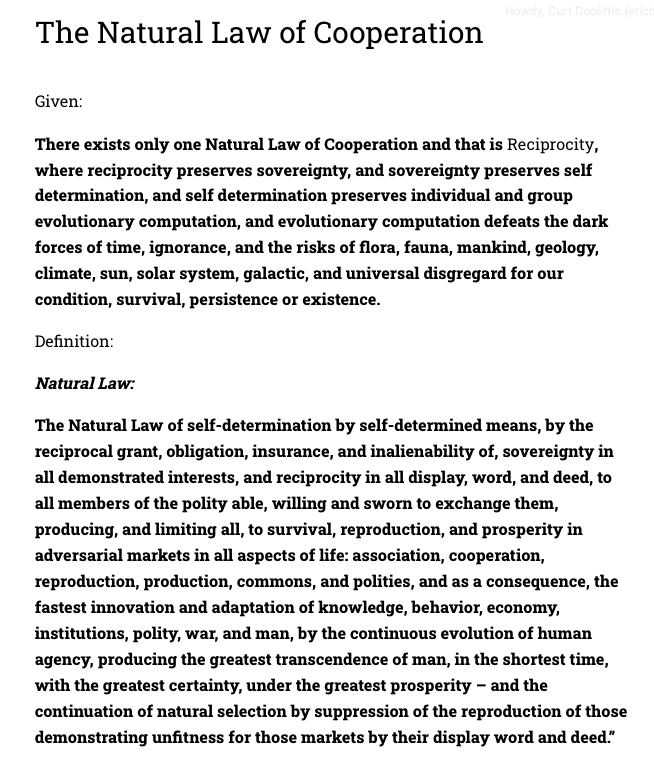
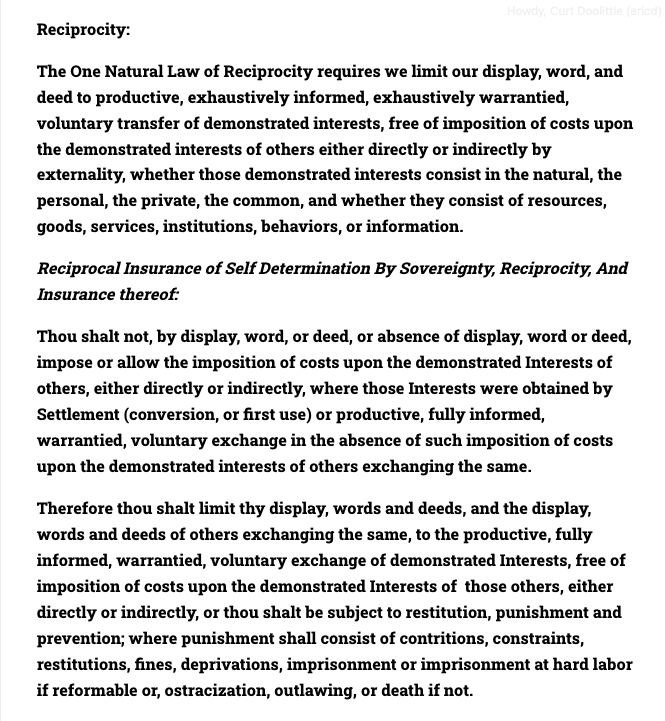
    So my work in natural law simply uses the findings of the sciences especially those over the past century and a half to state the natural law of cooperation as an evolutionary outcome of evolutionary computation over time, and itself an example of evolutionary computation by processing vast amounts of information for vast differences in abilities, wants and needs.

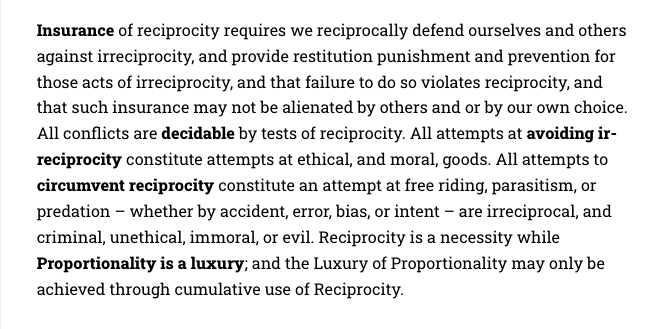
    Aristotle in this case was largely right. Even if he lacked the knowledge of causality that we possess today he understood from the evidence at hand the concept of balance (what we call reciprocity and proportionality), that both Common distributive justice (mutual insurance, proportionality) and Individual corrective justice (sovereignty, reciprocity, restitution, punishment) was necessary to preserve an equilibrium of cooperation that suppressed injustices – not produced justices. šŸ˜‰

    Aristotle’s concept of justice as proportionality is deeply integrated into his view of natural law. He believes that justice, as a virtue, fulfills the natural order and purpose (telos) of human society. Justice ensures that individuals can achieve their potential and contribute to the flourishing of the community, which is the ultimate goal of the polis (city-state) as a natural entity. In Aristotle’s view, the laws of a polis should reflect this natural order by promoting justice as proportionality, ensuring that each person receives what is due to them according to their merit and the nature of their relationships and transactions.

    In other words, Aristotle favored Classical Liberalism, and rule of law by the natural law.

    Cheers
    CD

    Source date (UTC): 2024-04-15 18:29:22 UTC

    Original post: https://twitter.com/i/web/status/1779940094134099968

  • That would mean the NAP is false. The NAP is derived from Tort (Tresspass, the u

    That would mean the NAP is false.
    The NAP is derived from Tort (Tresspass, the universal cause of retaliation ) which is, quite obviously, the evidence of all dispute resolution across all of history.
    All that differs is the scope of what can be trespassed against without…


    Source date (UTC): 2024-04-13 21:13:19 UTC

    Original post: https://twitter.com/i/web/status/1779256578467610756

    Reply addressees: @ViandeTiede666 @AutistocratMS @josh61597760 @GiwdulBielsira @FerghaneA @PLIB_fr @Cobra_FX_ @PBlanrue @arthurhomines @NIMH_Rage @RageCultureMag @Doomit_Doomit @PaduStream @Etienne_Chouard @ObjectivismeFR @cercle_cobalt @Bunker_D_ @JRochedy @MonsieurPhi @liberteadoree @fare @VillonAdam @whatifalthist

    Replying to: https://twitter.com/i/web/status/1779254426143985925

  • So WHY is NAP ‘true’, or ‘good’, or ‘useful’?

    So WHY is NAP ‘true’, or ‘good’, or ‘useful’?


    Source date (UTC): 2024-04-13 21:06:17 UTC

    Original post: https://twitter.com/i/web/status/1779254805950574650

    Reply addressees: @ViandeTiede666 @AutistocratMS @josh61597760 @GiwdulBielsira @FerghaneA @PLIB_fr @Cobra_FX_ @PBlanrue @arthurhomines @NIMH_Rage @RageCultureMag @Doomit_Doomit @PaduStream @Etienne_Chouard @ObjectivismeFR @cercle_cobalt @Bunker_D_ @JRochedy @MonsieurPhi @liberteadoree @fare @VillonAdam @whatifalthist

    Replying to: https://twitter.com/i/web/status/1779252256577114131

  • Our, my goal, is to end conflict by ending lying stating the truth, and working

    Our, my goal, is to end conflict by ending lying stating the truth, and working on reciprocal exchanges and compromises that reduce the stress of our differences. The false claim of equality or even the potential of equality is merely increasing the frictions between groups such that traditional class conflcit that COULD be eliminated through political policy is not possible across races and religions etc. It’s a noble goal. It’s a moral goal. And it will solve the problem of our conflict given our differences in abilities, needs, wants, and comforts.

    Reply addressees: @Tawm_Lee


    Source date (UTC): 2024-04-13 17:39:33 UTC

    Original post: https://twitter.com/i/web/status/1779202780634193920

    Replying to: https://twitter.com/i/web/status/1779169071935721608