Category: Natural Law and Reciprocity

  • Correct. The way I frame it is that there is rule of law of natural law (recipro

    Correct. The way I frame it is that there is rule of law of natural law (reciprocity) and under that free trade is moral trade. And there is the absence of that rule of law and that is immoral free trade. You can guess which culture put forward the latter.


    Source date (UTC): 2024-05-31 18:16:28 UTC

    Original post: https://twitter.com/i/web/status/1796606690214940775

    Reply addressees: @radiofreenw

    Replying to: https://twitter.com/i/web/status/1796605840973259117

  • It’s “Self determination by self determined means”. It’s convenient to eliminate

    It’s “Self determination by self determined means”.

    It’s convenient to eliminate the second assertion to reverse the entirety of the meaning of the statement.


    Source date (UTC): 2024-05-31 00:52:20 UTC

    Original post: https://twitter.com/i/web/status/1796343923809325158

    Reply addressees: @AutistocratMS @TheHammurabi

    Replying to: https://twitter.com/i/web/status/1796339736786997683

  • There are only three problems 1) searching for a moral solution that is in every

    There are only three problems 1) searching for a moral solution that is in everyone’s interest – even if no criminal wishes his (or in this case, her) crimes suppressed 2) discovering what that solution is, and 3) obtaining the power to implement it.
    I am not so worried about…


    Source date (UTC): 2024-05-29 01:53:17 UTC

    Original post: https://twitter.com/i/web/status/1795634488048865625

    Replying to: https://twitter.com/i/web/status/1795625672783942051

  • THE NATURAL LAW OF CHOICE, COOPERATION AND ORGANIZATION (NLI: excerpt from our c

    THE NATURAL LAW OF CHOICE, COOPERATION AND ORGANIZATION (NLI: excerpt from our c

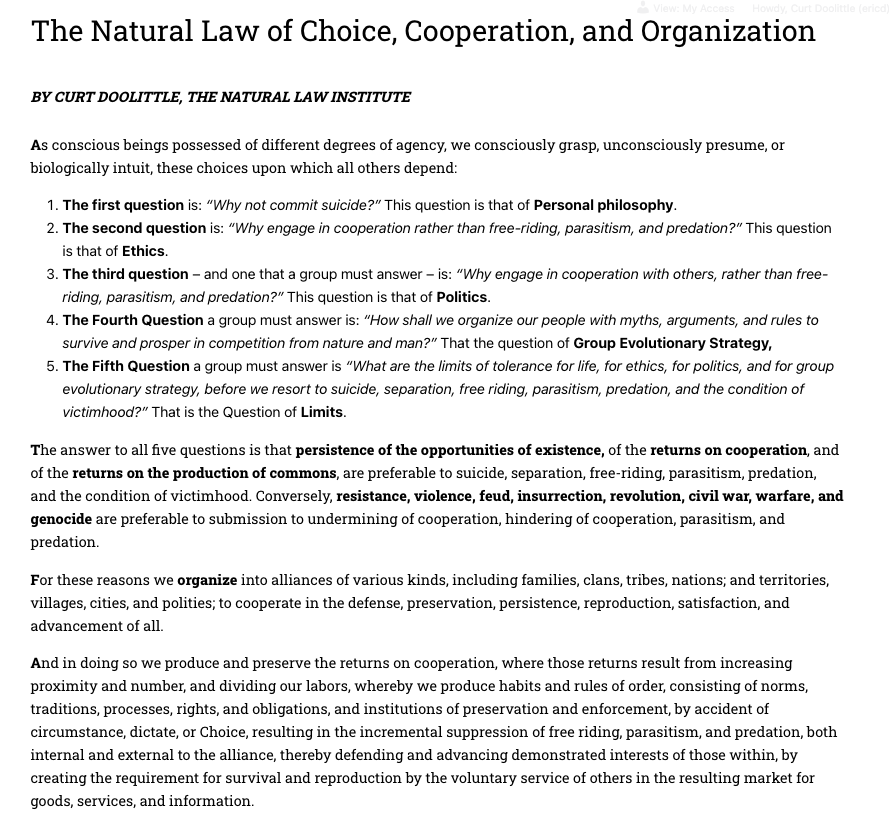
    THE NATURAL LAW OF CHOICE, COOPERATION AND ORGANIZATION
    (NLI: excerpt from our constitutional reforms)

    Historically, moral, social, economic, and political advocacy and philosophy have use the justificationary method of ‘justifying’ human behavior. In keeping with scientific… https://t.co/tCt1pIGy1N


    Source date (UTC): 2024-05-20 16:09:43 UTC

    Original post: https://twitter.com/i/web/status/1792588522060214466

  • THE NATURAL LAW OF CHOICE, COOPERATION AND ORGANIZATION (NLI: excerpt from our c

    THE NATURAL LAW OF CHOICE, COOPERATION AND ORGANIZATION
    (NLI: excerpt from our constitutional reforms)

    Historically, moral, social, economic, and political advocacy and philosophy have use the justificationary method of ‘justifying’ human behavior. In keeping with scientific falsification, in this short piece I try to reduce to first principles the reasons for the emergence of, necessity of, utility of, and preference for, Natural Law.

    These are The Five First Principles of Philosophy.


    Source date (UTC): 2024-05-20 16:09:42 UTC

    Original post: https://twitter.com/i/web/status/1792588521959460864

  • The Contribution of The Mises Institute and Libertarian Movement to Formalizing

    The Contribution of The Mises Institute and Libertarian Movement to Formalizing Natural Law

    I was active in the libertarian movement, then Mises Institute, then Property and Freedom Society for something more than a decade (I think… ;))
    But before and after that participation I have held a slightly different perspective: I work in power not persuasion, so I work in law, not philosophy.
    And there is something profound to be learned from that difference.
    Science, despite it’s strengths and weaknesses does eventually develop coherence within disciplines and correspondence with evidence in them, across them, and across the natural world (universe). In a perfect world we would iteratively discover the first principles of each science at ever scale of emergence of new possibilities (operations), such as physics, chemistry, biology et al (the disciplines). The discovery of these first principles is important to researchers in the production of evidence for further discovery of further opportunities for further knowledge.
    But, the discoveries in the sciences are important external to those disciplines in the production of decidability that allows us to pursue opportunities ourselves and for cooperation on one hand and the resolution of conflict on the other, by identifying ignorance, error, bias, pretenses, deceits, false promises, frauds, conspiracy, rent seeking, corruption, sedition and treason.
    Then in the falsification of falsehoods we require a science of decidability that can produce legal decidability, and thus laws, legislation, and regulation to prevent violations of our interests. And to understand our interests, you must understand at least behavioral economics, if for no other reason than the other behavioral sciences are not sciences but pseudosciences (factionalisms). We have evidence in both the record of legal cases and the record of economic behavior at all scales, and the record of survivability of polities, nations, federations, and empires at the largest scale.
    So a science of law must depend on laws of nature and human behavior within nature. And not discretionary law regardless of whether that discretion is performed by an individual a group or the entirety of the polity. So we require not only a that sciences produce the laws of nature, but that within that nature we require a science of the laws of cooperation and conflict to differentiate from arbitrarily man-made laws – one we traditionally call Natural Law.
    So you cannot understand a science of Natural Law without understanding Austrian economics, because Austrian economics is the closest to social science, because demonstrated interests (what we call property) is the foundation of cooperation, and cooperation is the foundation of social science, and economics (positiva) and law (negativa), and politics (positiva/negativa) if at all both empirical (non false), are the result of non variation from non violation of the natural law of tort, meaning the prohibition on imposition of costs on the demonstrated interests(property) of others – what libertarians oddly refer to as non-aggression.
    While I advocate that Rothbardian libertarianism and Anarcho Capitalism are impossible programs to bring into being for other than a diasporic subpopulation, and that Classical Liberalism and it’s Empirical Natural Law, empirical common law, and empirical concurrent legislation are necessary to form a sustainable and survivable polity under a condition of liberty that IS possible to bring into being – I still advocate the libertarian to anarcho-capitalism research program and the intellectual journey through libertarianism for as many as possible.
    The Misesian, Rothbardian, Hoppeian reduction of social science to property (demonstrated interests) to a value neutral scale independent system of measurement of both all individual action, and human interaction, and therefore all human behavior, by demarcating clearly the explanation of conflict, the explanation of conflict evasion, and the explanation of cooperation, and as a consequence of dispute resolution.
    Its also necessary (though I think Hoppe overstates) to produce an understanding and legal codification that prevents the lessons of the libertarian and anarchocapitalist research programs producing a system of measurement, that can be used to prevent the transformation of the Classical Liberalism’s “Commons-ism” into Progressivism, social democracy, socialism, and communism – each of which imposes more costs on individual demonstrated interests, and in doing so baits a population into irresponsibility for production and property, both private and common, and generates demand for authority to resolve conflicts that would not come into being if demonstrated interests were respected and respected because they were enforced.
    In my understanding, Hoppe’s most important contributions were:
    1. First, his explanation of monarchical responsibly as owners and politicians’ irresponsibility as renters, which, at the opposite end of the scale is no different from that of the populace toward the commons. and more so.
    2. And second, Hoppe’s formalism of the logic of property that by producing logical commensurability regardless of context and scale, reduced all social science to property (what I call demonstrated interests), but he did so under the research program (auspices) of limiting the definition of property (demonstrated interests) to the intersubjectively verifiable, meaning material things.
    3. Third, and in my opinion, most importantly, this emphasis Hoppe’s work and in the broader Rothbardian program, effectively formalized the foundations of natural law (of cooperation) for the first time converting it from the philosophical to the empirical to the operational – which is a term that the neither rather Kantian germanic framework Hoppe relies upon, or present philosophical libertarians are aware of, but should be since operations (actions), and construction (survival from falsification of) from first principles (irreducible causality, laws of nature), are the end point of scientific discoverty, producing a constructive logic that can falsify (and indirectly justify) any and all claims within a domain.
    And so the importance of Hoppe’s work, (of which unfortunately he favors promoting by Argumentation), is a profound contribution to intellectual history *IF* it is the foundation he discovered and articulated so completely that all social science, all economics, all law, and politics can be constructed in a single universally commensurable logic of decidability produced from first principles.
    And this combination of outcomes is my assessment of the durable value of the anarcho capitalist research program, even if the libertarian attempt to generalize this understanding into the possibility of an absence of the necessity to produce those commons that are necessary to produce and insure sovereignty and property – an ambition that is universal in the diasporic communities, precisely because they failed to produce survivable sovereignty because of their ideology, philosophy, religion, and customs preventing such commons at sufficient scale to preserve sovereignty.
    In other words libertarian and anarcho capitalist polities are unsurvivable because they depend on the commons produced by other polities, select for those members who those polities judge extract unearned gains (particularly baitings into hazard), and as such, eventually suppress those communities.
    The difference in survivability of polities then, is the production of common capital that indirectly reduces costs for all (capitalization) instead of direct redistribution of returns to all (consumption). Indirect wealth that fosters additional incentive for that responsibility for private and common and production.
    In addition, classical liberals seek to produce common physical and institutional capital, and Hayek added informal capital as a property (demonstrated interest), and I added informational capital (truth) as a demonstrated interests to prevent “fraud, baiting into hazard, deception, and lying in public to the public in matters public” there by producing the quality of information as a common asset upon which all in the commons depend.
    Oddly enough all this emphasis on truth, reciprocity, sovereignty, reciprocal insurance by duty to defend private and common, is just a continuation of the European group evolutionary strategy: where rule of law is the only possible means of cooperation at scale for pirates, raiders, and conquerors, whose mobility prevents the accumulation of fixed capital, whose warriors, raiders and pirates join the group as speculative investors (shareholders) are the only capital, and without the capacity to use rent on fixed capital, the leadership survives and governs by permission, obtained by volition, contract, and property.
    In my opinion, in three intellectual generations, between Mises and Rothbard (jewish diasporic value), Hoppe (german city state values), Hayek (anglo-germanic national values) and myself (anglo american imperial values) we have incrementally solved all of social science, at all four scales of community, polity, state, and federation (or empire), by converting what was otherwise merely a philosophy of advocacy to a science of indisputability, and in an operationally constructible science from first principles at that.
    As such, IMO, the Mises Institute should celebrate that success and claim victory perhaps more so than promoting anarcho capitalism alone, which is, and will continue to decline, as the ebullient optimism of the postwar era continues to dissipate with the end of the false promise of endless growth, the decline of freedom produced by European dominance, and not only the left’s absurd programs continue to crash into civilizational conflict.
    And regardless, the libertarian and Anarcho Capitalist programs offered insight as a stepping stone completing social science and allowing the formalization of natural law, and survivable polities restricted to preservation of liberty, while still producing capitalizing commons, reducing costs for all – thus preserving the most liberty that is possible to construct among human beings.
    Claim victory rather than claiming victimhood. 😉
    And make possible the pursuit of power instead of evasion. 😉
    Affections all, Thank you to MI and everyone in the movement. Cheers CD

    Source date (UTC): 2024-05-19 21:08:53 UTC

    Original post: https://x.com/i/articles/1792301422005944694

  • (harsh truth) All philosophies are class philosophies. The only solution to unif

    (harsh truth)
    All philosophies are class philosophies.

    The only solution to unifying these philosophies is science and law.
    The result is the natural law.


    Source date (UTC): 2024-05-18 23:56:57 UTC

    Original post: https://twitter.com/i/web/status/1791981333465465110

  • (harsh truth) All philosophies are class philosophies. The only solution to unif

    (harsh truth)
    All philosophies are class philosophies.

    The only solution to unifying these philosophies is science and law.
    The result is the natural law.


    Source date (UTC): 2024-05-18 23:56:57 UTC

    Original post: https://twitter.com/i/web/status/1791981333406748672

  • RT @curtdoolittle: @AutistocratMS @radiofreenw Opportunity is not a demonstrated

    RT @curtdoolittle: @AutistocratMS @radiofreenw Opportunity is not a demonstrated interest. It is a commons produced by the concentration of…


    Source date (UTC): 2024-05-16 06:06:44 UTC

    Original post: https://twitter.com/i/web/status/1790987227792560132

  • DISAMBIGUATION OF CONFLICT VS COMPETITION So you are trying to make the same poi

    DISAMBIGUATION OF CONFLICT VS COMPETITION
    So you are trying to make the same point that I used to undermine the libertarian presumption of cooperation, instead of “why don’t I kill you and take your stuff”.
    The reason is the dual use of the social term (rivalry) competition (together) into the commercial term, then applied to the natural sciences in the darwinian era.
    So whereas the ancient world was full of EITHER conflict through predation OR competition through cooperation, the use of the term competition under the darwinian revolution ‘made ambiguous’ the term competition by scaling it from a commercial particular to a universal in the common vernacular.

    Etymology
    The word “competition” comes from the Late Latin word “competitio” meaning “rivalry”. The word “compete” comes from the Late Latin word “competere” meaning “to strive together”

    Reply addressees: @radiofreenw


    Source date (UTC): 2024-05-15 15:08:53 UTC

    Original post: https://twitter.com/i/web/status/1790761277096112128

    Replying to: https://twitter.com/i/web/status/1790756097319383201