Category: Human Behavior and Cognitive Science

  • Is repentance is a self reflection that alters the course of action, similarly t

    Is repentance is a self reflection that alters the course of action, similarly to how altruistic punishment provokes retaliatory action? I am not sure how to operationally incorporate a self reflection. Or, are you saying we should, in the section on behavior, cover the suite of positives and negatives that manage guilt (debt) vs virtue (credit)? I mean, that’s what the ‘soul’ is – our self accounting of social debts and credits.

    Reply addressees: @evrydaydominion @WerrellBradley


    Source date (UTC): 2024-08-14 17:25:36 UTC

    Original post: https://twitter.com/i/web/status/1823772975268495362

    Replying to: https://twitter.com/i/web/status/1823755545129701394

  • Wife (Husband), Sexy (Sport-Fit), Below 14%Bf (Below 18%Bf) Cook (Fix Everything

    Wife (Husband),
    Sexy (Sport-Fit),
    Below 14%Bf (Below 18%Bf)
    Cook (Fix Everything, Maintain Everything),
    Mother (Father),
    Caretaker(Caretaker, especially erratic emotions),
    Businesswoman (Businessman, Athlete, Musician, etc)
    Hyperconsumer (Hyperproducer)
    Debt Creator (Debt Reducer)
    Hypergamous (Monogamous)
    Just Devoted Now (Loyal Later Anyway)
    Demanding (Tolerant)
    Never Happy (Usually Satisfied)

    And.. it goes downhill faster from there.

    Reply addressees: @GiaMMacool


    Source date (UTC): 2024-08-14 02:22:34 UTC

    Original post: https://twitter.com/i/web/status/1823545722031288320

    Replying to: https://twitter.com/i/web/status/1823385978829963414

  • Stereotypes are the most accurate measure in social science. (And of course, I w

    Stereotypes are the most accurate measure in social science.
    (And of course, I work on group and sex differences in lying for a living.)


    Source date (UTC): 2024-08-13 00:47:51 UTC

    Original post: https://twitter.com/i/web/status/1823159497692463611

    Reply addressees: @SilvermanJacob

    Replying to: https://twitter.com/i/web/status/1823158410050724033

  • The TLDR; Answer One cannot control one’s race and little more control over one’

    The TLDR; Answer
    One cannot control one’s race and little more control over one’s religion and culture – they are learned too early, forming too much of the base of the cognitive arbor.

    Activists, Intellectuals, Academics, Politicians, Bureaucrats, credentialists, virtue-signalers DO have control over causing admixture of people of different races, religions, and cultures. And it’s in their interest to create conflict only authority (them) can provide.

    As such solving the problem of the people who make the problem is different from criticizing the involuntary in the hope one can convert them, OR that the above mentioned self interested parties will somehow work against their interests and in favor of yours.

    In other words,, attacking the little people doesn’t help the platform assist in influencing the commons, but attacking the creators of the problem helps the platform in its mission of influencing the commons.

    In other words, fight the right battle. Otherwise you’re a sucker for the left’s baiting you into hazard, making you the problem not the elites who create the problem.

    Cheers
    CD

    Reply addressees: @CesarMarsais @jewamongyou


    Source date (UTC): 2024-08-12 20:37:35 UTC

    Original post: https://twitter.com/i/web/status/1823096517135130624

    Replying to: https://twitter.com/i/web/status/1823088531398398223

  • Jon Haidt (@JonHaidt) with his usual compassionate delivery of uncomfortable but

    Jon Haidt (@JonHaidt) with his usual compassionate delivery of uncomfortable but honest explanations and criticisms, takes on the delay and destruction of the development of executive function by phone and social media in everyone born after 1996.

    Watch him on Triggernometry:
    https://t.co/tyTtBfItT2

    I want to emphasize his correct framing and diagnosis: the impediment of the development of executive function: this is producing the failure of cognitive adulthood because their social and self regulatory ability doesn’t exist.

    ~”There is no way to make the time children spend on the phone better for them and safety for them. It can’t be done.”~

    ~”The norm needs to be the organic development of executive function through the end of puberty – where the prefrontal cortex is formed from 11-25.”~

    I’ll address what I’ve discovered in my own work in a repost of this one in order to maintain emphasis on Jon’s work.

    Cheers
    CD


    Source date (UTC): 2024-08-12 05:22:20 UTC

    Original post: https://twitter.com/i/web/status/1822866186532425728

  • Jon Haidt (@JonHaidt) with his usual compassionate delivery of uncomfortable but

    Jon Haidt (@JonHaidt) with his usual compassionate delivery of uncomfortable but honest explanations and criticisms, takes on the delay and destruction of the development of executive function by phone and social media in everyone born after 1996.

    Watch him on Triggernometry:
    https://t.co/tyTtBfItT2

    I want to emphasize his correct framing and diagnosis: the impediment of the development of executive function: this is producing the failure of cognitive adulthood because their social and self regulatory ability doesn’t exist.

    ~”There is no way to make the time children spend on the phone better for them and safety for them. It can’t be done.”~

    ~”The norm needs to be the organic development of executive function through the end of puberty – where the prefrontal cortex is formed from 11-25.”~

    I’ll address what I’ve discovered in my own work in a repost of this one in order to maintain emphasis on Jon’s work.

    Cheers
    CD


    Source date (UTC): 2024-08-12 03:47:30 UTC

    Original post: https://twitter.com/i/web/status/1822842318891720704

  • “CURT: Q: How is ego death caused by hallucinogens?”– 1) Primarily, by overridi

    –“CURT: Q: How is ego death caused by hallucinogens?”–

    1) Primarily, by overriding one of the serotonin receptors widely used in the brain, and particularly in perception, cognition, and mood, causing overstimulation of the networks overcoming existing pathways in both inhibitory and excitatory neurons.

    2) As a result, a disruption of the Default Mode Network (your ‘frames of reference’ when you’re at rest) – thinking, daydreaming, and the sense of self that results from the patterns in that default (dominant) network.

    3) Next, given that the brain is composed of neurons that both individually and collectively produce a prediction engine, where down in the hippocampal region, episodic memory continuously formed, and auto-associates all current stimuli in time and space to past episodes and their components and features, the result of network disruption is a decrease in ability for, and reliance on, prediction – and an increased dependence upon and emphasis of sensory stimuli.

    4) As a result, without the previous ‘frictions’ (think adding more voltage or current) we experience increased brain activity (‘Well, with all this traffic let’s take the back roads and explore!’) breaking down the isolation of habitual networks, making possible novel thoughts, and even leading to the comingling of senses (synesthesia). So the brain makes different associations whether past, present, or anticipated future, allowing for different valuations and relations between networks that form the elaborate set of relations between memories.

    5) Resulting in a feeling of disassociation from the prior ‘self’ (that set of default networks, memories, and valuations, past present and future) whether within the self or between the self and the outside world.

    6) As a result, these hallucinogens also affect the balance between excitatory and inhibitory neurotransmitters – changing synaptic plasticity (adaptability), amplifying or inhibiting signals as a consequence and this further degrades the ability for the brain to form the complex networks necessary to preserve the default modes and default networks that create the sense of ‘stability’ of self (measurements) over time, and increasing disassociation.

    7) The result of that disassociation is the possibility of forming different associations between sense, perception, valuation, experience, and memory, as a result – meaning there are fewer roadblocks – particularly valuative and emotional, thereby ‘resetting’ your default network’s system of ‘measurement’ – into a new state of ‘homeostasis’ (resting state) usually a more ‘calm’ state. And this process can be employed multiple times if necessary.

    8) Why? Because in this calm state of disassociation, all new associations favor concurrency with this state. This is the reason why the environment and people you share ‘disassociation with’ has such an influence on your hallucinogenic experience: whatever state you disassociate into will form the emotional and valuative ‘system of measurement’ that new network associations seek to agree upon “commensurability, coherence, consensus, cognitive-emotional homeostasis”. (Terms I use often.)

    9) Keep In Mind:
    So I want to restate the obvious for those who understand the extraordinary value of medical use of hallucinogens: It’s the relationship between your environment, the people in it, and your current emotional state that the hallucinogens allow you to adapt to. Hence the success of clinics in creating rooms that are oddly reminiscent versions of 1970’s positive sensory stimulation and reprogramming rooms so to speak. Or, for those more dependent on social regulation, positive feelings of people around you sharing the same experience.

    10) Ego death is the result of breaking down default networks and systems of measurement that you percieve as ‘yourself’ and causes you to rely on present sensory stimuli, and in doing so cause your brain to attempt to create new stable networks (homeostasis) under the new conditions, that will persist after the hallucinogens have worn off. As this process is incremental it may require multiple sessions in the right conditions to migrate these neworks. And that migration can only occur if one reaches the state of disassociation.

    Neurologically it’s not that complicated. The brain is organized to sense the current state and seek bodily homeostasis by predicting the changes in the mind and body necessary to restore homeostasis. The hard part is providing a means for it to do so quickly and easily. And it turns out, well, we found one. 😉

    I’m sure someone has written this same operational description before though I haven’t encountered it. And the academic literature often misses the point – the audience wants to understand the operational (mechanical) means by which these processes work, not the biochemical which they cannot sense and perceive.

    So I hope you found this useful. It’s not magical. In fact it’s rather ordinary – at least, once you understand it.

    Cheers All
    CD

    Reply addressees: @partymember55

    Source date (UTC): 2024-08-12 00:55:32 UTC

    Original post: https://twitter.com/i/web/status/1822799041379323904

    Replying to: https://twitter.com/i/web/status/1822775865186422900

  • HOW ARE THE BRAINS OF PSYCHOPATHS DIFFERENT? (a) Lower grey matter and lower whi

    HOW ARE THE BRAINS OF PSYCHOPATHS DIFFERENT?
    (a) Lower grey matter and lower white matter density in the orbitofrontal cortex and anterior insula. (common in all antisocial behavior). IMO the cause.
    (b) Decreased size of empathy and moral reasoning regions (ventromedial prefrontal cortex, orbitofrontal cortex). IMO probably a consequence.
    (c) Larger striatum (cognition, motor, action planning, decision making) Common in egotistical and antisocial behaviors. IMO a consequence.

    Suggests late stage failure of development and as such retention of pre-modern human cognitive features of the brain. (Failures of domestication syndrome). So where autism is a property of compartmentalization, and psychosis a failure of compartmentalization, similarly, it appears that common female misplaced empathy (which is endemic) is mirrored by absence of empathy (sociopathy/psychopathy).

    So just as there is value to the autism spectrum and the solipsistic spectrum, there is value to the sociopathy and misplaced empathy spectrum.

    Nature doesn’t so much have a recipe as evolution explores the limits until it finds one some way to benefit by crossing them.

    IMO the autistic spectrum is as deterministic an evolutionary outcome as is consciousness. it’s the direction of human evolution.

    Cheers

    Reply addressees: @patriciamdavis


    Source date (UTC): 2024-08-11 19:02:14 UTC

    Original post: https://twitter.com/i/web/status/1822710133161385985

    Replying to: https://twitter.com/i/web/status/1822703216137794010

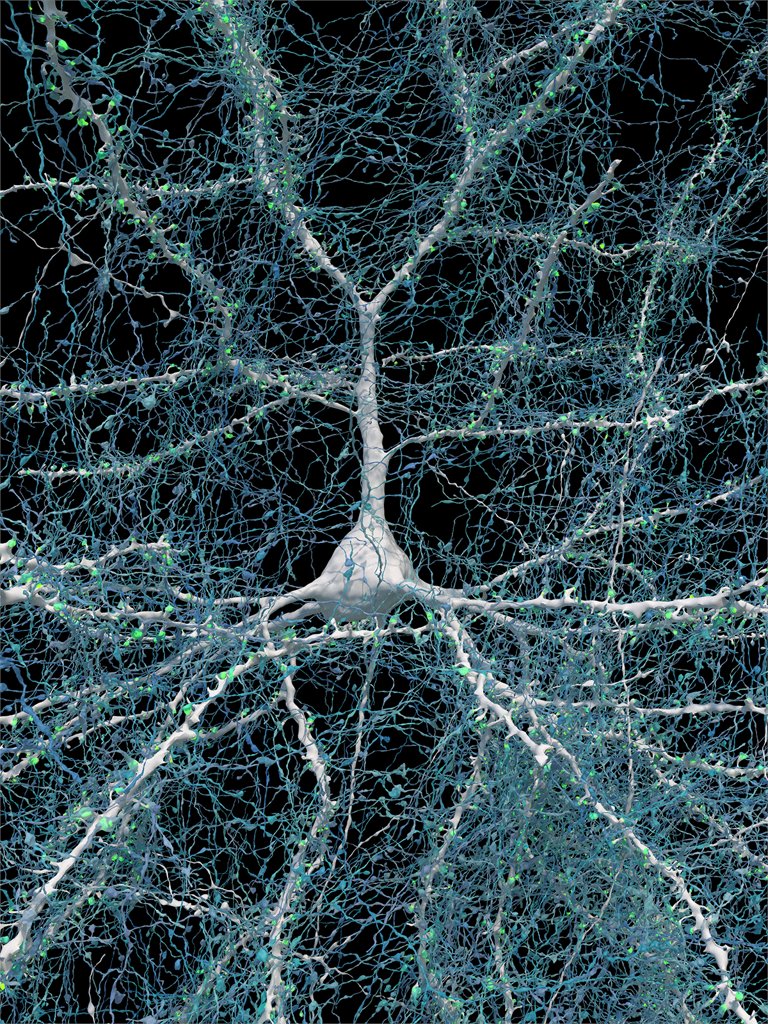
  • A Single Neuron’s Connections

    A Single Neuron’s Connections

    A Single Neuron’s Connections https://t.co/7ZogxWOs7P


    Source date (UTC): 2024-08-11 07:49:32 UTC

    Original post: https://twitter.com/i/web/status/1822540843711860819

  • RT @cremieuxrecueil: I’m delighted to see my charts have been posted in response

    RT @cremieuxrecueil: I’m delighted to see my charts have been posted in response to this multiple times.

    If you look at American PISA perf…


    Source date (UTC): 2024-08-10 20:03:09 UTC

    Original post: https://twitter.com/i/web/status/1822363073916932488