Category: Human Behavior and Cognitive Science

  • RT @chaseaustin888: I think it’s insane that women literally killed an entire ge

    RT @chaseaustin888: I think it’s insane that women literally killed an entire generation of mens desire to talk to and date them. Every man…


    Source date (UTC): 2025-02-05 03:43:12 UTC

    Original post: https://twitter.com/i/web/status/1886983891535491566

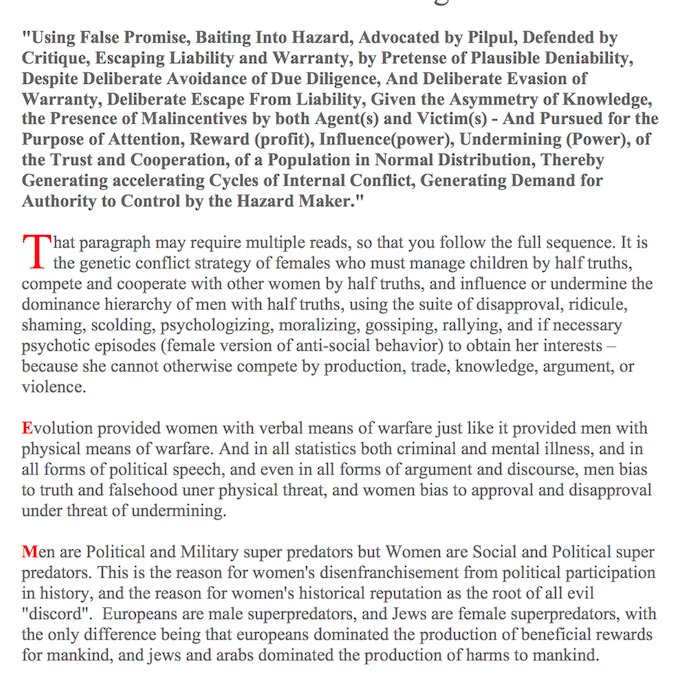
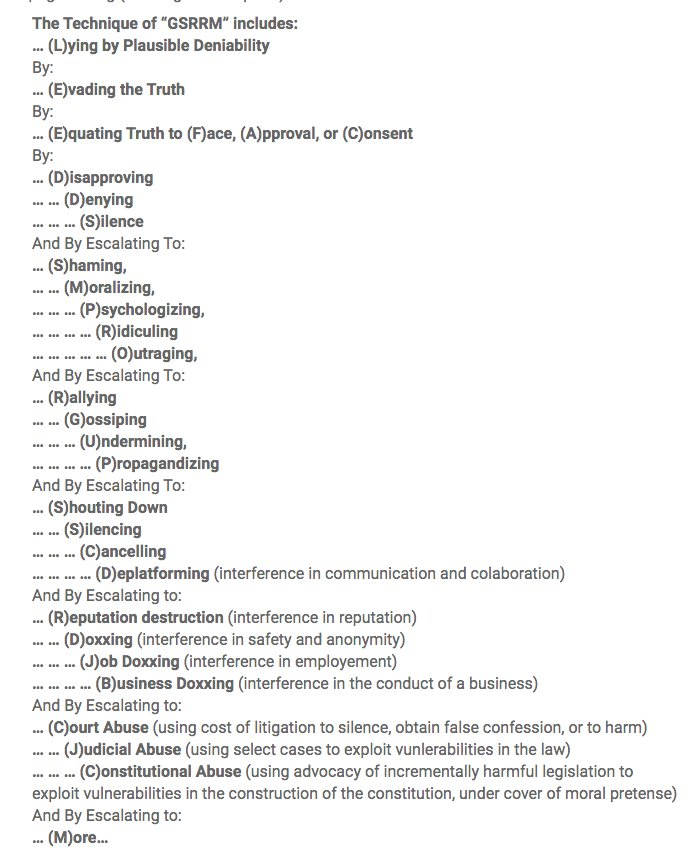
  • In the context of Curt Doolittle’s work, GSRRM stands for Gossiping, Shaming, Ra

    In the context of Curt Doolittle’s work, GSRRM stands for Gossiping, Shaming, Ra

    In the context of Curt Doolittle’s work, GSRRM stands for Gossiping, Shaming, Rallying, and Moralizing. This acronym is not related to gender, sexual, and romantic minorities but instead describes what Doolittle refers to as a “female competitive strategy” or a method of social… https://t.co/KvBilaLVzX


    Source date (UTC): 2025-02-04 01:34:21 UTC

    Original post: https://twitter.com/i/web/status/1886589077518201048

  • RT @curtdoolittle: @melodyolenski @canadianaco @JeanMarcNoelB @TrumpDailyPosts N

    RT @curtdoolittle: @melodyolenski @canadianaco @JeanMarcNoelB @TrumpDailyPosts No. I merely specialize in sex differences in perception cog…


    Source date (UTC): 2025-02-03 15:45:11 UTC

    Original post: https://twitter.com/i/web/status/1886440807802265890

  • No. I merely specialize in sex differences in perception cognition, expression,

    No. I merely specialize in sex differences in perception cognition, expression,

    No. I merely specialize in sex differences in perception cognition, expression, argument, deceit, and sedition.

    You do not even realize that both your original reply and this one are canonical female means of deception.

    You can either explain human behavior as rational… https://t.co/kXQUkRciXZ


    Source date (UTC): 2025-02-03 15:44:38 UTC

    Original post: https://twitter.com/i/web/status/1886440670883389817

    Replying to: https://twitter.com/i/web/status/1886430623314927639

  • Sandi: only women and immature men childishly attribute to emotion that which is

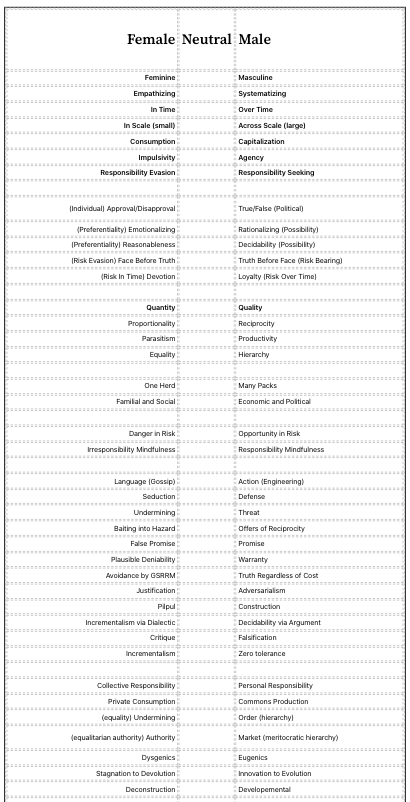
    Sandi: only women and immature men childishly attribute to emotion that which is economic, political and strategic in value.


    Source date (UTC): 2025-02-03 14:53:07 UTC

    Original post: https://twitter.com/i/web/status/1886427706012950981

    Reply addressees: @melodyolenski @canadianaco @JeanMarcNoelB @TrumpDailyPosts

    Replying to: https://twitter.com/i/web/status/1886410350960275665

  • A Bibliography for Neotenic Evolution and Domestication Syndrome In my work I co

    A Bibliography for Neotenic Evolution and Domestication Syndrome

    In my work I cover neotenic evolution and domestication syndrome in detail, from the regulation of the migration of stem cells from the neural tube, to the exchange of pedomorphism for extending adaptability, maturity, and life, to isolation and speciation under pressure for cooperation in increasingly cold or isolate conditions. I have collected this information over decades, and I”m asked for a reading list regularly. (I just don’t believe many people would do the work of reading it. 😉 ) This is a list of references I’ve collected via perplexity and chatgpt that I think get the ideas across without going too far into the biochemistry and neuroscience that the reader will be lost.
    Summary:
    The domestication syndrome, as observed in both animals and humans, has been linked to alterations in
    neural crest cell migration—a fundamental process in embryonic development. These changes lead to a suite of morphological and behavioral traits, such as reduced aggression, juvenile facial features, and increased social tolerance. Research suggests that selection for tameness results in milder cranial features, smaller teeth, depigmentation, and even altered stress responses, due to reductions in neural crest-derived tissues. Understanding how stem cells regulate development is crucial to explaining why selection for behavioral traits leads to physical changes as well.
    Key Sources:
    • Hall, Brian K. Evolutionary Developmental Biology. Springer, 1999.
    • Le Douarin, Nicole M., and Chaya Kalcheim. The Neural Crest. Cambridge University Press, 1999.
    • Wilkins, Adam S., Richard W. Wrangham, and W. Tecumseh Fitch. “The ‘Domestication Syndrome’ in Mammals: A Unified Explanation Based on Neural Crest Cell Behavior and Genetics.” Genetics, vol. 197, no. 3, 2014, pp. 795-808.
    • Sánchez-Villagra, Marcelo R., and Qian Wu. “Neotenic Features and Evolutionary Developmental Biology in Mammals.” Biological Reviews, vol. 96, no. 5, 2021, pp. 2066-2086.
    Summary:
    Neoteny—the retention of juvenile traits into adulthood—has played a major role in human evolution. Compared to other primates, humans have
    extended periods of brain plasticity, social learning, and behavioral flexibility, making us more adaptable to changing environments. Pedomorphism (juvenile-like morphology) is correlated with prolonged social dependency, greater learning capacity, and increased cooperative tendencies. This literature explores how slower maturation (heterochrony) affects cognition, social behavior, and even morality.
    Key Sources:
    • Gould, Stephen Jay. Ontogeny and Phylogeny. Harvard University Press, 1977.
    • Shea, Brian T. “Ontogenetic Scaling of the Fetal Skull in Primates.” American Journal of Physical Anthropology, vol. 73, 1987, pp. 69-79.
    • Leigh, Steven R. “Brain Growth, Life History, and Cognition in Primate and Human Evolution.” American Journal of Primatology, vol. 62, no. 3, 2004, pp. 139-164.
    • Cieri, Robert L., et al. “Craniofacial Feminization, Social Tolerance, and the Origins of Behavioral Modernity.” Current Anthropology, vol. 55, no. 4, 2014, pp. 419-443.
    Summary:
    Domestication alters both physical and behavioral traits. Across species, domesticated animals exhibit
    tamer temperaments, smaller brains, and prolonged juvenile behaviors compared to their wild counterparts. Genetic studies of self-domestication in humans suggest that selection for reduced aggression and increased social bonding had significant downstream effects on cranial morphology, stress physiology, and even hormone regulation. Domesticated traits appear to emerge from selection for reduced reactive aggression, leading to increased intraspecies cooperation.
    Key Sources:
    • Trut, Lyudmila N., et al. How to Tame a Fox (and Build a Dog). University of Chicago Press, 2017.
    • Hare, Brian, et al. “The Self-Domestication Hypothesis: Evolution of Bonobo Psychology is Due to Selection Against Aggression.” Animal Behaviour, vol. 83, no. 3, 2012, pp. 573-585.
    • Sánchez-Villagra, Marcelo R., and Qian Wu. “The Evolutionary Developmental Biology of Domestication: A Modern Synthesis.” Nature Ecology & Evolution, vol. 5, no. 10, 2021, pp. 1353-1363.
    • Albert, F. W., and T. F. C. Mackay. “The Genetics of Domestication: Insights from Genomic Approaches.” Annual Review of Genetics, vol. 52, 2018, pp. 223-245.
    Summary:
    Isolated populations under extreme environmental pressures tend to undergo
    speciation and behavioral specialization. Cold climates select for greater cooperative behaviors, as survival depends on coordinated effort rather than individual competition. Some argue that European and East Asian populations show higher degrees of self-domestication traits, possibly as a result of isolation-driven social selection. This literature examines how environmental selection pressures shape cooperative intelligence, social norms, and risk tolerance.
    Key Sources:
    • Finlayson, Clive. The Humans Who Went Extinct: Why Neanderthals Died Out and We Survived. Oxford University Press, 2009.
    • Wrangham, Richard. The Goodness Paradox: The Strange Relationship Between Virtue and Violence in Human Evolution. Pantheon Books, 2019.
    • Boehm, Christopher. Moral Origins: The Evolution of Virtue, Altruism, and Shame. Basic Books, 2012.
    • Hare, Brian, and Michael Tomasello. “Human Altruism and Evolutionary Self-Domestication.” Proceedings of the National Academy of Sciences, vol. 106, no. 52, 2009, pp. 21431-21432.
    Summary:
    Neoteny is directly linked to
    enhanced cognitive flexibility, extended learning periods, and complex social cognition. Humans exhibit greater emotional control, cooperative decision-making, and delayed gratification than other primates, traits associated with self-domestication. The literature here explores how evolutionary pressures shaped human intelligence, morality, and the emergence of complex societies. By retaining juvenile cognitive plasticity into adulthood, humans achieve higher levels of abstraction, language, and theory of mind.
    Key Sources:
    • Geary, David C. Male, Female: The Evolution of Human Sex Differences. American Psychological Association, 1998.
    • Spikins, Penny. The Prehistory of Compassion. Pen & Sword Books, 2015.
    • Tomasello, Michael. Becoming Human: A Theory of Ontogeny. Harvard University Press, 2019.
    • Sterelny, Kim. The Evolved Apprentice: How Evolution Made Humans Unique. MIT Press, 2012.
    This bibliography provides an optimal balance between books and journal articles, covering developmental biology, evolutionary theory, genetics, anthropology, and psychology.
    It also offers a structured roadmap for exploring how neotenic evolution and domestication shape morphology, behavior, cognition, and cooperation. Readers can start with foundational texts, then branch out into specialized literature.

    Cheers
    CD

    Source date (UTC): 2025-02-03 02:35:10 UTC

    Original post: https://x.com/i/articles/1886241994793746658

  • In my work I cover neotenic evolution and domestication syndrome in detail, from

    In my work I cover neotenic evolution and domestication syndrome in detail, from the regulation of the migration of stem cells from the neural tube, to the exchange of pedomorphism for extending adaptability, maturity, and life, to isolation and speciation under pressure for cooperation in increasingly cold or isolate conditions. I have collected this information over decades, and I”m asked for a reading list regularly. (I just don’t believe many people would do the work of reading it. 😉 ) This is a list of references I’ve collected via perplexity and chatgpt that I think get the ideas across without going too far into the biochemistry and neuroscience that the reader will be lost.

    1. Evolutionary Developmental Biology (Evo-Devo) & Neural Crest Migration

    Summary:
    The domestication syndrome, as observed in both animals and humans, has been linked to alterations in neural crest cell migration—a fundamental process in embryonic development. These changes lead to a suite of morphological and behavioral traits, such as reduced aggression, juvenile facial features, and increased social tolerance. Research suggests that selection for tameness results in milder cranial features, smaller teeth, depigmentation, and even altered stress responses, due to reductions in neural crest-derived tissues. Understanding how stem cells regulate development is crucial to explaining why selection for behavioral traits leads to physical changes as well.

    Key Sources:

    Hall, Brian K. Evolutionary Developmental Biology. Springer, 1999.

    Le Douarin, Nicole M., and Chaya Kalcheim. The Neural Crest. Cambridge University Press, 1999.

    Wilkins, Adam S., Richard W. Wrangham, and W. Tecumseh Fitch. “The ‘Domestication Syndrome’ in Mammals: A Unified Explanation Based on Neural Crest Cell Behavior and Genetics.” Genetics, vol. 197, no. 3, 2014, pp. 795-808.

    Sánchez-Villagra, Marcelo R., and Qian Wu. “Neotenic Features and Evolutionary Developmental Biology in Mammals.” Biological Reviews, vol. 96, no. 5, 2021, pp. 2066-2086.

    2. Pedomorphism, Neoteny & Extended Development

    Summary:
    Neoteny—the retention of juvenile traits into adulthood—has played a major role in human evolution. Compared to other primates, humans have extended periods of brain plasticity, social learning, and behavioral flexibility, making us more adaptable to changing environments. Pedomorphism (juvenile-like morphology) is correlated with prolonged social dependency, greater learning capacity, and increased cooperative tendencies. This literature explores how slower maturation (heterochrony) affects cognition, social behavior, and even morality.

    Key Sources:

    Gould, Stephen Jay. Ontogeny and Phylogeny. Harvard University Press, 1977.

    Shea, Brian T. “Ontogenetic Scaling of the Fetal Skull in Primates.” American Journal of Physical Anthropology, vol. 73, 1987, pp. 69-79.

    Leigh, Steven R. “Brain Growth, Life History, and Cognition in Primate and Human Evolution.” American Journal of Primatology, vol. 62, no. 3, 2004, pp. 139-164.

    Cieri, Robert L., et al. “Craniofacial Feminization, Social Tolerance, and the Origins of Behavioral Modernity.” Current Anthropology, vol. 55, no. 4, 2014, pp. 419-443.

    3. Domestication Syndrome, Behavior, and Genetics

    Summary:
    Domestication alters both physical and behavioral traits. Across species, domesticated animals exhibit tamer temperaments, smaller brains, and prolonged juvenile behaviors compared to their wild counterparts. Genetic studies of self-domestication in humans suggest that selection for reduced aggression and increased social bonding had significant downstream effects on cranial morphology, stress physiology, and even hormone regulation. Domesticated traits appear to emerge from selection for reduced reactive aggression, leading to increased intraspecies cooperation.

    Key Sources:

    Trut, Lyudmila N., et al. How to Tame a Fox (and Build a Dog). University of Chicago Press, 2017.

    Hare, Brian, et al. “The Self-Domestication Hypothesis: Evolution of Bonobo Psychology is Due to Selection Against Aggression.” Animal Behaviour, vol. 83, no. 3, 2012, pp. 573-585.

    Sánchez-Villagra, Marcelo R., and Qian Wu. “The Evolutionary Developmental Biology of Domestication: A Modern Synthesis.” Nature Ecology & Evolution, vol. 5, no. 10, 2021, pp. 1353-1363.

    Albert, F. W., and T. F. C. Mackay. “The Genetics of Domestication: Insights from Genomic Approaches.” Annual Review of Genetics, vol. 52, 2018, pp. 223-245.

    4. Cold Climate, Isolation & Speciation Pressures on Cooperation

    Summary:
    Isolated populations under extreme environmental pressures tend to undergo speciation and behavioral specialization. Cold climates select for greater cooperative behaviors, as survival depends on coordinated effort rather than individual competition. Some argue that European and East Asian populations show higher degrees of self-domestication traits, possibly as a result of isolation-driven social selection. This literature examines how environmental selection pressures shape cooperative intelligence, social norms, and risk tolerance.

    Key Sources:

    Finlayson, Clive. The Humans Who Went Extinct: Why Neanderthals Died Out and We Survived. Oxford University Press, 2009.

    Wrangham, Richard. The Goodness Paradox: The Strange Relationship Between Virtue and Violence in Human Evolution. Pantheon Books, 2019.

    Boehm, Christopher. Moral Origins: The Evolution of Virtue, Altruism, and Shame. Basic Books, 2012.

    Hare, Brian, and Michael Tomasello. “Human Altruism and Evolutionary Self-Domestication.” Proceedings of the National Academy of Sciences, vol. 106, no. 52, 2009, pp. 21431-21432.

    5. Cognitive & Social Evolution: The Neotenic Mind

    Summary:
    Neoteny is directly linked to enhanced cognitive flexibility, extended learning periods, and complex social cognition. Humans exhibit greater emotional control, cooperative decision-making, and delayed gratification than other primates, traits associated with self-domestication. The literature here explores how evolutionary pressures shaped human intelligence, morality, and the emergence of complex societies. By retaining juvenile cognitive plasticity into adulthood, humans achieve higher levels of abstraction, language, and theory of mind.

    Key Sources:

    Geary, David C. Male, Female: The Evolution of Human Sex Differences. American Psychological Association, 1998.

    Spikins, Penny. The Prehistory of Compassion. Pen & Sword Books, 2015.

    Tomasello, Michael. Becoming Human: A Theory of Ontogeny. Harvard University Press, 2019.

    Sterelny, Kim. The Evolved Apprentice: How Evolution Made Humans Unique. MIT Press, 2012.

    Final Thoughts

    This bibliography provides an optimal balance between books and journal articles, covering developmental biology, evolutionary theory, genetics, anthropology, and psychology.

    It also offers a structured roadmap for exploring how neotenic evolution and domestication shape morphology, behavior, cognition, and cooperation. Readers can start with foundational texts, then branch out into specialized literature.

    Cheers
    CD

    Source date (UTC): 2025-02-03 02:30:08 UTC

    Original post: https://x.com/i/articles/1886240726255824896

  • RT @Elton_Sahlberg: @curtdoolittle The Masculine Cognition scans sentences for u

    RT @Elton_Sahlberg: @curtdoolittle The Masculine Cognition scans sentences for useful content (Truth) and the Feminine Cognition scans sent…


    Source date (UTC): 2025-02-02 20:06:40 UTC

    Original post: https://twitter.com/i/web/status/1886144223990391123

  • DEI VS THE TERNARY LOGIC OF MAN WOMAN AND CHILD –“DEI (essentially feminism) is

    DEI VS THE TERNARY LOGIC OF MAN WOMAN AND CHILD

    –“DEI (essentially feminism) is an MIA condition. It’s the absence of everyone’s binary competence. Man, woman and child.
    DEI is essentially feminism. Feminism is the unbridled escalation of ternary incompetence — man, woman and… https://twitter.com/truthb4face/status/1886119455895306514


    Source date (UTC): 2025-02-02 19:38:20 UTC

    Original post: https://twitter.com/i/web/status/1886137094332109036

  • Q: @curtdoolittle: “Did the perception of cuteness in humans evolve as an adapti

    –Q: @curtdoolittle: “Did the perception of cuteness in humans evolve as an adaptive survival mechanism to increase offspring care and social bonding?”–

    Emergence: Breast-feeding: Oxytocin: Protection of offspring: notenic extension of childhood in order to manifeste prefrontal agency: social bonding: cooperation, cooperation at scale.
    “Cuteness” refers to a sensation in response to preservation of neotenic traits and the manifestation as agreeableness and charm instead of aggression. Domestication syndrome. 😉

    So, yes. 😉

    CD

    Reply addressees: @partymember55


    Source date (UTC): 2025-02-02 19:08:04 UTC

    Original post: https://twitter.com/i/web/status/1886129475450236928

    Replying to: https://twitter.com/i/web/status/1886126010682224894