Category: Epistemology and Method

  • NO REALITY ISN’T SUBJECTIVE, IT’S OBJECTIVE – THATS WHAT REALITY MEANS: OBJECTIV

    NO REALITY ISN’T SUBJECTIVE, IT’S OBJECTIVE – THATS WHAT REALITY MEANS: OBJECTIVE
    Reality like truth is that which exists and persists independent of subjective perception and opinion.
    Ergo, your simulation of reality is just whatever you know projected upon that which you can directly sense and perceive at the moment (some subset of reality).
    By claiming it’s whatever you know, you’re saying the equivalent of Jordan Peterson’s absurd claim that utilitarian truth (true enough for me to act with the knowledge, error, and ignorance I possess) is equal to demonstrable truth (true enough to resolve differences, forcibly if necessary, between subjective projections upon the subset of reality that you can sense and perceive.
    Cheers

    Reply addressees: @Gyeff0 @ScottAdamsSays


    Source date (UTC): 2024-04-22 14:48:15 UTC

    Original post: https://twitter.com/i/web/status/1782421162275876864

    Replying to: https://twitter.com/i/web/status/1782416591545610384

  • PSEUDOSCIENCES Technically speaking the reason I started working on epistemology

    PSEUDOSCIENCES
    Technically speaking the reason I started working on epistemology, beginning with the sciences, was due to exasperation with nonsense on media:
    Physics: As absurd as it sounds, physics went sideways with Cantor, Einstein, Bohr’s re-platonizing of mathematics in physics, the ‘mathiness’ and the Particles in Everything, and string theory nonsense that resulted in the failure of physics over the past seventy years or more.
    Diet: Other than eating paleo, drinking a lot of water, and exercise, even if just walking daily, and a bit less frequently lifting weights, and optimally playing team sports even less frequently, almost all dietary claims have been false.
    Psychology: Other than behavioral economics, a minority of the work on personality traits and intelligence, and neuroscience, most of it’s been false and quite a bit’s been harmful.
    Sociology: Other than behavioral, micro, and social economics, most has been false and quite a bit’s been harmful.
    Political Science: Other than political economy, and contemporary natural law, almost all of it’s been false, and almost all of it’s been harmful.
    Economics: Other than the descriptive economics that I’ve already mentioned, almost all of it has been harmful and baited populations into hazard resulting in the empowerment of and rent seeking by the financial and political sectors of the economy.
    Group Differences: was suppressed so the pseudoscience that evolved were the inversion – the claim that there were none or that they could be ameliorated without extensive eugenics – and this happens to be the worst pseudoscience of all.

    Other than diet, every one of those pseudosciences has it’s origins in the jewish to marxist sequence of revolts against european systematic materialism and it’s replacement with pictoral, and emotional, verbalisms.

    Cheers


    Source date (UTC): 2024-04-21 15:08:57 UTC

    Original post: https://twitter.com/i/web/status/1782063982276145152

  • RT @curtdoolittle: @sudovatnik @GearMentation @RokoMijic My work uses Constructi

    RT @curtdoolittle: @sudovatnik @GearMentation @RokoMijic My work uses Constructive Operationalism, or a constructive logic of operational t…


    Source date (UTC): 2024-04-18 11:07:49 UTC

    Original post: https://twitter.com/i/web/status/1780916136558694678

  • My work uses Constructive Operationalism, or a constructive logic of operational

    My work uses Constructive Operationalism, or a constructive logic of operational transformations – which for brevity I shorten to ‘operationalism’ and probably shouldn’t.

    Constructive operationalism is a methodology that defines concepts in terms of the specific sequence of…


    Source date (UTC): 2024-04-18 11:07:41 UTC

    Original post: https://twitter.com/i/web/status/1780916101364187365

    Reply addressees: @sudovatnik @GearMentation @RokoMijic

    Replying to: https://twitter.com/i/web/status/1780755763629346839

  • My work uses Constructive Operationalism, or a constructive logic of operational

    My work uses Constructive Operationalism, or a constructive logic of operational transformations – which for brevity I shorten to ‘operationalism’ and probably shouldn’t.

    Constructive operationalism is a methodology that defines concepts in terms of the specific sequence of constructive operations required to generate or instantiate them from first principles. It emphasizes the algorithmic nature of reality, viewing phenomena as the result of step-by-step processes or computations that transform inputs into outputs or one state into another.

    Key principles of constructive operationalism:

    Constructive definitions: Concepts are defined in terms of the specific sequence of constructive operations or algorithms that generate or instantiate them from first principles. These operations are grounded in physical reality and can be computationally, chemically, biologically, or cognitively realized.
    Algorithmic nature of reality: Reality is viewed as fundamentally algorithmic, with phenomena arising from the execution of specific sequences of constructive operations or state transformations.
    Step-by-step construction: Phenomena are explained by specifying the precise sequence of constructive operations that generate them, emphasizing the step-by-step nature of the process and the transformation of inputs into outputs.
    Constructed from first principles: The constructive operations are derived from a set of first principles, which serve as the foundational building blocks for generating more complex concepts and phenomena.
    Falsifiability: Constructive operational definitions are subject to rigorous falsification tests, with the ability to withstand attempts at refutation serving as a key criterion for their validity and reliability.
    Emphasis on generative mechanisms: Explanations focus on the generative mechanisms or constructive processes that give rise to phenomena, providing a causal understanding of how things come to be.
    Avoidance of abstract entities: Constructive operationalism avoids invoking abstract or Platonic entities, grounding concepts and explanations in concrete, physically realizable operations and processes.

    Constructive operationalism builds upon the insights of intuitionism and operationalism, but distinguishes itself by emphasizing the constructive, generative nature of concepts and phenomena. It goes beyond mere measurement procedures to specify the precise sequence of operations required to construct concepts from first principles.

    By grounding definitions in physical processes and subjecting them to falsification tests, constructive operationalism seeks to provide a more rigorous, causally grounded understanding of reality. It aims to reveal the algorithmic nature of phenomena and provide step-by-step explanations of how things come to be.

    Constructive operationalism has implications for various fields, including computer science, artificial intelligence, cognitive science, and philosophy of science. It provides a framework for understanding the generative mechanisms underlying phenomena and offers a principled approach to defining and explaining concepts in terms of their constructive operations.

    Overall, constructive operationalism represents a novel synthesis of intuitionist, operationalist, and falsificationist ideas, offering a powerful framework for understanding reality in terms of the constructive processes that give rise to it.


    Source date (UTC): 2024-04-18 11:07:40 UTC

    Original post: https://twitter.com/i/web/status/1780916101016137728

  • No. Aristotle(proto-scientific), Plato(literary), and Hume(empirical) and kant(

    No. Aristotle(proto-scientific), Plato(literary), and Hume(empirical) and kant( a prior rational) are Philosophers. My work is scientific and operational.

    Definitions of Methods:

    Mythology:
    Stories or narratives, often involving supernatural beings or events, used to explain natural phenomena, cultural practices, or the human condition.
    Relies on symbolism, metaphor, and allegory to convey meaning.
    Often passed down through oral traditions and can vary across cultures.

    Theology:
    The study of the nature of God or divine beings, and religious beliefs.
    Seeks to understand the relationship between the divine, the world, and human beings.
    Often based on sacred texts, revelation, or religious experiences.
    Relies on faith, interpretation, and argumentation to support its claims.

    Ideology:
    A system of ideas and ideals, especially one which forms the basis of economic or political theory and policy.
    Often encompasses a set of normative beliefs and values about how society should be organized and function.
    Can be influenced by cultural, historical, and political contexts.
    Relies on persuasion, rhetoric, and sometimes coercion to propagate its ideas.

    Philosophy:
    The study of fundamental questions about knowledge, reality, values, reason, and existence.
    Seeks to understand the nature of things through logical reasoning, argumentation, and critical examination of assumptions.
    Relies on rational inquiry, logical consistency, and conceptual analysis to develop its ideas.
    Can be divided into various branches, such as metaphysics, epistemology, ethics, and aesthetics.

    Empiricism:
    The theory that all knowledge is derived from sensory experience.
    Emphasizes the role of observation, experimentation, and evidence in the acquisition of knowledge.
    Seeks to base conclusions on verifiable data rather than intuition or reasoning alone.
    Forms the basis of the scientific method.

    Science:
    A systematic enterprise that builds and organizes knowledge in the form of testable explanations and predictions about the universe.
    Relies on empirical evidence, logical reasoning, and the scientific method (observation, hypothesis, experimentation, and revision) to develop its theories.
    Seeks to produce reliable, valid, and objective knowledge about the natural world.
    Emphasizes falsifiability, replicability, and peer review as mechanisms for self-correction and verification.

    Operational logic:
    The process of making decisions or solving problems based on a structured, step-by-step approach.
    Breaks down complex issues into smaller, manageable parts and applies logical reasoning to each step.
    Often used in fields such as engineering, computer science, and management.
    Key differences:

    Mythology and theology rely on narratives, symbolism, and faith, while philosophy, empiricism, science, and operational logic emphasize logical reasoning, evidence, and systematic inquiry.
    Ideology is primarily concerned with normative beliefs and values, while the others focus on descriptive or explanatory knowledge.
    Empiricism, science, and operational logic prioritize observation, experimentation, and practical application, while mythology, theology, and philosophy often deal with abstract or metaphysical questions.
    Science and operational logic aim to produce reliable, predictive, and actionable knowledge, while the others may have different goals, such as providing meaning, guiding behavior, or exploring the nature of reality.

    Reply addressees: @sudovatnik @GearMentation @RokoMijic

    Source date (UTC): 2024-04-18 11:01:15 UTC

    Original post: https://twitter.com/i/web/status/1780914484908871680

    Replying to: https://twitter.com/i/web/status/1780755763629346839

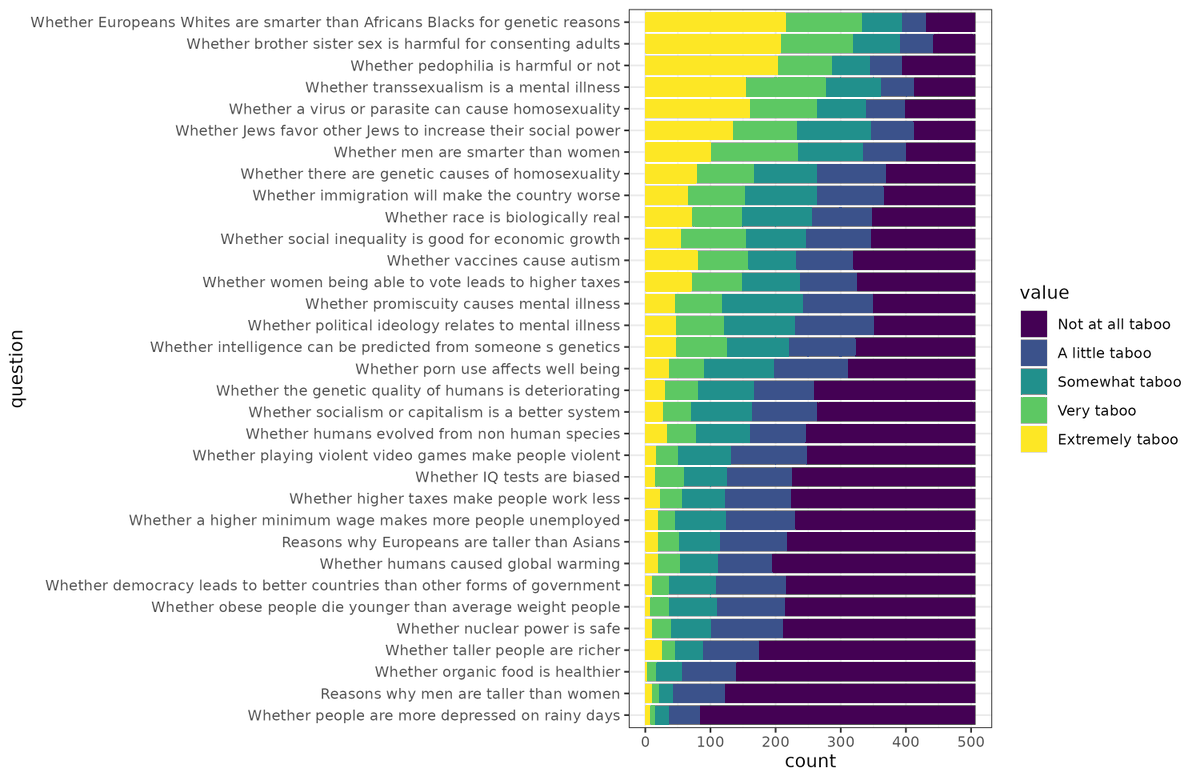
  • Measurement of Taboos (Every taboo is true)

    Measurement of Taboos (Every taboo is true)

    Measurement of Taboos
    (Every taboo is true) https://t.co/mA3m7AoEEx


    Source date (UTC): 2024-04-17 20:20:57 UTC

    Original post: https://twitter.com/i/web/status/1780692950269501945

  • “Q: Curt: What are your refutations of the arguments against operationalism?”–@

    –“Q: Curt: What are your refutations of the arguments against operationalism?”–@GiwdulBielsira;

    Great question. Thanks for asking.

    I should write a full article addressing the old issues with the various operational schools and intuitionism et al.
    Simple answer, if you understand the debate:
    (a) falsification vs justification
    (b) testifiability vs meaning
    (c) decidability vs undecidability
    (c) performative vs ideal truth
    (d) constructive vs descriptive
    (e) analogy to experience vs fictionalism
    (f) first principles vs measurements
    (g) relative completeness vs previous era ignorance
    (h) explicit incompleteness vs implicit or fictional
    (i) near impossibility of lying vs ease of lying
    (j) Bridgman/Brouwer vs interpretations
    AND;
    1) Operationalism/Intuitionism were influential in causing reform in physics, psychology, and linguistics.
    2) Utility in proportion to questions of human scale (this requires explanation) and highest in law because it is at human scale. (May require some understanding of my wok on the spectrum of grammars).
    3) Current challenge in ai revolution b/c of brute forcing via language, and subsequent awareness of embodiment and recursive falsification as necessary to solve the problem.
    SO;
    Bridgman was early. Did not and could not complete the project. He could not overcome association with positivism rather than darwinian survival (falsification).
    AFAIK I have. And no criticism has yet survived.

    Cheers


    Source date (UTC): 2024-04-17 14:55:53 UTC

    Original post: https://twitter.com/i/web/status/1780611141997076480

  • PHILOSOPHY ENDED IN THE LAST CENTURY The problem with philosophical tradition is

    PHILOSOPHY ENDED IN THE LAST CENTURY
    The problem with philosophical tradition is that it’s predicated on textual and scriptural interpretation. It’s verbal not operational.

    But words don’t mean things, people mean things and they satisfy the demand for unambiguity, consistency, correspondence, and the possibility – or they don’t.

    So the entire program seems to have ended somewhere between Godel and Kripke: The reliance on set logic rather than operations, on non-contradiction vs operational possibility, on ideals rather than distributions, and ignoring costs, rather than accounting for them.

    In other words: Performative truth can only consist of satisfaction of demand for decidability in the context (which, like math and measurement, determines the degree of precision – scale dependence).

    Continental Philosophy still survives because the continent is still trying to find a bias to human experience, rather than a scientific description of human experience that we can determine is correct given its complete explanatory power for all experience.

    I have no idea why philosphy departments still survive and I doubt they will outlast the next generation.

    But people don’t want to pay the cost of learning the sciences, so they stay with literature, which remains somewhat intuitionistic.

    It’s hard to teach people to reason (or calculate) entirely. We all want to intuit rather than reason. (avoid the cost).

    But the discount on thought results from malinvestment in what is intuitionistically accessible, (cheap to test), and creates high costs over time.

    The investment in learning independent of intuition, then using it to explain intuition, produces long-term returns.

    So the cheap route, as always, produces its own limits (ceiling).

    Cheers


    Source date (UTC): 2024-04-17 00:32:55 UTC

    Original post: https://twitter.com/i/web/status/1780393969232363520

  • THE AI AGE NEEDS EPISTEMOLOGY AND ETHICS FROM FIRST PRINCIPLES. –“‘Normie’ desc

    THE AI AGE NEEDS EPISTEMOLOGY AND ETHICS FROM FIRST PRINCIPLES.

    –“‘Normie’ describes the type of person who lets other people decide about what one believes to be good and true. The success of modern homo sapiens has been a triumph of human programmability, but the AI age needs… https://twitter.com/Plinz/status/1780152167342428192


    Source date (UTC): 2024-04-16 14:31:14 UTC

    Original post: https://twitter.com/i/web/status/1780242551196291269