Category: Economics, Finance, and Political Economy

  • Again, a false point. The southern economy could not transition rapidly to an in

    Again, a false point. The southern economy could not transition rapidly to an industrial given the capital tied up in their slaves. As such the only peaceful solution was for hte government to borrow the money to pay for the industrialization and repatriation of the slaves.

    Grownups make economic decisions and account for consequences. The infantilized (and especially feminine) mind accounts only for feelings.

    Reply addressees: @LaPaturette @chrisdier @NikkiHaley


    Source date (UTC): 2023-12-28 18:26:19 UTC

    Original post: https://twitter.com/i/web/status/1740439049205145601

    Replying to: https://twitter.com/i/web/status/1740431595490967585

  • No, they had no means of doing so without the USG paying for the slaves, so that

    No, they had no means of doing so without the USG paying for the slaves, so that the south could industrialize. The north refused to let the govt borrow the money to free and repatriate the slaves to africa (which was the right solution for everyone).


    Source date (UTC): 2023-12-28 17:46:58 UTC

    Original post: https://twitter.com/i/web/status/1740429145392152736

    Reply addressees: @MsMakeupJunkie @Duke_of_angels @chrisdier @NikkiHaley

    Replying to: https://twitter.com/i/web/status/1740427884031095004

  • THE IMMORALITY OF THE CIVIL WAR –“There are no solutions only trade-offs”– Thi

    THE IMMORALITY OF THE CIVIL WAR –“There are no solutions only trade-offs”– Thi

    THE IMMORALITY OF THE CIVIL WAR

    –“There are no solutions only trade-offs”–

    This is the first principle social, political and economic measurement: accounting for the difference between choices and full accounting of both the seen and unseen in those choices.

    Regarding:… https://t.co/LqiviNFoxt


    Source date (UTC): 2023-12-28 17:43:57 UTC

    Original post: https://twitter.com/i/web/status/1740428384130216428

    Reply addressees: @Thecoffeetalkin @8184cc @chrisdier @NikkiHaley

    Replying to: https://twitter.com/i/web/status/1740418422104866897

  • THE IMMORALITY OF THE CIVIL WAR –“There are no solutions only trade-offs”– Thi

    THE IMMORALITY OF THE CIVIL WAR

    –“There are no solutions only trade-offs”–

    This is the first principle social, political and economic measurement: accounting for the difference between choices and full accounting of both the seen and unseen in those choices.

    Regarding: —“So enslaved people just just suffer for an (at the time) unknown number of years waiting for a natural process?”–

    Was the trade off of six hundred thousand dead, the terror of that horrific war, the near destruction of southern (scotts irish) civilization, and the century of consequences, including the current race-marxist division fomenteed by the neoMarxists not worth the less than thirty years of continued enslavement by a three million slaves?
    Worse, was it worth not borrowing the money to pay off the landholders for their slaves (which was considered)?
    Was it worse than paying off the landholders for their slaves and repatriating those slaves back to africa? (which was the optimum solution).

    THE ECONOMIES OF THE NORTH VS SOUTH
    –“The American economy was caught in transition on the eve of the Civil War. What had been an almost purely agricultural economy in 1800 was in the first stages of an industrial revolution which would result in the United States becoming one of the world’s leading industrial powers by 1900. But the beginnings of the industrial revolution in the prewar years was almost exclusively limited to the regions north of the Mason-Dixon line, leaving much of the South far behind.

    In 1860, the South was still predominantly agricultural, highly dependent upon the sale of staples to a world market. By 1815, cotton was the most valuable export in the United States; by 1840, it was worth more than all other exports combined. But while the southern states produced two-thirds of the world’s supply of cotton, the South had little manufacturing capability, about 29 percent of the railroad tracks, and only 13 percent of the nation’s banks. The South did experiment with using slave labor in manufacturing, but for the most part it was well satisfied with its agricultural economy.

    The North, by contrast, was well on its way toward a commercial and manufacturing economy, which would have a direct impact on its war making ability. By 1860, 90 percent of the nation’s manufacturing output came from northern states. The North produced 17 times more cotton and woolen textiles than the South, 30 times more leather goods, 20 times more pig iron, and 32 times more firearms. The North produced 3,200 firearms to every 100 produced in the South. Only about 40 percent of the Northern population was still engaged in agriculture by 1860, as compared to 84 percent of the South.

    Even in the agricultural sector, Northern farmers were out-producing their southern counterparts in several important areas, as Southern agriculture remained labor intensive while northern agriculture became increasingly mechanized. By 1860, the free states had nearly twice the value of farm machinery per acre and per farm worker as did the slave states, leading to increased productivity. As a result, in 1860, the Northern states produced half of the nation’s corn, four-fifths of its wheat, and seven-eighths of its oats.

    The industrialization of the northern states had an impact upon urbanization and immigration. By 1860, 26 percent of the Northern population lived in urban areas, led by the remarkable growth of cities such as Chicago, Cincinnati, Cleveland, and Detroit, with their farm-machinery, food-processing, machine-tool, and railroad equipment factories. Only about a tenth of the southern population lived in urban areas.

    Free states attracted the vast majority of the waves of European immigration through the mid-19th century. Fully seven-eighths of foreign immigrants settled in free states. As a consequence, the population of the states that stayed in the Union was approximately 23 million as compared to a population of 9 million in the states of the Confederacy. This translated directly into the Union having 3.5 million males of military age – 18 to 45 – as compared to 1 million for the South. About 75 percent of Southern males fought the war, as compared to about half of Northern men.

    The Southern lag in industrial development did not result from any inherent economic disadvantages. There was great wealth in the South, but it was primarily tied up in the slave economy. In 1860, the economic value of slaves in the United States exceeded the invested value of all of the nation’s railroads, factories, and banks combined.”–

    YOU”RE NOT MORAL IN IGNORANCE
    So your moral virtue signaling is neither moral, nor virtuous, but profoundly ignorant and foolish

    THE COST OF THE CIVIL WAR
    The overall cost of the U.S. Civil War from 1861 to 1865 is complex and involves considering both direct and indirect costs, including economic, human, and societal impacts. The financial costs in terms of contemporary currency and today’s values can differ significantly.

    Here’s an overview:

    Direct Costs
    Government Expenditures: This includes military expenses like salaries, weapons, equipment, and supplies. The Union government spent about $3.2 billion, and the Confederacy spent approximately $1 billion in 1860s dollars.
    Economic Losses: The war caused significant destruction, particularly in the South, including infrastructure, agricultural, and property damage.

    Human Costs
    Casualties: The human cost was immense, with an estimated 620,000 soldiers dying from combat, accidents, starvation, and disease. This doesn’t include civilian casualties, which were also significant.
    Veteran Care: Long-term costs for caring for the wounded and for veterans’ benefits.

    Indirect Costs
    Economic Disruption: The war disrupted trade, agriculture, and industry, especially in the Southern states, leading to economic losses beyond immediate war expenses.
    Lost Labor and Productivity: The death of hundreds of thousands of men and the impact on civilian populations reduced economic productivity.

    Adjusting for Inflation
    Adjusting for inflation, the cost of the Civil War would be much higher in today’s dollars. Some estimates put the total cost well into the hundreds of billions or even trillions of current U.S. dollars, considering both direct expenditures and wider economic impacts.
    Societal and Economic Repercussions
    The war also had lasting societal and economic repercussions, particularly in the South, which faced years of rebuilding and economic hardship.

    Conclusion
    The overall cost of the U.S. Civil War is difficult to quantify precisely due to the vast range of direct and indirect factors involved. Financially, it was incredibly costly for both the Union and the Confederacy, and the human and societal costs were profound and long-lasting. The war not only shaped the future of the United States but also left an enduring legacy on its economic and social landscape.

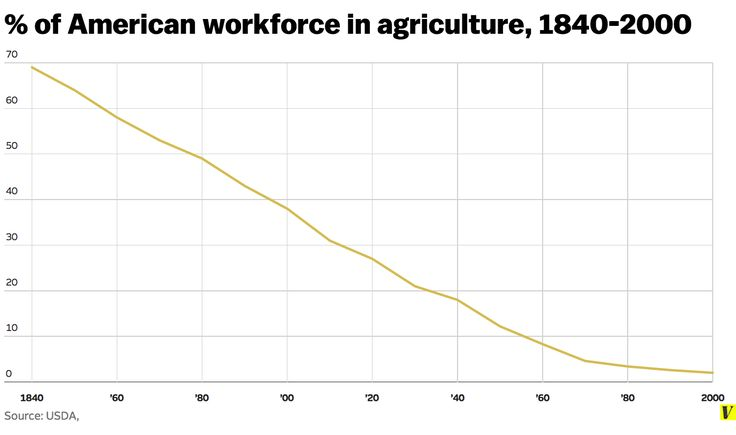
    In the end, it was an economic problem. The south would need to have their slaves paid for and repatriated and time to use those funds to industrialize and the north would not borrow the money via the central government to do so.

    Which was the better choice?

    Especially when agricultural employment was crashing hard and fast. (See attached)

    Cheers

    Source date (UTC): 2023-12-28 17:43:56 UTC

    Original post: https://twitter.com/i/web/status/1740428383488454656

  • The worse problem is that this wasn’t really an issue and it was pointless, becu

    The worse problem is that this wasn’t really an issue and it was pointless, becuase slavery became economically unviable in the face of industrial farming within thirty years. So this is a great conflict in our history that was like the other progressive initiatives of the civil rights era the attempt to circumvent natural processes that were deterministic, in order to justify political activism by ‘do gooders’. Just like today.

    Reply addressees: @8184cc @chrisdier @NikkiHaley


    Source date (UTC): 2023-12-28 16:45:43 UTC

    Original post: https://twitter.com/i/web/status/1740413731136286720

    Replying to: https://twitter.com/i/web/status/1740387687465681206

  • Conflates a tactic with a strategy to provoke moral outrage obscuring the causal

    Conflates a tactic with a strategy to provoke moral outrage obscuring the causality which is agrarian vs industrial, and the asymmetric taxation punitive to the south.


    Source date (UTC): 2023-12-28 15:00:15 UTC

    Original post: https://twitter.com/i/web/status/1740387187705749687

    Reply addressees: @JoeGold44935611 @chrisdier @NikkiHaley

    Replying to: https://twitter.com/i/web/status/1740380675507978463

  • Research taxes. Prior to the American Civil War, the Southern states contributed

    Research taxes.

    Prior to the American Civil War, the Southern states contributed a significant portion (most) of federal tax revenue, despite that the North had a free population of about 22 million and the South a free population of about 5.5 million, primarily due to the nature of the economy and the tax structure at the time. So a tax of 4 or 5 to 1.

    The key reasons for this include:

    Tariffs: The primary source of federal revenue before the Civil War was tariffs, which are taxes on imported goods. The Southern states, with their agrarian economies, relied heavily on importing goods from Europe. In contrast, the Northern states were more industrialized and produced many goods domestically. Therefore, the South ended up paying a larger share of tariffs.

    Export Economy: The Southern economy was heavily based on agriculture, particularly the export of cash crops like cotton, tobacco, and rice. These exports were crucial not only to the U.S. economy but also to the global market, especially in Europe. While the export itself was not directly taxed, the goods and services needed to support this export economy were often imported and thus subject to tariffs.

    Lack of Industrialization: The North’s industrial economy meant it was less reliant on imports than the agrarian South. Northern industries also benefited from protective tariffs that made imported goods more expensive, thus protecting domestic manufacturers from foreign competition. This situation was a source of tension, as the South felt that the tariff policy unfairly favored Northern interests.

    Limited Federal Taxation Methods: Before the 16th Amendment (1913), which allowed the federal government to levy an income tax, the U.S. government’s ability to raise revenue was limited mostly to tariffs and excise taxes. There was no federal income tax that could diversify the tax burden across different sectors and regions of the economy.

    Political Disputes Over Tariffs: The issue of tariffs was a major point of contention between the North and the South. Southern states argued that the tariff system was inequitable and favored Northern industrial interests.

    This dispute over tariffs and the perception of an unfair economic advantage contributed to the growing sectional tensions leading up to the Civil War.

    (Ergo I am correct (as usual))

    Reply addressees: @Duke_of_angels @chrisdier @NikkiHaley


    Source date (UTC): 2023-12-28 14:57:52 UTC

    Original post: https://twitter.com/i/web/status/1740386590940106752

    Replying to: https://twitter.com/i/web/status/1740381336546967820

  • slavery wasn’t the main cause of the civil war. It was the last straw in a serie

    slavery wasn’t the main cause of the civil war. It was the last straw in a series of conflicts that arose because the south was paying for the federal govt yet was subject to northern dominance in that government. Even slavery was only an issue because had it spread westward…


    Source date (UTC): 2023-12-28 14:26:27 UTC

    Original post: https://twitter.com/i/web/status/1740378683511046398

    Replying to: https://twitter.com/i/web/status/1740359279553507746

  • RT @ThruTheHayes: FIXES FOR BANKING, FINANCE, TAXES, THE ECONOMY, ETC. The refor

    RT @ThruTheHayes: FIXES FOR BANKING, FINANCE, TAXES, THE ECONOMY, ETC.

    The reforms commanded by the Law are the largest since the Roman er…


    Source date (UTC): 2023-12-27 20:34:44 UTC

    Original post: https://twitter.com/i/web/status/1740108977705451829

  • RT @erikbrus25: @TomKawczynski @curtdoolittle Ending Financial Predation: The st

    RT @erikbrus25: @TomKawczynski @curtdoolittle Ending Financial Predation:

    https://naturallawinstitute.com/ending-financial-sector-predation/

    https://curtdoolittle.com/articles/62127601/

    The state at t…


    Source date (UTC): 2023-12-27 03:06:05 UTC

    Original post: https://twitter.com/i/web/status/1739845077281681503