Krugman, Delong, Stiglitz, et al. “Saltwater” school for the maximization of consumption, and the prohibition on the construction of intergenerational commons, including OUR INSTITUTIONS, CULTURE, CIVILIZATION, AND GENES.
As far as I know, economics ‘went wrong’ when “the republican income statement no longer propagated to the monarchical balance sheet.” In other words, when we failed to account for ALL capital changes, including territorial, genetic, cultural, normative, knowledge, and institutional, and therefore treated economics as a means of pseudo-scientific cherry-picking of measurements, under the pretense that such capital was being mobilized rather than consumed (or simply lost or destroyed).
The postwar era, by the pseudoscientific taboo against the darwinian revolution and the necessity of continuing 3500 years of environmental eugenics, and 1600 years of manorial eugenics, and 800 years of juridical eugenics, converted the discipline into the means by which to conduct war against civilization: the incremental domestication of animal man into equilibrium with his productive technologies, and his means of calculating a survivable future with them: sovereignty, reciprocity, law (tort), markets in everything, property, money, prices.
Economics is either a measure of cooperation, and therefore, reciprocity, and therefore political economy, and as such Law (tort – dispute resolution), Legislation (commons production and defense), and regulation (prior restraint by the insurer of last resort), and attendant standards of measurement, or it is merely an innumerate pseudoscience to justify the consumption of accumulated capital in pursuit of slow reversal of eugenic evolution, regression to the ancient mean, and the source of the justification for the consequente devolution of civilization and man.
Efficiency is a rather ridiculous pursuit unbound by justification for less visible capital destruction , just as is legislation is a pursuit unbound by rules of contract.
The Market Failure hypothesis is rather ridiculous since if the market produces proceeds sufficient to subsidize goods services and information, and distorting that market harmful to it.
And a hundred other nonsense-schemes we use to obscure the reversal of eugenic evolution, or the returns on conquest and sale of continents, or the conversion of intergenerational lending to temporal redistribution and the price of that risk, or the transition from physical money to digital record of credit and debt, and the end of necessity or value of distribution of liquidity through the financial system, and the inability to reconstruct that capital without such chaos we dare not speak of it.
Science is not kind. We have yet to have the necessary revolution in economics by its reunification with the law. As far as I know there is only one social science – the law (tort), legislation (contracts for the commons) and regulation (insurance) and the rest is measurement of its consequence.
This was the difference between the austrian (rule of law), chicago (rule of law insured) and saltwater (return to arbitrary rule of man) schools of economics. Today, post 2008, it is very difficult to see much more than “I dunno what to do know” from the profession, except to permute as do the physicists on dark matter, because we lack the instrumentation necessary to obtain the information sufficient to correct our theories, and therefore limited to failure (collapse) and therefore desperate incentive to correct these errors, rather than falsify the 20th century social pseudosciences in economics as we are doing in psychology and sociology, with cognitive sciences and genetics.
The Worm Turns, and as Hayek warned but could not himself answer: the 20th will be remembered as an era of the restoration of mysticism – which we more correctly state as platonism, idealism, sophism, innumeracy, and pseudoscience.
Problem is that only a moron that is entirely ignorant of both probability (“ludic fallacy”) and economics (“risk measurement”) would be ignorant and stupid enough to conflate closed (ludic) and unclosed (risk) measures. Odds can be calculated, but risk only PRICED. Left=Idiot
Chris Wallace, winning:
WALLACE: What are the odds? One in a hundred? What–What?
TRUMP: I don’t do odds, I gave very detailed–
WALLACE: You ran a casino sir.
Bob, Serious question. What bias or biases do you suggest drive Krugman’s propagandism? I spent a few months looking into it in 09, but I think you have a deeper understanding…
1) let’s assume there is only one consumer lender: the treasury. what happens to default rates?
And 2) under single (consumer) lender, with limits by rolling income, why are defaults a problem?
And 3) now let’s distribute liquidity via those same accounts, and what happens?
And (4) if those ‘rents’ on state-secured interest aren’t available where does investment capital seek longer term returns instead?
With the exception that;
(5) black market ‘loan’ might increase (not for sizable), because there is always an unpredictable ‘lottery payment’ coming from insertion of liquidity to maintain the money supply, with zero delay.
—I’m sure there is a solution that can “protect the commons” and provide an efficient and cost-effective solution. My understanding is that passenger flights are required to carry USPS, where the private companies must own their own planes. Curt Doolittle maybe you can chime in a propertarian solution to this problem?”—@[572309326:2048:Bryan Nova Brey]
The problem is the cost of government employees. The service is also supported by spam mail none of us want (or need, in the age of the internet). All political services can be provided by libraries (forms etc). All shipping better provided by private agencies. Selling it whole yet requiring all domestic postcards, and ‘letters’ at a subsidized price would solve the problem.
Insuring the private postal service and ups and anyone else for that matter, the way we insure banks (insurer of last resort) in the case of national emergency is adequate.
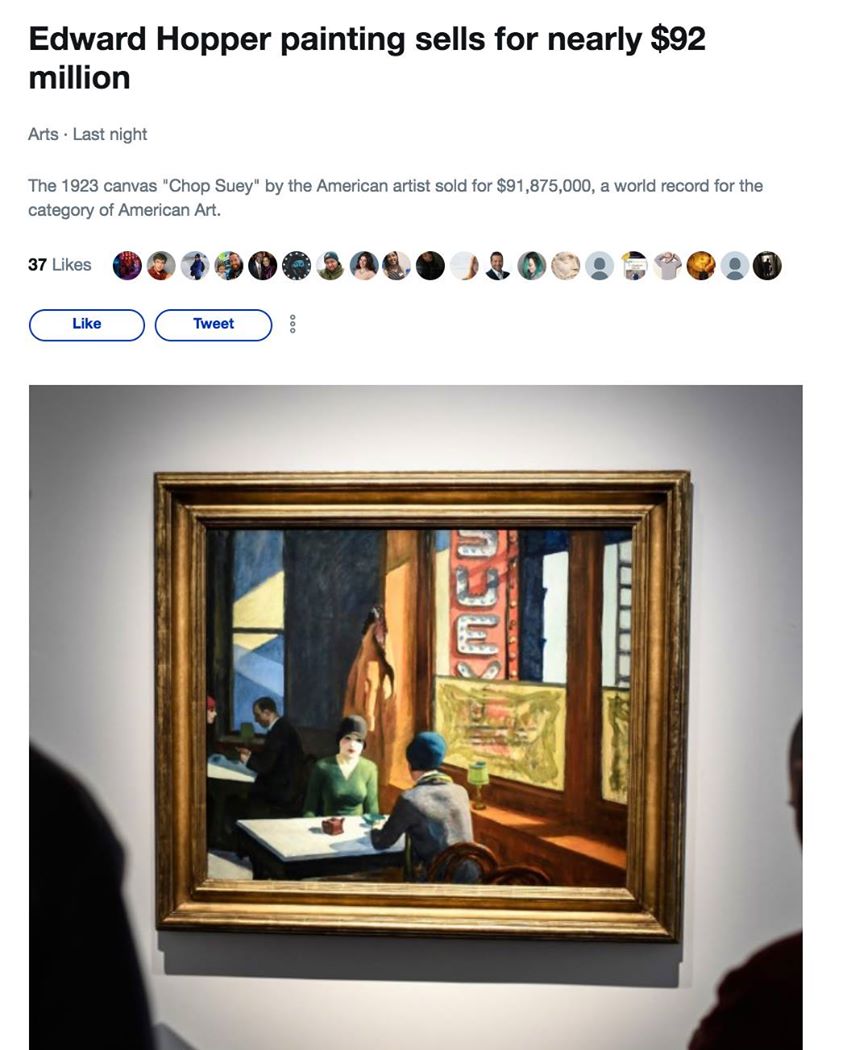
photos_and_videos/TimelinePhotos_SxeO6JU-xg/46308130_10156777432192264_3649572524754206720_o_10156777432187264.jpg Hopper is still increasing in value/Morgan James MorrisonWhy?Nov 14, 2018, 10:58 AMJohn EdwardOne of my favorite painters.Nov 14, 2018, 11:04 AMJohn EdwardThe high end art market typically tracks the net worth of the 0.001%. So anytime there’s a stock market bubble, art auctions for every artist goes up by an even greater percentage (due to leverage).Nov 14, 2018, 11:06 AMJohn EdwardAlso rich people use art as a way to “park” their money in a tax sheltered asset.Nov 14, 2018, 11:07 AMCurt Doolittle^Yep.Nov 14, 2018, 11:07 AMCurt Doolittlethe optimum economic indexNov 14, 2018, 11:07 AMMorgan James MorrisonAh ok, so its a “market” reason. i thought maybe there was some sort of psychological reason like people are enjoying art that makes them feel isolated because people are more isolated.Nov 14, 2018, 11:15 AMMorgan James MorrisonWhy Hopper’s art specifically is still enjoyed and valued so highNov 14, 2018, 11:15 AMMatt EvansThere are at least three categories of art purchasing
1) speculation – purely economic
2) for who else will notice that you have the piece – virtue signaling to others
3) for the personal enjoyment of the piece itself – taste, which is objective [see: roger Scruton on beauty]
Which do you think this hopper painting represents? For me, it’s not #3.Nov 14, 2018, 11:18 AMCurt DoolittleMatt Evans Well, hopper is … I mean, artists are artifacts of time and place and hopper is probably the best artifact of that time and place. The collector (collection owner) died last spring, and he was an entrepreneur that collected what he loved. there is a difference between what I would hang in my home and what I would state “yes, this is great art”. But that is the difference between taste and truth. Hopper is a great artist of his era, if not the greatest, one of them. He captured that moment in time for eternity.Nov 14, 2018, 11:21 AMMatt EvansCurt Doolittle But, for the sake of argument, let us say you provide me with a piece that is undeniably the greatest piece of modern day performance art. Or any modernist or post-modernist art, really.
Not only will I not place it in my home, but I will also tell you it is not truth, or, more generously, that the maximum amount of truth it has to say is that the “artist” is a sick creature that comes from a sick and dying society.
But there are many ways to say that, and reasonable people don’t think they are “art”.
being a product of a time and place does not absolve “artists” who create degenerate garbage; who demonstrate no particular talent at any particular craft
I don’t assert that Hopper is degenerate garbage, or is a talentless monster. I don’t even suggest it. The painting looks fine.
It doesn’t, however, strike me as the finest oil painting in American history. Or rather, if it truly is, that’s disappointing for America.Nov 14, 2018, 11:42 AMConnor WhittlawDo you come up with these ideas/metrics/etc by yourself or is there s lot of external collation going on?
For myself, I have few novel ideas, but am a great metric finder and collator for others.Nov 14, 2018, 11:43 AMCurt DoolittleBelieve it or not …. this is a subject economists studied in depth, and Gary Stanley Becker (where I get my use of supply and demand language in social science from ) wrote about it specifically.
https://www.amazon.com/Economic-Approach-Human-Behavior/dp/0226041123Nov 14, 2018, 11:47 AMEric BumpusThe first type of cryptocurrency.Nov 14, 2018, 11:54 AMArno KælandMorgan James Morrison Status signalling also plays a part in these art markets and the more super-wealthy there are, the more desirable the status symbols become. Cars and houses no longer really do the trick because even a mere ‘deca-millioaire’ can afford the most expensive new cars available.Nov 14, 2018, 1:08 PMAndy Ujku-DardaniaOne of my favorite paintersNov 14, 2018, 3:02 PMConnor WhittlawCheersNov 14, 2018, 3:15 PMEdward John WyattYeeee boiNov 14, 2018, 4:06 PMZachary BertCurt Doolittle yeah and it was supposed to be left to the Seattle Art Museum and we got fucked somehowNov 14, 2018, 8:41 PMKari Anne DorstadWow ill see if my accountant will write me a check !! Lol 😂Nov 14, 2018, 9:34 PMNoel FritschI.e., rich people are often stupid.
As an indicator, valuable. As an actual investment? Not so much.
Can chop suey or nighthawks dispatch with zombies?
Or be traded for the dispatchment of zombies in a post Petro dollar world?
Methinks not…Nov 14, 2018, 10:06 PMJohn EdwardNoel Fritsch what you’re describing are lower order goods and commodities. Those are bets on social breakdown, while art is a bet on continuing growth of economic efficiency and complexity.Nov 14, 2018, 10:08 PMMurphy CellCurt you should check out Odd Nerdrums new short film about Kant ruining art.
https://youtu.be/EcjVXBXn7b4Nov 16, 2018, 10:33 AMCurt Doolittlethank you for thisNov 16, 2018, 10:47 AMMurphy CellCurt Doolittle it’s good. You’ll dig it. I don’t agree with some of it. But he names the art police! And laments at seeing brilliant artists and former students dumbing their work down so that they can make a living. The documentary “the Mona Lisa Curse” by Salt old bastard Robert Hughes is amazing too. I loved that guy.Nov 16, 2018, 10:50 AMHopper is still increasing in value/