—“There’s a difference between money and currency and legal tender.”–Moritz Bierling
Yep.
Source date (UTC): 2020-04-22 12:42:00 UTC
—“There’s a difference between money and currency and legal tender.”–Moritz Bierling
Yep.
Source date (UTC): 2020-04-22 12:42:00 UTC
—“This nation was not built on free trade.”—Nathan Borup
Free trade is a ((())) leftist agenda. We either have fully reciprocal trade or not. If we have fully reciprocal trade we will have the freest trade reciprocally possible – and that is the optimum. 😉
Source date (UTC): 2020-04-22 12:00:00 UTC
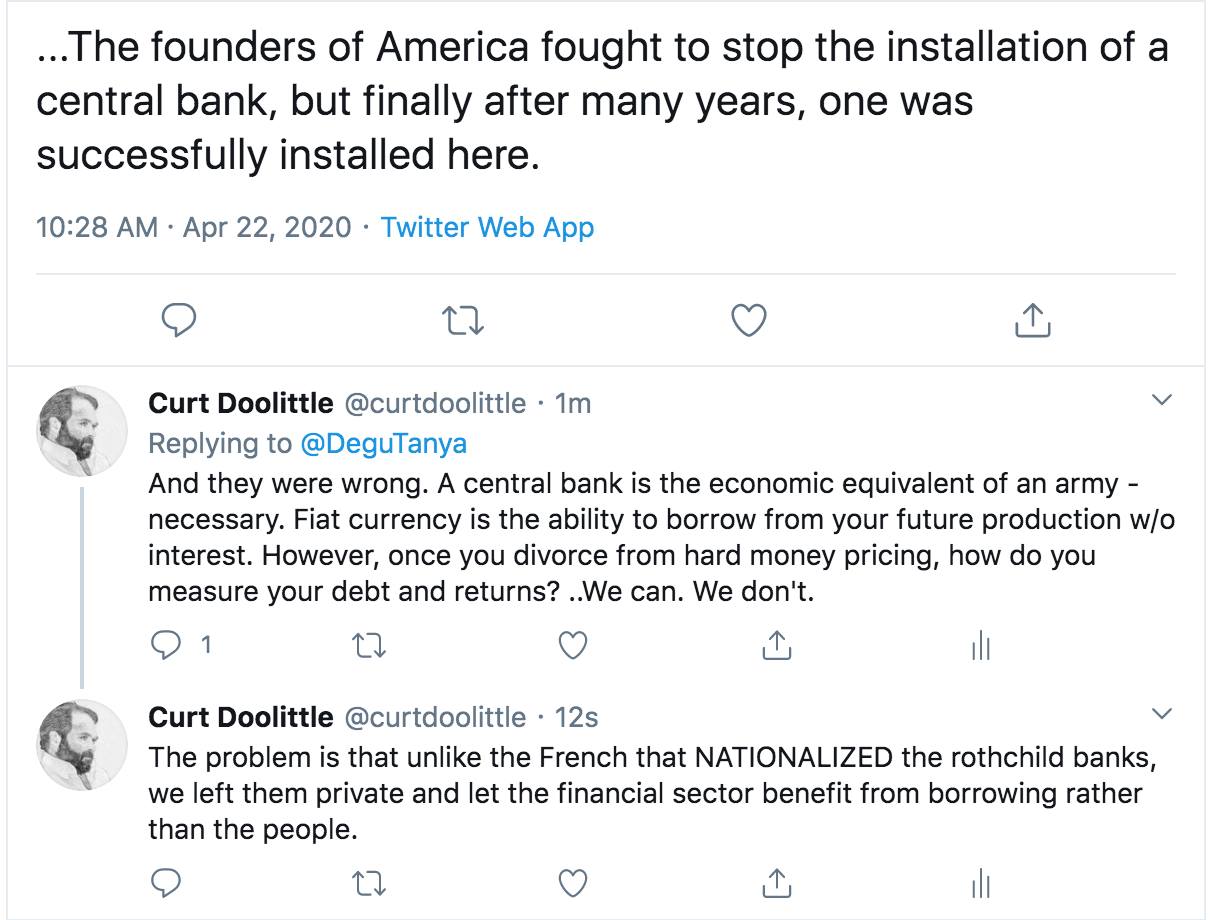
photos_and_videos/TimelinePhotos_kg5QueHwVw/94883643_263715438359950_5222435637843460096_o_263715435026617.jpg A CENTRAL BANK IS THE ECONOMIC EQUIVALENT OF AN ARMY – NECESSARY
(just necessarily national rather than private)A CENTRAL BANK IS THE ECONOMIC EQUIVALENT OF AN ARMY – NECESSARY
(just necessarily national rather than private)
Source date (UTC): 2020-04-22 10:35:00 UTC
INFLATION IS THE FUEL OF CORRUPTION OF THE STATE
By Francesco Principi
(read and learn)
This is the reason why the northeastern border of the Roman empire stopped at the Rhine river. The Germans were poor populations and therefore of no interest to the Romans
The goal of the rulers who so badly governed was to coin and spend more. Caracalla thought that if he had removed some silver from the coins, nobody would have noticed and that he would have multiplied the money in circulation. It was ultimately a good thing for everyone.
The Roman coin was the denarius, and from him comes the word money, it was initially pure silver. At the time of Augustus, the first emperor, each denarius was made up of 95% silver and 5% other metals, such as bronze. A century later, with Trajan, the percentage of silver was 85%. Eighty years later, Marcus Aurelius once again depreciated the denarius, bringing it to only 75% of silver. The denarius, therefore, had devalued by 20% in two centuries. A fairly tolerable thing. Caracalla, who was in great need of capital for his expenses, devalued the coin to leave us only 50 percent of silver; that is, he devalued it by 25 percent in one year.
The aureus also lost value due to a legal provision. During the reign of Augustus, about forty coins came out of every pound of gold. Caracalla extended the pound until he also got out fifty coins which, of course, maintained the face value, but not the purchasing power.
With such a monetary experiment and without the emperor predicting it, prices shot up. Caracalla missed the party: living in the countryside in Asia, he was stabbed by one of his guards while pissing on the edge of a road. A worthy end for one of the most impudent people in history.
Those who came after him did nothing but make things worse. Almost all the emperors of the third century were military and almost all came to power following violent coups. There is a figure that says a lot: only one of them, Ostiliano, who reigned for six months in 251, died of natural causes; the rest fell at the hands of the guards or on the battlefield, generally against their successors. This period is defined by historians as “the crisis of the third century”. To tell the truth, they should speak of the end of Roman civilization, because from this moment on the Roman world became much more similar to the medieval period than to the classical one.
Over the course of this century, the denarius never stopped devaluing, until it was converted into a piece of silver-plated bronze that quickly passed from hand to hand. But bad money, as the saying goes, passes from hand to hand and nobody keeps it. As for the aureus, it practically disappeared from circulation, and when it appeared it was thinned and adulterated. Inflation exceeded 1,000%, and this only with the fragmented data we have available: probably, in certain periods and in certain places it was even greater.
After the political and economic chaos of the third century, Diocletian’s adjustment came and, without being able to resort to devaluation anymore, he crushed the inhabitants of the Empire with taxes and attempted a monetary reform. The reform failed and its edict sanctioning a price cap was completely ignored by people who, in less than a century, had gone from having silver money in their pockets to handling the so-called “follis”, small pieces of bronze of low value . The Romans had been staggeringly depleted in just a few decades because of the government; and with them the commerce, industry and agriculture of the Empire declined.
The seed of the almighty state, always in need of funds to survive, had now taken root. Emperor Constantine suppressed the aureus and put into circulation a new gold coin, the solid, much depreciated compared to the previous one. An aureus of the ancients was worth, for the quantity of precious metal contained, two solids. The silver coin, adulterated to the point of nausea, disappeared from circulation.
Constantine obtained the amount of gold necessary for the reform by confiscating it from the rich eastern cities and pagan temples, already in retreat behind the conversion of the Emperor to Christianity. To finance the functioning of the state, new taxes were invented that could only be paid in gold, the only form of payment accepted by foreign mercenaries who militated in the army. They were called barbarians, although, to tell the truth, even though they were barbarians, they were certainly not fools, since they were willing to gamble their lives only for real money.
Gold turned into a refuge for those who could get it, that is, the military and high imperial officials. The rest of the population had to settle for the bronze in the bags and the copper of the informal money, illegally coined, which served as a small coin. The rich class of small owners and merchants, the ancient base of Roman greatness, was ruined without the possibility of recovery. There was therefore a concentration of land in the hands of a few large owners
So we can conclude that inflation (beyond high taxation) is the fuel of any corrupt state.
Having no large quantities of gold or precious metals, the Romans drew human capital from the Germanic populations and used them in their army.
Source date (UTC): 2020-04-21 12:32:00 UTC
art is a commons. games are a private consumption.
False equivalency of private and common.
Source date (UTC): 2020-04-18 20:59:22 UTC
Original post: https://twitter.com/i/web/status/1251616334766628864
Reply addressees: @buldursgait @DeguTanya @BepDelta @Dark_TossEX @MarfamSilva @paxchristus0 @ReadLinkola
Replying to: https://twitter.com/i/web/status/1251614637063385091
Games are escapism. That’s the equivalent asking for faith to be taken out of religion, or class warfare to be taken out of politics.
The commons (public), the involuntarily private (broadcast), the private (computer games, the living room, the bedroom, your fantasies.)
Source date (UTC): 2020-04-18 20:17:36 UTC
Original post: https://twitter.com/i/web/status/1251605824130224128
Reply addressees: @buldursgait @DeguTanya @BepDelta @Dark_TossEX @MarfamSilva @paxchristus0 @ReadLinkola
Replying to: https://twitter.com/i/web/status/1251604788275564545
Most political conflict would rapidly dissipate if maintaining a checking account, accounting, basic economics, business economics, and macro economics was taught early in life. And if basic contracts were taught early in life. And if economic history were taught early in life.
There is a reason they don’t teach it.
So the state can lie.
Source date (UTC): 2020-04-18 15:45:00 UTC
—“That’s what it always comes down to, freedom from consequences. The false promise of freedom from consequences is baiting into hazard as ignoring consequences must necessarily result in destruction.”—Andrew M Gilmour
Source date (UTC): 2020-04-18 15:43:00 UTC
I DON”T SPEND TIME REFUTING MARXISM. BUT IT”S TRIVIALLY EASY
—“Is there an article in which you relate these claims to the specific Marxist tenets, like surplus value, the labor theory of value, historical materialism, alienated labour, and so on? … I noticed you didn’t mention any of these in your comment here, so I’m not sure we’re really talking about the same thing.”—Morus Alba
It is not necessary to refute marx since it’s been done for decades. Just the fallacy of the labor theory of value eradicates most of the work; the claim on profits without claim on risk and loss; the claim that the primary beneficiary of industrialization is not the working classes and the poor; the claim of equality and oppression rather than natural sortition by genetic ability individual and family; the claim of society as corporal over family and polity for family; the claim of oppression rather than continuation of natural selection; The means of argument and it’s monopoly proposition to undermine trifuncationalism, markets, and rule of law.
I mean, I don’t think I need to do anything other than state correctly that it’s a pseudoscientific authoritarian religion that repeats the false promise of the supernatural authoritarian religion of judaism, christianity, and islam and sold to the poor in the modern world as freedom from physical law, just as freedom from physical law was sold to the underclases in the ancient world – and that gave us the dark ages of ignorance by judaism, christianity, and islam.
That’s why we don’t teach marx in economics, only non-science.
So if you want me to refute a given marxist proposition I will because it’s trivially easy. If you want me to refute ashkenazi capitalism I’ll refute that just as easily. If you want me to refute neoconservatism I’ll do that easily. If you want me to refute postmodernism or feminism I’ll do those just as easily.
My goal of course is to expand the law so that false promise of freedom from physical, natural and evolutionary law, by baiting people into hazard is as illegal in political fraud as the same strategy is in commercial fraud.
So most of my work is in exposing the strategy of abrahamic deception – which is as sophisticated a means of deceit as aristotelianism is a means of truth production – and writing laws that not only reverse it’s harms, but which prevent its future use … thereby restoring us to trifuncationalism, sovereignty, reciprocity, the natural law and jury, and markets in all aspects of life, including the suppression of the reproduction of the unproductive classes so that they do not return man to middle eastern ignorance and poverty as did christianity and islam, nor tolerate survival by parasitism as we have seen with judaism’s profiting from baiting host peoples into hazard with tax collection, usury, gambling, prostitution, drug and alcohol sales on credit, organized crime. propaganda, and rent seeking.
BY ANALOGY
We humans are just monkeys running software with more memory and cpu power.
I’m removing ‘memory leak’ from the human software. And law ist he means by which we program humans via negativa, without needing to program them via-positiva, and therefore leaving them open to competition in adversarial markets continuing our rapid evolution during this brief geological respite between crisis that threaten mankind.
Source date (UTC): 2020-04-18 13:37:00 UTC
“CURT WHAT ABOUT SOCIALISM”
Define how you use the term socialism. I’m assuming you mean european socialism (french-german) not jewish socialism (jewish russian).
Socialism means state control of the means of production.
Mixed economy means using the borrowing power of the state to strategically finance what the private sector cannot or will not.
My opinion is the same as most major economists – that the state does not capture the proceeds of those investments and return them to the common people.
My opinion is that we should finance repatriation of all non-trivial industry AND automate the heck out of it, and that the state should take non-voting interest in these companies and demand dividends as income for the people.
My opinion is that the financial sector is predatory and that consumer credit should be purely statistical and direct from the treasury eliminating all rent seeking from the financial sector.
My opinion is that liquidity necessary to generate demand should not be distributed to the financial sector for credit multipliers, but as cash distribution directly to citizens that business and finance compete for.
My opinion is that education is largely wasted income other than the high end stem fields, and that all other schooling takes one year to two years non-resident at most.
My opinion is that teaching and research staffs should be separate corporations with separate controls, and that phd and research programs should be well funded and largely state funded.
My opinion is that the military used to fund basic research, and that presently, basic research must be faked under medical or non-military, when in general the state should treat investment in research as a venture capitalists, seeking returns for the polity in longer time horizons than other peoples.
My opinion is that the best education in the world should be offered to all citizens from the best educators in the world, and that this should be a continuous process, and it should cost almost nothing (200 per course or something)
My opinion is that if universities admit students that if the student doesn’t compete two years or transfer the university eats the money. And that the university carries the loan entirely, even if the loan is borrow by the university from the government.
My opinion is that if we did this we’d be back to one income households just fine.
Source date (UTC): 2020-04-16 22:32:00 UTC