1. 😉 Define ‘Supply’. 2. Can we ever run out of fractional shares of BTC? 3. What is the mechanism for consolidating fractional shares of zero purchasing power?
How much can I divide a bushel of wheat? A Dollar? A Share of Stock? a BTC?. So yes the supply of btc (Tokens) is ~infinitely divisible under the presumption of defense against dilution (inflation of supply). However, the supply can expand ~infinitely. (x-crossover curves.)
I don’t make errors. Division does increase supply. the same coin can be divided N times among N people, all of whom share an interest in that original coin. This may or may not affect purchasing power. States may print more one dollar bills. This may or may not affect PP either.
Another illusion. Shares remain dilutable (auto-issue) by division with maintenance of the momentum (demand) the only preservation of purchasing power. And there is no corporate account or central bank to buy back shares to increase their value.
As far as I can tell this chart you’ve put forward is an act of financial fraud. We simply don’t prosecute opinions not directly related to sale and transfer of the asset (series seven).
So were beans. Are beans money? Most of history used bushels of grain. Does that mean it’s money?
It’s not just indivisibility it’s the failure of ANY of the properties I listed, including ILLIQUIDITY. Money=Liquid. Gold is illiquid. It’s hard to sell in most of the world.
–“What do you think made gold become money?”- Jeffrey Swann @AgoristView
1) Gold was a valuable commodity like other commodities, but not ‘money’. I didn’t require refinement, but it was too expensive for use as money. So it was just a commodity. Silver required refinement. The first money was electrum. But any metal will do. The honest question is whether gold, ever in history served as money – and the answer is “no”. Gold coins were too expensive, and served as money-like commodities, only liquid in certain conditions, just as they do today, because the value is too high, and liquidity too low.
2) Metal Commodity Money (money proper) has the properties:
a) Scarce, non-perishable, commodity(useful), and a universal signal good(luxury),
b) Consistent weight and volume, unitizable, countable, with a low ratio of weight and volume to value.
c) Trade-markable (warrantable), re-trade-markable (melt, re-stamp), and standard of weight and measure
Therefore;
d) STATES can create a market for a universally desirable commodity by demanding taxes paid in a universal commodity
e) And POLITIES can increase economic velocity (reduce friction) by converting agricultural goods to money.
f) And States can construct, defend, tax, and regulate MARKETS increasing returns.
g) States Can Pay SOLDIERS, and scale the number of soldiers to expand markets.
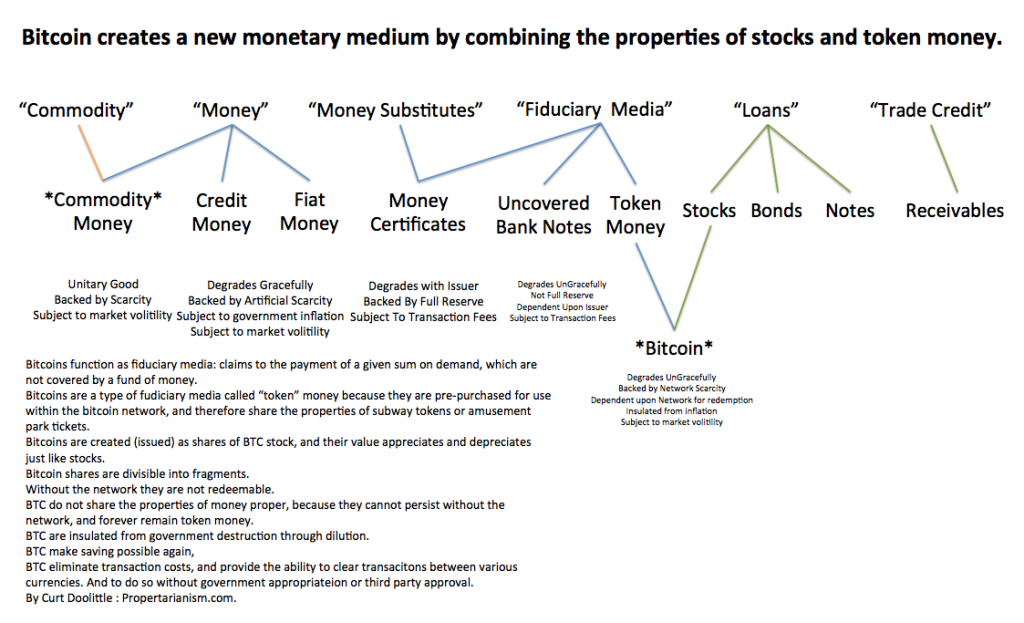
3) Bitcoin in the Financial Product Hierarchy
–“What do you think made gold become money?”- Jeffrey Swann @AgoristView
1) Gold was a valuable commodity like other commodities, but not ‘money’. I didn’t require refinement, but it was too expensive for use as money. So it was just a commodity. Silver required refinement. The first money was electrum. But any metal will do. The honest question is whether gold, ever in history served as money – and the answer is “no”. Gold coins were too expensive, and served as money-like commodities, only liquid in certain conditions, just as they do today, because the value is too high, and liquidity too low.
2) Metal Commodity Money (money proper) has the properties:
a) Scarce, non-perishable, commodity(useful), and a universal signal good(luxury),
b) Consistent weight and volume, unitizable, countable, with a low ratio of weight and volume to value.
c) Trade-markable (warrantable), re-trade-markable (melt, re-stamp), and standard of weight and measure
Therefore;
d) STATES can create a market for a universally desirable commodity by demanding taxes paid in a universal commodity
e) And POLITIES can increase economic velocity (reduce friction) by converting agricultural goods to money.
f) And States can construct, defend, tax, and regulate MARKETS increasing returns.
g) States Can Pay SOLDIERS, and scale the number of soldiers to expand markets.
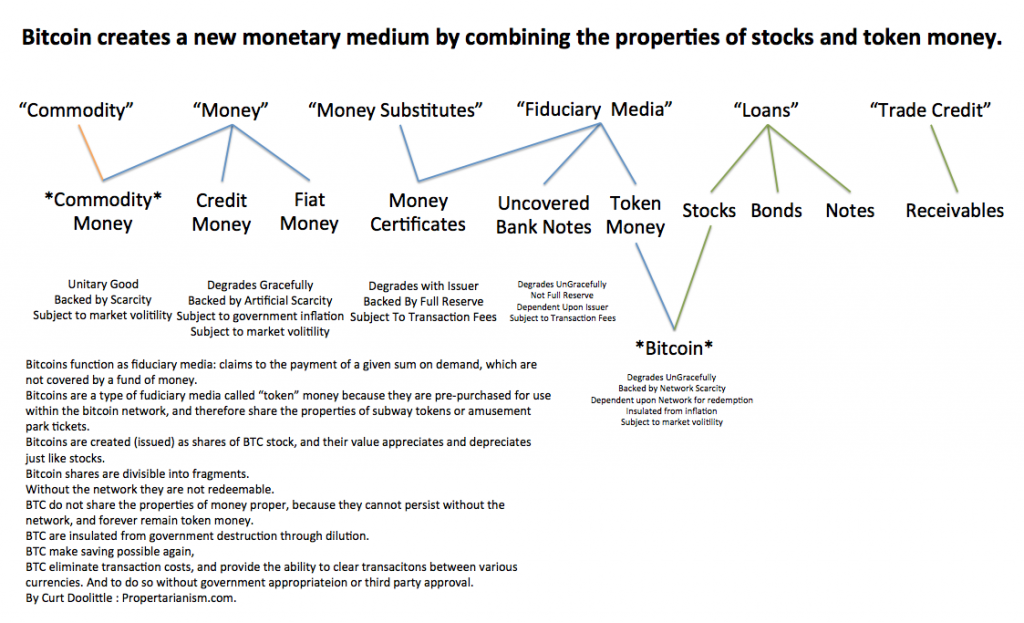
3) Bitcoin in the Financial Product Hierarchy