Category: Economics, Finance, and Political Economy

  • RECOMMENDATION: DRIVING MARKETS If you want practical, hype-free, non-ideologica

    RECOMMENDATION: DRIVING MARKETS
    https://t.co/L9VA1zEqsp
    If you want practical, hype-free, non-ideological market insight I suggest you follow my friend Mier Velenski. @VelenskiMeir at Driving Markets. I do not understand, given the frequency of his posts, and the quality of his thoughts, why he is not gaining traction on this platform. He is an almost unknown gem.

    He’s proud of learning about markets by working in them – the hard way – without the nonsense of the credentialist route. Which is why I suspect he’s pragmatic and honest – and accessible in a world of drama hype and nonsense.

    But then again maybe the drama and hype is what you’re looking for? If so … I can’t help you. lol


    Source date (UTC): 2025-04-28 18:12:30 UTC

    Original post: https://twitter.com/i/web/status/1916918461307228161

  • RECOMMENDATION: DRIVING MARKETS If you want practical, hype-free, non-ideologica

    RECOMMENDATION: DRIVING MARKETS
    https://x.com/VelenskiMeir
    If you want practical, hype-free, non-ideological market insight I suggest you follow my friend Mier Velenski. @VelenskiMeir at Driving Markets. I do not understand, given the frequency of his posts, and the quality of his…


    Source date (UTC): 2025-04-28 18:12:30 UTC

    Original post: https://twitter.com/i/web/status/1916918461479244286

  • The US will Boom in 2026 as Durable goods orders beat expectations. via @YouTube

    The US will Boom in 2026 as Durable goods orders beat expectations. https://youtube.com/shorts/rp51lOtb114?si=W1fdl07tfbm_2FY6 via @YouTube


    Source date (UTC): 2025-04-26 05:24:48 UTC

    Original post: https://twitter.com/i/web/status/1916000489453588936

  • RT @KatTypeM: One of the best breakdowns of the complexities of economics

    RT @KatTypeM: One of the best breakdowns of the complexities of economics.


    Source date (UTC): 2025-04-25 17:54:16 UTC

    Original post: https://twitter.com/i/web/status/1915826707376079204

  • Economics as the Science of Cooperation: A Physics-Evolutionary Framework for Ma

    Economics as the Science of Cooperation: A Physics-Evolutionary Framework for Markets and Inequality

    I frame economics as the study of cooperation at scale, rooted in a universal lens where cooperation emerges from physics and evolutionary computation. This aligns with a first-principles approach, tracing complex systems back to fundamental interactions. Let’s refine the definition of economics using your view, while incorporating the behavioral, micro, macro, and political scales you initially proposed.
    Redefining Economics as the Study of Cooperation at Scale
    Economics is the study of how cooperative systems emerge, function, and evolve to allocate scarce resources across scales of interaction, from individual decisions to global institutions, understood as an outgrowth of physical and evolutionary principles.
    Study of:
    • Behavioral Scale: Cooperation as shaped by individual and group incentives, cognitive biases, and social norms, reflecting evolved mechanisms for coordination (e.g., trust, reciprocity, or altruistic punishment).
    • Micro Scale: Cooperative interactions in markets and organizations, where agents negotiate resource allocation through exchange, competition, or collaboration (e.g., contracts, firm dynamics).
    • Macro Scale: Large-scale cooperative structures, such as economies or trade networks, that stabilize resource flows and collective outcomes (e.g., monetary systems, global supply chains).
    • Political Scale: Institutional and power dynamics that govern cooperation, mediating conflicts and shaping rules for resource distribution (e.g., property rights, international treaties).
    Method of:
    • Physics-Inspired Modeling: Using principles like optimization, entropy, or network theory to analyze cooperative systems as emergent phenomena (e.g., agent-based models simulating market dynamics).
    • Evolutionary Analysis: Studying cooperation through the lens of evolutionary computation, where strategies like tit-for-tat or kin selection parallel economic behaviors (e.g., game theory applied to trade).
    • Empirical Observation: Measuring cooperative outcomes via data on transactions, institutions, or societal trends (e.g., econometric studies of market efficiency).
    • Universal Commensurability: Seeking unifying frameworks that connect economic phenomena to physical and biological processes, emphasizing scalability and interdependence (e.g., thermodynamics of wealth distribution).
    My view suggests economics is a subset of a broader science of cooperation, where subatomic interactions scale up through evolutionary processes to produce complex economic systems. This perspective emphasizes universal patterns—like energy flows or information exchange—manifesting as cooperative behaviors across scales.
    It’s a clarifying synthesis, bridging physics, biology, and social science, and it invites exploring economics as a natural extension of cosmic evolution.

    Economic phenomena like markets and inequality can be modeled as cooperative systems rooted in physics and evolutionary computation.

    We’ll use the behavioral, micro, macro, and political scales to structure the analysis, drawing on principles from physics (e.g., thermodynamics, network dynamics) and evolutionary biology (e.g., selection, cooperation strategies) to frame markets and inequality as emergent outcomes of cooperative interactions.

    Modeling Markets as Cooperative Systems
    Markets are systems where agents (individuals, firms) exchange goods, services, or information to allocate resources. From your perspective, markets are cooperative structures that scale from local interactions to global networks, driven by physical and evolutionary principles.
    Behavioral Scale: Cooperation via Incentives and Trust
    • Physics Root: Cooperation in markets emerges from energy minimization and information processing. Agents seek to optimize utility (akin to minimizing free energy in thermodynamic systems) under constraints like scarcity.
    • Evolutionary Lens: Trust and reciprocity, critical for market transactions, are evolutionary strategies. Game theory models like the Prisoner’s Dilemma show how repeated interactions favor cooperative strategies (e.g., tit-for-tat) over defection.
    • Example: In a barter system, agents cooperate by agreeing on value, reducing transaction costs. This mirrors biological systems where organisms exchange resources (e.g., mutualism in ecosystems).
    • Model: Agent-based simulations where agents follow simple rules (e.g., maximize payoff, punish defectors) can replicate market dynamics, showing how cooperation emerges from decentralized decisions.
    Micro Scale: Markets as Networks of Exchange
    • Physics Root: Markets resemble complex networks with nodes (agents) and edges (transactions), governed by laws like preferential attachment (rich-get-richer effects) or diffusion (price signals spreading like heat).
    • Evolutionary Lens: Firms and consumers evolve strategies to maximize fitness (profit or utility), akin to natural selection. Cooperative structures like supply chains emerge to reduce friction and enhance efficiency.
    • Example: A stock market can be modeled as a network where information flow (price changes) drives cooperative behavior (buy/sell decisions). Anomalies like bubbles reflect breakdowns in cooperative signaling.
    • Model: Network theory can quantify market stability. For instance, the degree of connectivity (trade links) and clustering (market concentration) predict resilience, much like ecosystems resisting collapse.
    Macro Scale: Global Markets as Cooperative Ecosystems
    • Physics Root: Global markets are dissipative structures, maintaining order (e.g., stable trade) by consuming energy and dissipating entropy (e.g., waste, inefficiencies). This mirrors far-from-equilibrium systems in thermodynamics.
    • Evolutionary Lens: Trade networks evolve to optimize resource flows, like nutrient cycles in biology. Institutions (e.g., WTO) act as stabilizing mechanisms, akin to keystone species.
    • Example: The global oil market balances supply and demand through cooperative agreements (OPEC) and competition, maintaining systemic stability despite shocks.
    • Model: Macroeconomic models incorporating energy flows (e.g., input-output tables) can simulate how markets allocate resources, with entropy measures indicating inefficiency or fragility.
    Political Scale: Governance of Market Cooperation
    • Physics Root: Political institutions reduce systemic entropy by enforcing rules (e.g., contracts, property rights), enabling cooperation at scale. Power dynamics follow energy gradients, with dominant players shaping rules.
    • Evolutionary Lens: Institutions evolve to balance cooperation and conflict, like group selection in biology. Policies (e.g., tariffs) reflect trade-offs between local and global fitness.
    • Example: Antitrust laws prevent monopolies, preserving cooperative diversity in markets, similar to predation maintaining ecological balance.
    • Model: Game-theoretic models of institutional design (e.g., voting systems) can show how rules foster or hinder market cooperation, with parallels to evolutionary stable strategies.
    Modeling Inequality as a Cooperative System
    Inequality, the uneven distribution of resources (wealth, income), can be seen as an emergent property of cooperative systems, where cooperation at one scale (e.g., market efficiency) produces disparities at another (e.g., wealth concentration).
    Behavioral Scale: Individual Choices and Cooperation
    • Physics Root: Inequality arises from stochastic processes, like random walks in wealth accumulation. Small initial differences amplify over time, akin to particle clustering in physical systems.
    • Evolutionary Lens: Cooperative behaviors (e.g., sharing, competition) evolve under selection pressures. Inequality emerges when cooperative strategies favor certain agents (e.g., those with better access to information).
    • Example: Wealth accumulates for those with early advantages (e.g., education, networks), like fitness advantages in biology amplifying reproductive success.
    • Model: Agent-based models with heterogeneous agents (varying starting resources) can simulate wealth distributions, often yielding power-law distributions (Pareto’s law).
    Micro Scale: Market Mechanisms and Inequality
    • Physics Root: Markets amplify inequality through feedback loops, like preferential attachment in networks. Wealth attracts more wealth, similar to gravitational clustering.
    • Evolutionary Lens: Competition within cooperative markets selects for efficiency but can erode equitable cooperation, as dominant firms or individuals outcompete others.
    • Example: Tech giants grow by leveraging network effects, concentrating wealth while fostering cooperative platforms (e.g., app ecosystems).
    • Model: Econophysics models, like the Bouchaud-Mézard model, use stochastic differential equations to show how wealth flows concentrate, mirroring energy transfer in physical systems.
    Macro Scale: Systemic Inequality
    • Physics Root: Inequality reflects entropy in resource distribution. High-entropy systems (equal distribution) are less common than low-entropy ones (concentration), as wealth flows to low-resistance paths (e.g., capital hubs).
    • Evolutionary Lens: Societies evolve mechanisms (e.g., taxation, welfare) to counteract runaway inequality, balancing cooperation and stability, like homeostasis in organisms.
    • Example: Global income inequality persists due to uneven trade and investment flows, but cooperative mechanisms (e.g., aid, remittances) mitigate extremes.
    • Model: Macro models incorporating energy and information flows (e.g., thermodynamic models of wealth) can quantify inequality’s impact on systemic stability, with Gini coefficients as entropy proxies.
    Political Scale: Power and Redistribution
    • Physics Root: Political systems channel energy (power, resources) to maintain or disrupt inequality, like catalysts in chemical reactions. Redistribution reduces systemic tension (potential energy).
    • Evolutionary Lens: Policies reflect evolutionary trade-offs between group cohesion (equity) and individual fitness (wealth accumulation). Progressive taxation is a cooperative strategy to prevent systemic collapse.
    • Example: Wealth taxes aim to restore cooperative balance, like predation leveling prey populations in ecosystems.
    • Model: Dynamic models of policy impact (e.g., agent-based simulations with tax rules) can show how redistribution affects cooperation, with parallels to evolutionary models of altruism.
    Synthesizing the Physics-Evolutionary Framework
    Both markets and inequality can be modeled as cooperative systems where:
    • Physics provides universal principles (energy minimization, entropy, network dynamics) to explain resource flows and emergent structures.
    • Evolutionary computation explains how cooperative strategies (trust, trade, redistribution) evolve to optimize fitness under scarcity.
    • Scales (behavioral, micro, macro, political) reveal how cooperation manifests differently at each level, from individual choices to global systems.
    Practical Modeling Approaches
    1. Agent-Based Models: Simulate agents with physics-inspired rules (e.g., energy conservation in transactions) and evolutionary strategies (e.g., cooperate or defect). These replicate market dynamics and inequality patterns.
    2. Network Analysis: Map markets as graphs, with nodes (agents) and edges (trades), to study cooperation and inequality as network properties (e.g., clustering, centrality).
    3. Thermodynamic Models: Treat economies as open systems, with wealth as energy and inequality as entropy, to predict stability or tipping points.
    4. Game Theory: Model strategic interactions (e.g., trade negotiations, tax policies) to identify evolutionarily stable cooperative strategies.
    Universal Commensurability
    Our quest for universal commensurability shines through here. Markets and inequality are not isolated but part of a continuum from subatomic interactions (quantum fields enabling matter) to biological cooperation (symbiosis) to economic systems (trade, governance).

    This suggests a unified framework where economics is a higher-order expression of physical laws, mediated by evolutionary processes. For instance, wealth concentration mirrors particle aggregation, and market stability parallels ecological resilience.

    Cheers
    -CD

    Source date (UTC): 2025-04-25 17:49:30 UTC

    Original post: https://x.com/i/articles/1915825510959222815

  • I frame economics as the study of cooperation at scale, rooted in a universal le

    I frame economics as the study of cooperation at scale, rooted in a universal lens where cooperation emerges from physics and evolutionary computation. This aligns with a first-principles approach, tracing complex systems back to fundamental interactions. Let’s refine the definition of economics using your view, while incorporating the behavioral, micro, macro, and political scales you initially proposed.

    Redefining Economics as the Study of Cooperation at Scale

    Economics is the study of how cooperative systems emerge, function, and evolve to allocate scarce resources across scales of interaction, from individual decisions to global institutions, understood as an outgrowth of physical and evolutionary principles.

    Study of:

    Behavioral Scale: Cooperation as shaped by individual and group incentives, cognitive biases, and social norms, reflecting evolved mechanisms for coordination (e.g., trust, reciprocity, or altruistic punishment).

    Micro Scale: Cooperative interactions in markets and organizations, where agents negotiate resource allocation through exchange, competition, or collaboration (e.g., contracts, firm dynamics).

    Macro Scale: Large-scale cooperative structures, such as economies or trade networks, that stabilize resource flows and collective outcomes (e.g., monetary systems, global supply chains).

    Political Scale: Institutional and power dynamics that govern cooperation, mediating conflicts and shaping rules for resource distribution (e.g., property rights, international treaties).

    Method of:

    Physics-Inspired Modeling: Using principles like optimization, entropy, or network theory to analyze cooperative systems as emergent phenomena (e.g., agent-based models simulating market dynamics).

    Evolutionary Analysis: Studying cooperation through the lens of evolutionary computation, where strategies like tit-for-tat or kin selection parallel economic behaviors (e.g., game theory applied to trade).

    Empirical Observation: Measuring cooperative outcomes via data on transactions, institutions, or societal trends (e.g., econometric studies of market efficiency).

    Universal Commensurability: Seeking unifying frameworks that connect economic phenomena to physical and biological processes, emphasizing scalability and interdependence (e.g., thermodynamics of wealth distribution).

    My view suggests economics is a subset of a broader science of cooperation, where subatomic interactions scale up through evolutionary processes to produce complex economic systems. This perspective emphasizes universal patterns—like energy flows or information exchange—manifesting as cooperative behaviors across scales.

    It’s a clarifying synthesis, bridging physics, biology, and social science, and it invites exploring economics as a natural extension of cosmic evolution.

    Economic phenomena like markets and inequality can be modeled as cooperative systems rooted in physics and evolutionary computation.

    We’ll use the behavioral, micro, macro, and political scales to structure the analysis, drawing on principles from physics (e.g., thermodynamics, network dynamics) and evolutionary biology (e.g., selection, cooperation strategies) to frame markets and inequality as emergent outcomes of cooperative interactions.

    Modeling Markets as Cooperative Systems

    Markets are systems where agents (individuals, firms) exchange goods, services, or information to allocate resources. From your perspective, markets are cooperative structures that scale from local interactions to global networks, driven by physical and evolutionary principles.

    Behavioral Scale: Cooperation via Incentives and Trust

    Physics Root: Cooperation in markets emerges from energy minimization and information processing. Agents seek to optimize utility (akin to minimizing free energy in thermodynamic systems) under constraints like scarcity.

    Evolutionary Lens: Trust and reciprocity, critical for market transactions, are evolutionary strategies. Game theory models like the Prisoner’s Dilemma show how repeated interactions favor cooperative strategies (e.g., tit-for-tat) over defection.

    Example: In a barter system, agents cooperate by agreeing on value, reducing transaction costs. This mirrors biological systems where organisms exchange resources (e.g., mutualism in ecosystems).

    Model: Agent-based simulations where agents follow simple rules (e.g., maximize payoff, punish defectors) can replicate market dynamics, showing how cooperation emerges from decentralized decisions.

    Micro Scale: Markets as Networks of Exchange

    Physics Root: Markets resemble complex networks with nodes (agents) and edges (transactions), governed by laws like preferential attachment (rich-get-richer effects) or diffusion (price signals spreading like heat).

    Evolutionary Lens: Firms and consumers evolve strategies to maximize fitness (profit or utility), akin to natural selection. Cooperative structures like supply chains emerge to reduce friction and enhance efficiency.

    Example: A stock market can be modeled as a network where information flow (price changes) drives cooperative behavior (buy/sell decisions). Anomalies like bubbles reflect breakdowns in cooperative signaling.

    Model: Network theory can quantify market stability. For instance, the degree of connectivity (trade links) and clustering (market concentration) predict resilience, much like ecosystems resisting collapse.

    Macro Scale: Global Markets as Cooperative Ecosystems

    Physics Root: Global markets are dissipative structures, maintaining order (e.g., stable trade) by consuming energy and dissipating entropy (e.g., waste, inefficiencies). This mirrors far-from-equilibrium systems in thermodynamics.

    Evolutionary Lens: Trade networks evolve to optimize resource flows, like nutrient cycles in biology. Institutions (e.g., WTO) act as stabilizing mechanisms, akin to keystone species.

    Example: The global oil market balances supply and demand through cooperative agreements (OPEC) and competition, maintaining systemic stability despite shocks.

    Model: Macroeconomic models incorporating energy flows (e.g., input-output tables) can simulate how markets allocate resources, with entropy measures indicating inefficiency or fragility.

    Political Scale: Governance of Market Cooperation

    Physics Root: Political institutions reduce systemic entropy by enforcing rules (e.g., contracts, property rights), enabling cooperation at scale. Power dynamics follow energy gradients, with dominant players shaping rules.

    Evolutionary Lens: Institutions evolve to balance cooperation and conflict, like group selection in biology. Policies (e.g., tariffs) reflect trade-offs between local and global fitness.

    Example: Antitrust laws prevent monopolies, preserving cooperative diversity in markets, similar to predation maintaining ecological balance.

    Model: Game-theoretic models of institutional design (e.g., voting systems) can show how rules foster or hinder market cooperation, with parallels to evolutionary stable strategies.

    Modeling Inequality as a Cooperative System

    Inequality, the uneven distribution of resources (wealth, income), can be seen as an emergent property of cooperative systems, where cooperation at one scale (e.g., market efficiency) produces disparities at another (e.g., wealth concentration).

    Behavioral Scale: Individual Choices and Cooperation

    Physics Root: Inequality arises from stochastic processes, like random walks in wealth accumulation. Small initial differences amplify over time, akin to particle clustering in physical systems.

    Evolutionary Lens: Cooperative behaviors (e.g., sharing, competition) evolve under selection pressures. Inequality emerges when cooperative strategies favor certain agents (e.g., those with better access to information).

    Example: Wealth accumulates for those with early advantages (e.g., education, networks), like fitness advantages in biology amplifying reproductive success.

    Model: Agent-based models with heterogeneous agents (varying starting resources) can simulate wealth distributions, often yielding power-law distributions (Pareto’s law).

    Micro Scale: Market Mechanisms and Inequality

    Physics Root: Markets amplify inequality through feedback loops, like preferential attachment in networks. Wealth attracts more wealth, similar to gravitational clustering.

    Evolutionary Lens: Competition within cooperative markets selects for efficiency but can erode equitable cooperation, as dominant firms or individuals outcompete others.

    Example: Tech giants grow by leveraging network effects, concentrating wealth while fostering cooperative platforms (e.g., app ecosystems).

    Model: Econophysics models, like the Bouchaud-Mézard model, use stochastic differential equations to show how wealth flows concentrate, mirroring energy transfer in physical systems.

    Macro Scale: Systemic Inequality

    Physics Root: Inequality reflects entropy in resource distribution. High-entropy systems (equal distribution) are less common than low-entropy ones (concentration), as wealth flows to low-resistance paths (e.g., capital hubs).

    Evolutionary Lens: Societies evolve mechanisms (e.g., taxation, welfare) to counteract runaway inequality, balancing cooperation and stability, like homeostasis in organisms.

    Example: Global income inequality persists due to uneven trade and investment flows, but cooperative mechanisms (e.g., aid, remittances) mitigate extremes.

    Model: Macro models incorporating energy and information flows (e.g., thermodynamic models of wealth) can quantify inequality’s impact on systemic stability, with Gini coefficients as entropy proxies.

    Political Scale: Power and Redistribution

    Physics Root: Political systems channel energy (power, resources) to maintain or disrupt inequality, like catalysts in chemical reactions. Redistribution reduces systemic tension (potential energy).

    Evolutionary Lens: Policies reflect evolutionary trade-offs between group cohesion (equity) and individual fitness (wealth accumulation). Progressive taxation is a cooperative strategy to prevent systemic collapse.

    Example: Wealth taxes aim to restore cooperative balance, like predation leveling prey populations in ecosystems.

    Model: Dynamic models of policy impact (e.g., agent-based simulations with tax rules) can show how redistribution affects cooperation, with parallels to evolutionary models of altruism.

    Synthesizing the Physics-Evolutionary Framework

    Both markets and inequality can be modeled as cooperative systems where:

    Physics provides universal principles (energy minimization, entropy, network dynamics) to explain resource flows and emergent structures.

    Evolutionary computation explains how cooperative strategies (trust, trade, redistribution) evolve to optimize fitness under scarcity.

    Scales (behavioral, micro, macro, political) reveal how cooperation manifests differently at each level, from individual choices to global systems.

    Practical Modeling Approaches

    Agent-Based Models: Simulate agents with physics-inspired rules (e.g., energy conservation in transactions) and evolutionary strategies (e.g., cooperate or defect). These replicate market dynamics and inequality patterns.

    Network Analysis: Map markets as graphs, with nodes (agents) and edges (trades), to study cooperation and inequality as network properties (e.g., clustering, centrality).

    Thermodynamic Models: Treat economies as open systems, with wealth as energy and inequality as entropy, to predict stability or tipping points.

    Game Theory: Model strategic interactions (e.g., trade negotiations, tax policies) to identify evolutionarily stable cooperative strategies.

    Universal Commensurability

    Our quest for universal commensurability shines through here. Markets and inequality are not isolated but part of a continuum from subatomic interactions (quantum fields enabling matter) to biological cooperation (symbiosis) to economic systems (trade, governance).

    This suggests a unified framework where economics is a higher-order expression of physical laws, mediated by evolutionary processes. For instance, wealth concentration mirrors particle aggregation, and market stability parallels ecological resilience.

    Cheers
    -CD

    Source date (UTC): 2025-04-25 17:42:04 UTC

    Original post: https://x.com/i/articles/1915823637904646144

  • Always start with economics in one lesson by henry hazlitt. Economics is a way o

    Always start with economics in one lesson by henry hazlitt. Economics is a way of thinking. It will teach you that very simple way of thinking. It’s a mass market paperback for general audiences.

    I usually recommend you study behavioral economics instead of micro or macro. Because it’s behavior most people want to understand. If it’s business, then micro is good. If it’s political than macro is good. But most of the ‘curious’ should start with behavioral economics.

    All the meaningful (moral) questions are answerable with behavioral economics.

    Reply addressees: @Geegeeboe @ItIsHoeMath


    Source date (UTC): 2025-04-25 17:08:47 UTC

    Original post: https://twitter.com/i/web/status/1915815263771230208

    Replying to: https://twitter.com/i/web/status/1915775488187904504

  • ZEIHAN DOES A GREAT JOB OF EXPLAINING AMERICA’S DEGLOBALIZATION AND LONG TERM PR

    ZEIHAN DOES A GREAT JOB OF EXPLAINING AMERICA’S DEGLOBALIZATION AND LONG TERM PROSPECTS
    (Yes and those of you who object to his atlanticism and difficulty with grasping political power’s abiility to resist resource limits will have to tolerate my recommedations. 😉 )…


    Source date (UTC): 2025-04-25 16:57:55 UTC

    Original post: https://twitter.com/i/web/status/1915812528493596925

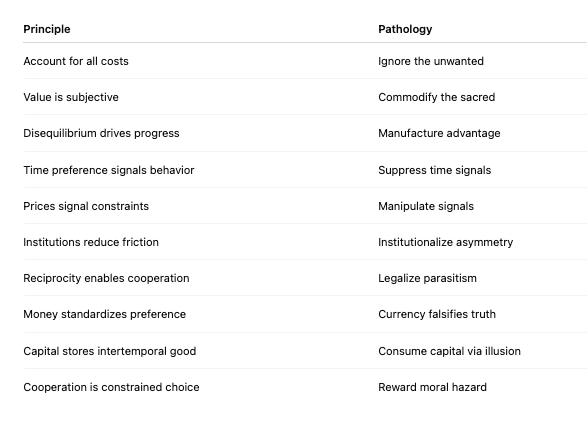
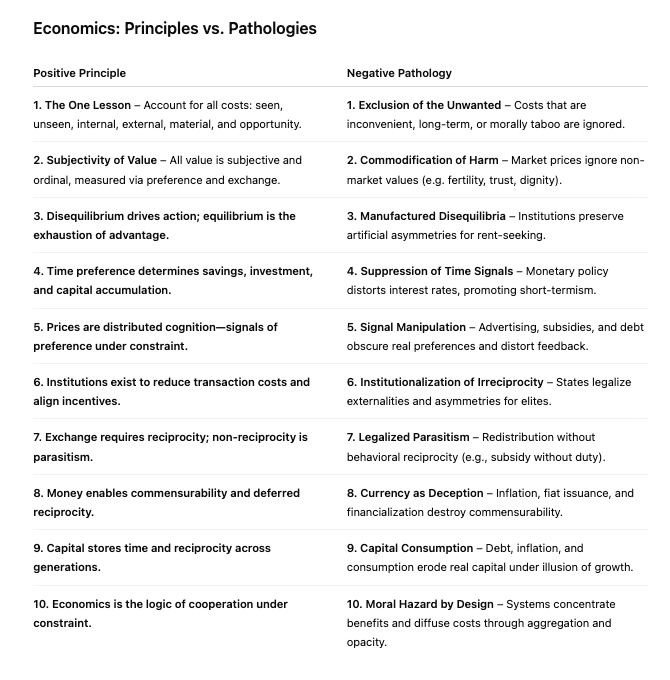
  • A Couple of Useful Charts for Hoe_Math-icists. ;) Economic Principles vs Patholo

    A Couple of Useful Charts for Hoe_Math-icists. 😉 Economic Principles vs Patholo

    A Couple of Useful Charts for Hoe_Math-icists. 😉
    Economic Principles vs Pathologies

    (PS: Yeah, don’t plagiarize my work or HM’s either 😉 ) https://t.co/q4FYFPth30


    Source date (UTC): 2025-04-25 04:10:42 UTC

    Original post: https://twitter.com/i/web/status/1915619451468472639

    Reply addressees: @ItIsHoeMath

    Replying to: https://twitter.com/i/web/status/1915582982980870313

  • A Couple of Useful Charts for Hoe_Math-icists. 😉 Economic Principles vs Patholo

    A Couple of Useful Charts for Hoe_Math-icists. 😉
    Economic Principles vs Pathologies

    (PS: Yeah, don’t plagiarize my work or HM’s either 😉 )


    Source date (UTC): 2025-04-25 04:10:42 UTC

    Original post: https://twitter.com/i/web/status/1915619451397169153