Category: Commentary, Critique, and Response

  • 4) Hicks’ argument, which you did not understand, is that POMO is an evolution o

    4) Hicks’ argument, which you did not understand, is that POMO is an evolution of the (Marxist) means by which to circumvent reciprocity (science, economics, and law) by claiming power (science/truth, law/power, economics/necessity) is sentimental and psychological (arbitrary).


    Source date (UTC): 2018-10-25 13:10:50 UTC

    Original post: https://twitter.com/i/web/status/1055446588112470016

    Reply addressees: @PhilosophyCuck @WorMartiN

    Replying to: https://twitter.com/i/web/status/1055224404764999680


    IN REPLY TO:

    @Jonas_Ceika

    @curtdoolittle @WorMartiN You also end by saying one should study law, not literature. First off, I don’t study literature. Secondly, how is that an argument? And how is if Marx is liable for murder at all relevant to my points? I’m genuinely confused.

    Original post: https://twitter.com/i/web/status/1055224404764999680
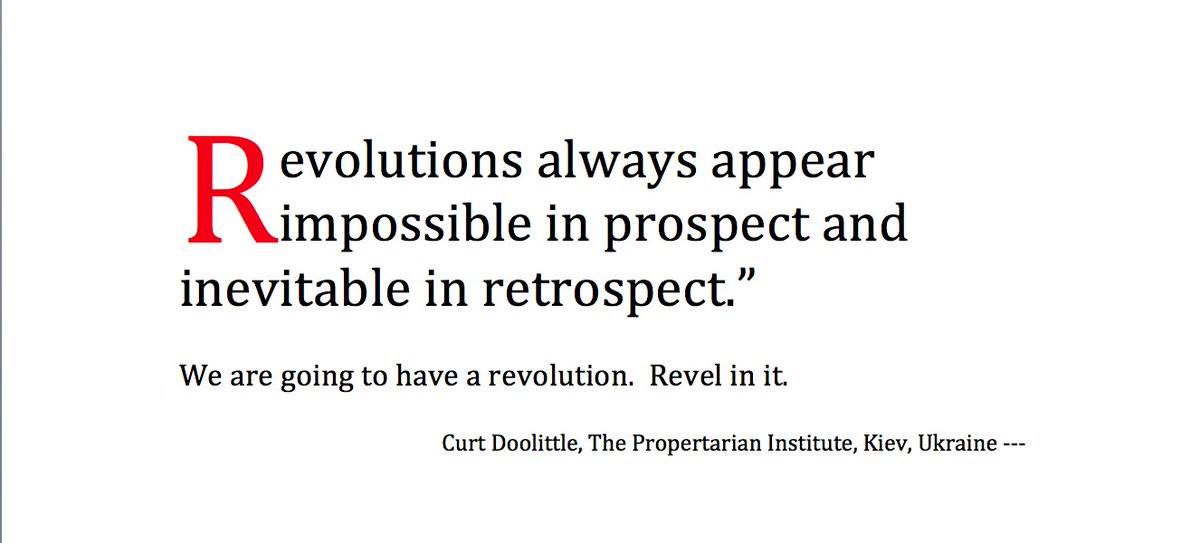
  • 1) I’m happy to go into depth on this subject but the argument is quite simple,

    1) I’m happy to go into depth on this subject but the argument is quite simple, and was put forward by one of your commenters:
    –“Postmodernists: question who controls knowledge and where it comes from”–


    Source date (UTC): 2018-10-25 12:56:32 UTC

    Original post: https://twitter.com/i/web/status/1055442990527889410

    Reply addressees: @PhilosophyCuck @WorMartiN

    Replying to: https://twitter.com/i/web/status/1055224404764999680


    IN REPLY TO:

    @Jonas_Ceika

    @curtdoolittle @WorMartiN You also end by saying one should study law, not literature. First off, I don’t study literature. Secondly, how is that an argument? And how is if Marx is liable for murder at all relevant to my points? I’m genuinely confused.

    Original post: https://twitter.com/i/web/status/1055224404764999680

  • POSTMODERN BOOKCASE (humor) (via @[507283246:2048:Stephen Hicks])

    POSTMODERN BOOKCASE

    (humor)

    (via @[507283246:2048:Stephen Hicks])


    Source date (UTC): 2018-10-25 10:13:00 UTC

  • SHARING AGAIN (humor) –“What if I don’t get it?”– It’s subtle. the original so

    https://www.bitchute.com/video/07bRmXfwONfx/?fbclid=IwAR2NTjbUq3zq9eEljDMikfHdywwrw_ejgYIyUcaWdYjWLAF9AToxCM-rReMWORTH SHARING AGAIN

    (humor)

    –“What if I don’t get it?”–

    It’s subtle. the original song is ostensibly about women but is actually about the music industry (and society) itself. By replacing the characters it’s about the mainstream media and the npc society. I suspect most people won’t get it at that level, and I’m not even sure that the guy who made it was conscious of the essay he was creating or not, or he just intuited it and ‘went there’ unconsciously. Either way it’s freaking funny at the low level and brilliant at the artistic(political) level. I’m forever in his debt. šŸ˜‰

    https://www.bitchute.com/video/07bRmXfwONfx/?fbclid=IwAR2NTjbUq3zq9eEljDMikfHdywwrw_ejgYIyUcaWdYjWLAF9AToxCM-rReM


    Source date (UTC): 2018-10-25 08:37:00 UTC

  • “How many shacks could a serf shack stack if a serf stack could stack shacks?”–

    —“How many shacks could a serf shack stack if a serf stack could stack shacks?”—Micah Pezdirtz


    Source date (UTC): 2018-10-25 00:15:40 UTC

    Original post: https://twitter.com/i/web/status/1055251512300134400

  • UPDATE: Just had a post removed by FB, but wasn’t banned, for quoting Emil Preli

    UPDATE: Just had a post removed by FB, but wasn’t banned, for quoting Emil Prelic’s rant, when I was using it as an example of east and west differences in valuation of the church.

    At least I wasn’t (yet) banned. I don’t particularly mind them removing or hiding posts. Banning is just out of hand.


    Source date (UTC): 2018-10-24 22:39:00 UTC

  • You didn’t come close to making an argument – just made excuses. I think you sho

    You didn’t come close to making an argument – just made excuses. I think you should address my response. It’s not worth hick’s time to answer that kind of ‘critique’ (Straw man). You can either make a scientific argument (not one of ‘intentions’ or ‘meaning’) or you can’t.


    Source date (UTC): 2018-10-24 20:43:38 UTC

    Original post: https://twitter.com/i/web/status/1055198149898395651

    Reply addressees: @WorMartiN @PhilosophyCuck

    Replying to: https://twitter.com/i/web/status/1054975670453972992


    IN REPLY TO:

    Original post on X

    Original tweet unavailable — we could not load the text of the post this reply is addressing on X. That usually means the tweet was deleted, the account is protected, or X does not expose it to the account used for archiving. The Original post link below may still open if you view it in X while signed in.

    Original post: https://twitter.com/i/web/status/1054975670453972992

  • photos_and_videos/TimelinePhotos_43196237263/44753968_10156730939212264_84638868

    photos_and_videos/TimelinePhotos_43196237263/44753968_10156730939212264_84638868

    photos_and_videos/TimelinePhotos_43196237263/44753968_10156730939212264_8463886896819339264_o_10156730939202264.jpg Dylan McLaughlinDieser staat geht unterOct 24, 2018 9:16pm


    Source date (UTC): 2018-10-24 19:24:00 UTC

  • Lying despite telling the truth

    October 24th, 2018 9:00 PM https://www.sciencedirect.com/science/article/pii/S0010027716300178

    LYING DESPITE TELLING THE TRUTH Highlights •We defend a subjective view on lying that does not require objective falsity. •Four experiments suggest that the subjective view fits with most people’s intuitions. •Conversational pragmatics can explain findings favoring an objective view. •Implications for research about people’s concepts are discussed. Abstract According to the standard definition of lying an utterance counts as a lie if the agent believes the statement to be false. Thus, according to this view it is possible that a lie states something that happens to be true. This subjective view on lying has recently been challenged by Turri and Turri (2015) who presented empirical evidence suggesting that people only consider statements as lies that are objectively false (objective view). We argue that the presented evidence is in fact consistent with the standard subjective view if conversational pragmatics is taken into account. Three experiments are presented that directly test and support the subjective view. An additional experiment backs up our pragmatic hypothesis by using the uncontroversial case of making a promise.

  • Lying despite telling the truth

    October 24th, 2018 9:00 PM https://www.sciencedirect.com/science/article/pii/S0010027716300178

    LYING DESPITE TELLING THE TRUTH Highlights •We defend a subjective view on lying that does not require objective falsity. •Four experiments suggest that the subjective view fits with most people’s intuitions. •Conversational pragmatics can explain findings favoring an objective view. •Implications for research about people’s concepts are discussed. Abstract According to the standard definition of lying an utterance counts as a lie if the agent believes the statement to be false. Thus, according to this view it is possible that a lie states something that happens to be true. This subjective view on lying has recently been challenged by Turri and Turri (2015) who presented empirical evidence suggesting that people only consider statements as lies that are objectively false (objective view). We argue that the presented evidence is in fact consistent with the standard subjective view if conversational pragmatics is taken into account. Three experiments are presented that directly test and support the subjective view. An additional experiment backs up our pragmatic hypothesis by using the uncontroversial case of making a promise.