Category: Civilization, History, and Anthropology

  • THE SECRET TO JEWISH SUCCESS: EXTREME FEMINISM Jews have, more successfully than

    THE SECRET TO JEWISH SUCCESS: EXTREME FEMINISM

    Jews have, more successfully than all other people, and somewhat by accident of selective upward redistribution of reproduction transferred… https://www.facebook.com/permalink.php?story_fbid=287207388542825&id=100017606988153


    Source date (UTC): 2018-08-26 15:42:17 UTC

    Original post: https://twitter.com/i/web/status/1033741427673579520

  • We are the people who smith.

    INDO EUROPEANS DEVELOPED MAGIC BECAUSE OF METALWORKING (Magic) —-“In Indo-European civilizations,” writes Francois-Xavier Dillman, “magic definitely cannot be disassociated from all of the beliefs, representations, religious rites […] on the contrary, it is one of the most prevalent components, one of those that resists the most against Christianization. The same author underlines that runic writing and Germanic magic are often “one and the same.” Patrick Moisson also emphasizes that there is a fine line between magic and religion, but he notes that whereas religion seeks to conciliate divinities with sacrifice and worship, magic “constrains divine powers with appropriate rites,” which assumes the existence of impersonal forces and “means to constrain the supernatural world.”— SEMITIC CIVILIZATION DEVELOPED MYSTICISM BECAUSE OF THE STARS.


    Curt Doolittle Our oldest myth is the blacksmith and the demon(devil), which we know as “Faust”. Our other oldest mythical figure is the Green Man, which for most of history were elves, but diverged into a whole family of Germanic and Scandinavian versions from fairies to trolls. Tom McSweeny: Some nice tales here regarding blacksmiths and their association with magic because of their absolutely astounding roi for the society from round Europe and furtherhttp://www.sacred-texts.com/etc/mhs/mhs10.htm Liupold Engelwulf : Adding bones to up the carbon content. Imagine tossing your ancestors bones or your enemies bones into the forge… only to see the output become harder steel.

  • We are the people who smith.

    INDO EUROPEANS DEVELOPED MAGIC BECAUSE OF METALWORKING (Magic) —-“In Indo-European civilizations,” writes Francois-Xavier Dillman, “magic definitely cannot be disassociated from all of the beliefs, representations, religious rites […] on the contrary, it is one of the most prevalent components, one of those that resists the most against Christianization. The same author underlines that runic writing and Germanic magic are often “one and the same.” Patrick Moisson also emphasizes that there is a fine line between magic and religion, but he notes that whereas religion seeks to conciliate divinities with sacrifice and worship, magic “constrains divine powers with appropriate rites,” which assumes the existence of impersonal forces and “means to constrain the supernatural world.”— SEMITIC CIVILIZATION DEVELOPED MYSTICISM BECAUSE OF THE STARS.


    Curt Doolittle Our oldest myth is the blacksmith and the demon(devil), which we know as “Faust”. Our other oldest mythical figure is the Green Man, which for most of history were elves, but diverged into a whole family of Germanic and Scandinavian versions from fairies to trolls. Tom McSweeny: Some nice tales here regarding blacksmiths and their association with magic because of their absolutely astounding roi for the society from round Europe and furtherhttp://www.sacred-texts.com/etc/mhs/mhs10.htm Liupold Engelwulf : Adding bones to up the carbon content. Imagine tossing your ancestors bones or your enemies bones into the forge… only to see the output become harder steel.

  • MAGIC, INDO-EUROPEANS AND THE TAMING OF THE MASSES by Daniel Gurpide (awesome) F

    MAGIC, INDO-EUROPEANS AND THE TAMING OF THE MASSES

    by Daniel Gurpide

    (awesome)

    From an anthropological perspective, traditional magic practices were perfectly adequate to a certain level of development. In this sense, ‘authentic’ magic aims at clarifying a psycho-technique (self-discipline) with a specific goal in mind; it guides man into the appropriate form for a given project. It either prepares man to bear without excessive anxiety the hostile pressures of a universe that he does not yet control, or it helps give free reign to certain instincts and repress others, so that he can accomplish more successfully a certain undertaking.

    With this type of magic, man had learnt to manipulate himself. He had given himself a self-chosen nature, and had succeeded in his hominisation. Hence, authentic magic constitutes the original ‘know-how’ of human self-domestication, and the domestication of the psyche by consciousness, organised by a science that was born through reflection on the know-how of animal nature.

    Magic degenerates as soon as it claims to find application to a relation diverse from the one instituted between consciousness and psyche: that is, between man (as living being) and the world (as event), under the wholly imaginary pretext that the human psyche participates in the cause of that event. It then leads to a cosmological theory that is entirely unfounded. On the other hand, where this reflection allows him to isolate the true terms of the ‘magic relation,’ man acquires an exact description of himself and his circumstances, and of the position he occupies within the living world. He transforms himself, from then on, into the domesticator of the living world.

    Hundreds of thousands of years after hominisation, it was with the Indoeuropean/Neolithic Revolution that another type of man emerges. Having learned what ‘moves’ himself, man tries now to ‘move’ animals and plants according to his wishes and needs. As far as social animals are concerned, he intends to take on a directive role, becoming the leader of the pack. Similarly, having attained a superior consciousness—thanks to the correct understanding of magic—he presents himself as aristocracy in relation to the rest of society and affirms his own sovereignty.

    With the advent of Indoeuropeans, man’s taming of the living world occurred in parallel to the taming of the mass—by the elite. Hereafter, ‚religion‘ comes to be the ideological system that will serve to ‘tie fast’ society and subject the group to a certain influence.

    (from Curt: Man began domestication of man, just as he had domesticated Fire, Metal, Plant, and Animal. That is the meaning of aristocracy: parenting (domesticating) the animal (lacking agency) man. )


    Source date (UTC): 2018-08-26 15:06:00 UTC
  • German Excellence

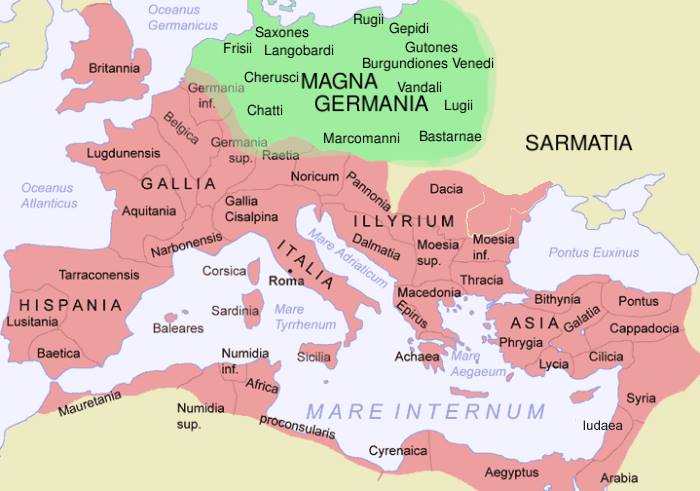
    Germans do not achieve excellence by radical IQ as do the Anglos, they achieve it by Truth, Duty, and Piety. You can’t learn IQ, but you can learn Truth, Duty, and Piety. And if you HAVE IQ nothing stops you from ALSO adopting Truth, Duty, and Piety.

  • German Excellence

    Germans do not achieve excellence by radical IQ as do the Anglos, they achieve it by Truth, Duty, and Piety. You can’t learn IQ, but you can learn Truth, Duty, and Piety. And if you HAVE IQ nothing stops you from ALSO adopting Truth, Duty, and Piety.

  • We Had No Religion only Law, Oath, Festival and Myth (Literature)

    —“It is perhaps misleading even to say that there was such a religion as paganism at the beginning of [the Common Era] … It might be less confusing to say that the pagans, before their competition with Christianity, had no religion at all in the sense in which that word is normally used today. They had no tradition of discourse about ritual or religious matters (apart from philosophical debate or antiquarian treatise), no organized system of beliefs to which they were asked to commit themselves, no authority-structure peculiar to the religious area, above all no commitment to a particular group of people or set of ideas other than their family and political context. If this is the right view of pagan life, it follows that we should look on paganism quite simply as a religion invented in the course of the second to third centuries AD, in competition and interaction with Christians, Jews and others. — North 1992, 187—88, [34]

  • We Had No Religion only Law, Oath, Festival and Myth (Literature)

    —“It is perhaps misleading even to say that there was such a religion as paganism at the beginning of [the Common Era] … It might be less confusing to say that the pagans, before their competition with Christianity, had no religion at all in the sense in which that word is normally used today. They had no tradition of discourse about ritual or religious matters (apart from philosophical debate or antiquarian treatise), no organized system of beliefs to which they were asked to commit themselves, no authority-structure peculiar to the religious area, above all no commitment to a particular group of people or set of ideas other than their family and political context. If this is the right view of pagan life, it follows that we should look on paganism quite simply as a religion invented in the course of the second to third centuries AD, in competition and interaction with Christians, Jews and others. — North 1992, 187—88, [34]