Category: Civilization, History, and Anthropology

  • photos_and_videos/TimelinePhotos_43196237263/42289745_10156655080157264_37660429

    photos_and_videos/TimelinePhotos_43196237263/42289745_10156655080157264_3766042941080993792_n_10156655080152264.jpg Jesse Van SteelandtAre the indo Europeans of India of the same stock as the Pashtuns from Pakistan and Afghanistan? Caucasoid or not, they are still a fairly violent/degenerate people.Sep 22, 2018 1:14pmDawid WellaThe Pashtuns are a hotch potch of tribal raiders of Iranic and possibly also Turkic descentSep 22, 2018 1:19pmJesse Van SteelandtGo on….Sep 22, 2018 1:23pmLance KennedyWhat’s your take on Dravidians?Sep 22, 2018 1:59pmGöran DahlThey’re different from each other. Pashtuns have a lot more Iran_Neolithic than Indians, who also have Onge-like ancestry and East Asian ancestry. High caste Indians and Pashtuns have similar levels of actual Indo-European ancestry, but the Pashtuns still beat them by a small margin.Sep 22, 2018 2:26pmCurt DoolittleDon’t really have one.Sep 22, 2018 2:49pm


    Source date (UTC): 2018-09-22 13:03:00 UTC

  • ANOTHER TAKE ON INDIAN ORIGINS by Mark Lanzarotta, The ancestors of the Dravidia

    ANOTHER TAKE ON INDIAN ORIGINS

    by Mark Lanzarotta,

    The ancestors of the Dravidians, the Proto-Elamites, originated from a Zarzian (Nostratic) migration from the Zagros Mountains to Turkmenistan around 13,000 BC. They were driven from there in 8000 BC by Proto-Sumerians from the Altais and fled to Iran, where they gave rise to the Elamites, among others. They began to drift into India around 7000 BC and wrested it from the Nihalis (the new arrivals started the Mehrgarh civilization, a blend of Dravidians and native Nihalis). The Mundas didn’t exist yet, they came from Yunnan later. The Dravidians married the Australoid indigenes and became quite dark, though they imposed their language on the conquered people. In the Indus Valley was invented Dentistry by these people. The Iranian Dravidians (Elamites) drove the Kartvelians from Mazanderan to the Caucasus around 6000 BC. The Indus Valley people had terrible floods and plagues which drove them south. The Aryans, a mixture of Iranians and Hunas, began to filter into India around 1300 BC, absorbing some Dravidians and driving the others south. The Indo-Aryan kingdoms mentioned in the Mahabharata were established by 1100 BC. Bengal remained Dravidian much longer than western India, though they were eventually conquered. Bengal means “God’s Country” in the language of the Mundas, the original inhabitants.

    The Dravidians were related to but not the same as Elamites, since they arose as a mixture of Elamites and African settlers from the Horn of Africa in the Ormozgan area of southeastern Iran, around 7500 BC.

    The ancient Adivasis or Australoids originally spoke Australian languages before the Dravidians conquered them. The Dravidians are related to Austro-Asiatics like the Mundas through extensive admixture in India, though not by common origin. Dravidians are Nostratics with an Eritrean admixture, they have a separate origin from the Austric peoples. The Australoid Adivasis are among the oldest Indians of them all, they arrived in India in 60,000 BC. But they were preceded by the Negrito ancestors of the Andamese, who were in Uttar Pradesh as early as 85,000 BC. Before them Denisovan hominin and Homo Erectus lived in India for countless ages, and a few of their most ancient genes are still in the Indian people today.


    Source date (UTC): 2018-09-22 12:53:00 UTC

  • MY TAKEAWAY IS THAT THE LOSS OF THE HRAPPAN CIVILIZATION WAS EQUIVALENT IN DAMAG

    MY TAKEAWAY IS THAT THE LOSS OF THE HRAPPAN CIVILIZATION WAS EQUIVALENT IN DAMAGE TO THE MUSLIM CONQUEST.

    (China was wise to build her walls. We must imitate her leadership.)

    J R Updated Feb 4

    The first peoples in India were Austro-Asiatics who arrived 50,000 years ago. Their journey started in East Africa in what is Ethiopia.

    These are the same peoples living in the Andaman Islands, Papua New Guinea, and the Australian Aborigines.

    These peoples were able to use canoes and fishing to navigate the coastal waters and settled along islands from India to Australia – and their populations can be found along those islands today.

    Proto-Dravidians developed in India over about tens of thousands of years through the admixture of Austro-Asiatic, Indo-European, and Tibeto-Burmese DNA.

    They became an advanced urbane civilization based on agriculture and maritime trade, which was the largest by both land area, economy, and population in the ancient world.

    They formed the Indus Valley Civilization and later migrated to South India, and also South-East Asia.

    During this time, India continued to experience immigration from outside lands, and analysis of the Mehargh population shows that the from 7000 BCE to 2500 BCE the population had changed.

    As the Indus Valley were expert sea farers, and the early Austro-Asiatics were sea farers, my postulatation is that the proto-Dravidians had originated from the Austro-Asiatics.

    The Vedic Aryans on the other hand were land based, using the horse and chariot, metal working, and cattle husbandry. They originated from the central Eurasian steppe and came by way of Afghanistan to India.

    Even earlier then them, it is believed there was a migration Westward to Europe of the proto-Indo-Europeans, and the Vedics share many similarities linguistically, culturally, and religiously with Slavs, Celts, Greeks, and other early European peoples. This includes clans led by chiefs and priests/druids, soma and potions, nature worship, as well as common root words.

    Along the way, they left some of their cousins in Afghanistan. These cousins would become the Zorastrians, moved to Iran and formed the Persian Empire.

    The Zorastrians are more recently related to the Vedics and have even more commonalities like ritual fire, which Vedics called Yagna and Zorastrians called Yazna. Soma which the Zorastrians called Haoma, etc.

    However, the Zorastrians adopted a dualistic monotheism and discarded nature worship. They also added many ideas of their own innovation that are believed to have been borrowed by or influenced the Abrahamic religions including resurrection, good and evil, Satan, and armageddon – these concepts don’t exist in the Eastern religions.

    The Vedics kept everything of their past and added to it, eventually adding dualism, non-dualism, and qualified non-dualism into what would become the philosophy of Yoga.

    This philosophy of Yoga is believed to take its roots from the ancient Dravidian religion but developed further until it was distilled into a goal of immortality through Self realization which was to realize through union of absorption (Yoga) that the Universe comprised of two principles, a male principle, the transcendent formless God which was pure mind, pure existence, and pure bliss (sat chit ananda), and shakti or energy the female principle which through Maya or the capacity for dimensionality formed the entire Universe and gave birth to time and causality (karma). Through this realization, the small soul (jiva), can realize its identity with an absolute existence that is outside of time and therefore not subject to impermanence or decay, and through the purification of desires in the heart escapes the cycle of birth and death. Although the soul is immortal, due to it’s ignorance (avidya), at death its desires will lead it to take birth again and again, in various lokas (planes of existence), as per its deeds and merits which form the basis of future thoughts and actions (also karma).

    Free will exists but is not fully exercised because the soul is not entirely free from its causal nature.

    Therefore all beings take birth as a result of desire, except the perfected beings or divine incarnations (Avatars), which take birth with full knowledge of their divine nature for a higher purpose.

    This in a nutshell was the culmination of the Vedic philosophy that occurred by around 700 BCE.

    The Rig Veda’s later books start to delve into this area, but the earlier books are properly in the realm of nature worship.

    The Rig Veda makes few references to sea faring, but regularly refers to chariots, cattle, horses, and metal work.

    The frequency of their vocabulary references tells us their cultural milieu. They were aware of the ocean and the ships, but it was not an integral part of their daily life.

    However, sea faring was an integral part of the Dravidian way of life, and this is also why we suspect they are the original founders of the Indus Valley Civilization – which relied extensively on sea trading with Mesopotamia.

    Today studies have show that Indians, even isolated tribal populations, have a mix of DNAs from every part of the world notably Austro-Asiatic, Indo-European, and Mongoliod with a spectrum of variations between regional populations.

    The chronology seems to indicate that the mature civilization of Indus Valley was weakened by weather changes, especially drought and the decline of major rivers that were glacier fed. These glaciers formed in the last ice age that ended around 10,000 BCE and held in the Himalayas vast stores of water. As they retreated, they fed glacial streams and rivers, which gave steady supply of drinking quality water to the Indus river basin, that was further enriched by the monsoon rains.

    The Himalayas are huge and glaciers appear to have provided water for several thousand years but eventually the rivers start to dry up, and the entire way of life that depends on them is now facing uncertainty with droughts becoming common and many cities being abandoned. Some key cities remain but only a fraction of what existed before.

    At this time, the nomadic Vedics arrive and are attracted by wealth of the Indus cities and appear to be in a conflict.

    The Vedics have the advantage of the horse and the archer. The Indus Valley had no horses but they may have had the ass or donkey. The horse does not appear in any seal – although there is one disputed seal that could be a small horse.

    The Vedic hymns describe chargers, coursers, steeds very frequently – large, fast and powerful horses. If Indus Valley was the same as the Rig Vedics, they would have had many artifacts of horses. Whereas many animals are found, horse is notably absent.

    The horse is originally from the central Eurasian steppe, so it would make sense that the people coming from that area have the horse before anyone else.

    After taking over these cities, the Vedics seem to realize that the Indus Valley was very advanced, and have soon adopted their ideas and philosophy.

    By the time, we get into the late Rig Veda, they are no longer roving barbarians seeking spoils and treasure, but have mellowed out quite a bit.

    They have now adopted and integrated with the Indus religion and culture. Also, they may have taken Dravidian wives. The later Rig Veda starts to show the pre-cursors of Upanishadic thinking.

    The creation hymn Nasadiya Sukta – considered to be one of the newest hymns – is a completely different form of thinking than the incantations of the early Vedic hymns.

    This is so different that we have to suspect these ideas are coming from the proto-Dravidian religion and have developed further similar to the Hellenistic syncretism that occurs 500 years later.


    Source date (UTC): 2018-09-22 12:49:00 UTC
  • THERE ARE NO CAUCASIANS REMAINING IN INDIA? —“India has been underrepresented

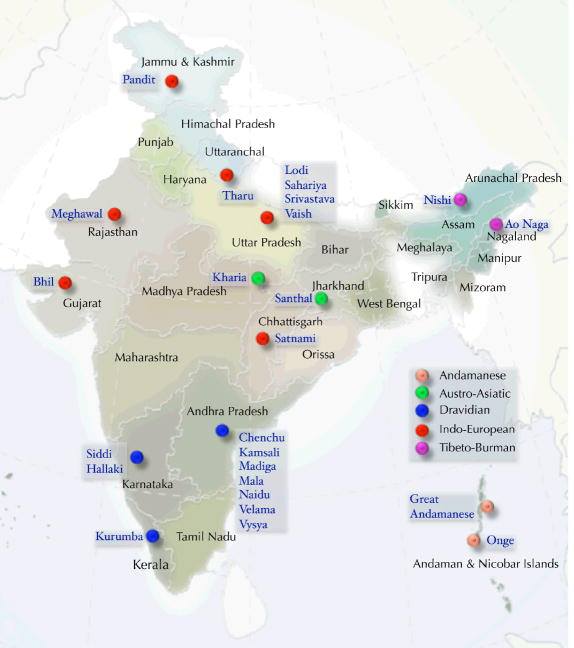
    THERE ARE NO CAUCASIANS REMAINING IN INDIA?

    —“India has been underrepresented in genome-wide surveys of human variation. We analyze 25 diverse groups to provide strong evidence for two ancient populations, genetically divergent, that are ancestral to most Indians today. One, the “Ancestral North Indians” (ANI), is genetically close to Middle Easterners, Central Asians, and Europeans, while the other, the “Ancestral South Indians” (ASI), is as distinct from ANI and East Asians as they are from each other. By introducing methods that can estimate ancestry without accurate ancestral populations, we show that ANI ancestry ranges from 39-71% in India, and is higher in traditionally upper caste and Indo-European speakers. Groups with only ASI ancestry may no longer exist in mainland India. However, the Andamanese are an ASI-related group without ANI ancestry, showing that the peopling of the islands must have occurred before ANI-ASI gene flow on the mainland. Allele frequency differences between groups in India are larger than in Europe, reflecting strong founder effects whose signatures have been maintained for thousands of years due to endogamy. We therefore predict that there will be an excess of recessive diseases in India, different in each group, which should be possible to screen and map genetically.”—


    Source date (UTC): 2018-09-22 12:46:00 UTC

  • All three species of homo (mongoloid, negroid, and caucasoid) were incredibly su

    All three species of homo (mongoloid, negroid, and caucasoid) were incredibly successful. The Dravidians and Australoids were successful but not competitive. And it certainly appears that the Australoids and their relations nearby actually devolved for some reason – perhaps lack of competition.

    The steppe and desert have been increasing aggression for thousands of years, and pushing evolution outward from the world center of trade (intersection of trade routes).

    My argument suggests, that humans have INCREASED in aggression and theft by VIOLENCE has only been SUBSTITUTED by theft by indirection (externality).

    And humans are now competing by externality.

    And that pro-social behavior is a cover for competition by externality.

    ie: A mask.


    Source date (UTC): 2018-09-22 11:23:00 UTC

  • Not only is ethnocentrism the optimum group evolutionary strategy, but duplicity

    Not only is ethnocentrism the optimum group evolutionary strategy, but duplicity (parasitism) is the optimum outgroup strategy, since it avoids the cost of conquest and replacement.


    Source date (UTC): 2018-09-22 10:33:00 UTC

  • “For the last 1500 years history has been a north sea family feud. Large men in

    —“For the last 1500 years history has been a north sea family feud. Large men in beards arguing about who gets the cod fishery created the market that caused to world to progress. it’s an anglo-celtic-germanic-nordic-franco world and everyone else just lives here.”— Ryan Williams


    Source date (UTC): 2018-09-22 08:49:00 UTC

  • September 22nd, 2018 1:44 PM [N]ote that all groups are split into classificatio

    September 22nd, 2018 1:44 PM [N]ote that all groups are split into classifications other than homo sapiens. There are at least three and arguably four species of homo sapiens. There was a movement to group humans and chimpanzees but chimps and bonobos can interbreed, and Europeans, East asians, and africans can interbreed.

  • September 22nd, 2018 1:28 PM [O]ur Women Were Recruited and Defected Again, Just

    September 22nd, 2018 1:28 PM

    [O]ur Women Were Recruited and Defected Again, Just as Under Christianity. …
    … Fool us once, shame on them.
    … Fool us twice, shame on us.

  • Big Families Are Not Really Difficult

    September 22nd, 2018 1:02 PM BIG FAMILIES ARE NOT REALLY DIFFICULT
    by Nick Bailey

    —“Big families actually aren’t as much of a pain as the (((news media))) portrays. I had a carseat/stroller combo that lasted through the first 5 kids. I had 5 sons in a row, so baby clothes just got saved and passed to the next kid for years. Eventually, the workload of dealing with the younger kids gets spread out among both parents and the older kids. Feeding them is cheap if you just make one-pot meals at home.
    The first kid is the most expensive. Each one after that is generally less expensive, especially once you realize you don’t need all the stuff the ‘experts’ say you need. Good medical insurance is an absolute must, though.”—