Category: Civilization, History, and Anthropology

  • Trust, Cooperation (reciprocity), and Decidability of Limits Are Vectors that Develop a Civilization’s Long Term Success

    TRUST, COOPERATION (RECIPROCITY), AND DECIDABILITY OF LIMITS ARE VECTORS THAT DEVELOP A CIVILIZATION’S LONG TERM SUCCESS by Lucas Cort (Flawless – CD) The idea that everyone is equal appears to be a good rule for cooperation (when people share similarities) but it neglects full accounting in terms of differences in specialization, incentives,actions, and abilities. Individual: Morphology, cognition, incentives, preferences, morals, culture Genders: Morphology (bodies: bone structure and density, reproductive organs, endocrinology, brain structure distributions), reproductive strategies (incentives, preferences, morals, temperament) Races: Morphology (bodies: bone structure and density, reproductive organs, brain structure distributions), neoteny (rates and duration of sexual maturity), distributions of reproductive strategies, (incentives, preferences, morals, temperament) and group evolutionary strategies (cultural, organization and applications of violence) Classes: Rates of production, consumption, distributions of proceeding categories: (individual,genders,races) If we don’t address differences, we distort the measures that lead to decidability through full accounting and disambiguation. Differences in all these categories can be seen as specializations in the acquisition of genetic, social-cultural, and economic capital. They affect the way we act in the environment with others due to differing incentives. The result of demonstrated property (property-en-toto) shows that people invest and are willing to defend against the impositions of costs. Differing incentives, cognitive biases, reproductive and group evolutionary strategies show that people value property differently. Understanding that differences between the golden rule and the silver rule: Golden rule – “Do unto others as you would have done unto you” Silver rule – “Do not unto others as you would not have done unto you.” And

    Tolerance and forbearance:

    Tolerance – “I use Tolerance to mean allowing costs to be assessed against non-consenting parties as ambiguity makes it unclear what additional party is specifically responsible for costs” – Luke Weinhagen Forbearance – “Forbearance includes tolerance AND limits (until the cost one was willing carried has been exceeded), AND active participation – its a choice which one can boycott/defect based on the cost carried.” – Bill Joslin Clarifies limits, and aids in decidability to in and out group disputes. By disambiguating differences we can address the constant relations across and between these groups, and their interactions allows us to accurately measure transfers between them. Measuring violations of reciprocity under rule of law makes us equal before the law. We are not all equal, but if we insure each other against parasitism, we can preserve cooperation. That way, we don’t shift costs, and we identify group conflict so that we can focus on real solutions to incentivize cooperation. (CD: I can’t tell I didn’t write it myself. It’s flawless. it’s very difficult to get to this level of competency. color me impressed. thank you Lucas. )
  • Trust, Cooperation (reciprocity), and Decidability of Limits Are Vectors that Develop a Civilization’s Long Term Success

    TRUST, COOPERATION (RECIPROCITY), AND DECIDABILITY OF LIMITS ARE VECTORS THAT DEVELOP A CIVILIZATION’S LONG TERM SUCCESS by Lucas Cort (Flawless – CD) The idea that everyone is equal appears to be a good rule for cooperation (when people share similarities) but it neglects full accounting in terms of differences in specialization, incentives,actions, and abilities. Individual: Morphology, cognition, incentives, preferences, morals, culture Genders: Morphology (bodies: bone structure and density, reproductive organs, endocrinology, brain structure distributions), reproductive strategies (incentives, preferences, morals, temperament) Races: Morphology (bodies: bone structure and density, reproductive organs, brain structure distributions), neoteny (rates and duration of sexual maturity), distributions of reproductive strategies, (incentives, preferences, morals, temperament) and group evolutionary strategies (cultural, organization and applications of violence) Classes: Rates of production, consumption, distributions of proceeding categories: (individual,genders,races) If we don’t address differences, we distort the measures that lead to decidability through full accounting and disambiguation. Differences in all these categories can be seen as specializations in the acquisition of genetic, social-cultural, and economic capital. They affect the way we act in the environment with others due to differing incentives. The result of demonstrated property (property-en-toto) shows that people invest and are willing to defend against the impositions of costs. Differing incentives, cognitive biases, reproductive and group evolutionary strategies show that people value property differently. Understanding that differences between the golden rule and the silver rule: Golden rule – “Do unto others as you would have done unto you” Silver rule – “Do not unto others as you would not have done unto you.” And

    Tolerance and forbearance:

    Tolerance – “I use Tolerance to mean allowing costs to be assessed against non-consenting parties as ambiguity makes it unclear what additional party is specifically responsible for costs” – Luke Weinhagen Forbearance – “Forbearance includes tolerance AND limits (until the cost one was willing carried has been exceeded), AND active participation – its a choice which one can boycott/defect based on the cost carried.” – Bill Joslin Clarifies limits, and aids in decidability to in and out group disputes. By disambiguating differences we can address the constant relations across and between these groups, and their interactions allows us to accurately measure transfers between them. Measuring violations of reciprocity under rule of law makes us equal before the law. We are not all equal, but if we insure each other against parasitism, we can preserve cooperation. That way, we don’t shift costs, and we identify group conflict so that we can focus on real solutions to incentivize cooperation. (CD: I can’t tell I didn’t write it myself. It’s flawless. it’s very difficult to get to this level of competency. color me impressed. thank you Lucas. )

  • The Choice – and Our Civilization’s Choices

    The Choice – and Our Civilization’s Choices https://t.co/oHPMLaqcEG

  • The Choice – and Our Civilization’s Choices

    The Choice – and Our Civilization’s Choices https://propertarianism.com/2020/06/01/the-choice-and-our-civilizations-choices-2/


    Source date (UTC): 2020-06-01 13:29:39 UTC

    Original post: https://twitter.com/i/web/status/1267448222877876224

  • The Choice – and Our Civilization’s Choices

    Life separates plant from mineral. Consciousness separates animals from plants. Agency separates man from animals. And not everyone has agency. —Ryan Drummond Thus we have a choice. – Evolve the rest of man into agency (aryanism, africanism) – Cooperate at our current level of agency (hinduism) – Farm the rest of man that lacks agency (asianism) – Devolve man into the lack of agency (judaism and islam) —Curt Doolittle

  • The Choice – and Our Civilization’s Choices

    Life separates plant from mineral. Consciousness separates animals from plants. Agency separates man from animals. And not everyone has agency. —Ryan Drummond Thus we have a choice. – Evolve the rest of man into agency (aryanism, africanism) – Cooperate at our current level of agency (hinduism) – Farm the rest of man that lacks agency (asianism) – Devolve man into the lack of agency (judaism and islam) —Curt Doolittle

  • You Can’t Unsee It

    Their rapid verbal facility with gossip, pilpul, and critique, is not matched by intellectual achievement in arts, writing, innovation, or productivity. And, upon investigation, in all but the hardest of sciences, it still consists of false promise, baiting into hazard, rewards from undermining achieved, pilpul and critique.

  • You Can’t Unsee It

    Their rapid verbal facility with gossip, pilpul, and critique, is not matched by intellectual achievement in arts, writing, innovation, or productivity. And, upon investigation, in all but the hardest of sciences, it still consists of false promise, baiting into hazard, rewards from undermining achieved, pilpul and critique.

  • Click Your Heels Dorothy, We Found Home. 😉

    9718B608-52DF-49A4-BB10-D8188A4C6838

      CLICK YOUR HEELS DOROTHY, WE FOUND HOME. 😉

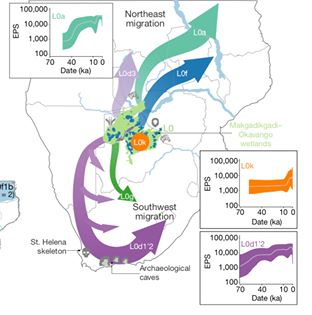
    —“By establishing mitogenomic timelines, frequencies and dispersals, we show that the L0 lineage emerged within the residual Makgadikgadi–Okavango palaeo-wetland of southern Africa7, approximately 200 ka (95% confidence interval, 240–165 ka). Genetic divergence points to a sustained 70,000-year-long existence of the L0 lineage before an out-of-homeland northeast–southwest dispersal between 130 and 110 ka. Palaeo- climate proxy and model data suggest that increased humidity opened green corridors, first to the northeast then to the southwest. Subsequent drying of the homeland corresponds to a sustained effective population size (L0k), whereas wet–dry cycles and probable adaptation to marine foraging allowed the southwestern migrants to achieve population growth (L0d1’2), as supported by extensive south-coastal archaeological evidence8–10. Taken together, we propose a southern African origin of anatomically modern humans with sustained homeland occupation before the first migrations of people that appear to have been driven by regional climate changes.”—

  • Click Your Heels Dorothy, We Found Home. 😉

    9718B608-52DF-49A4-BB10-D8188A4C6838

      CLICK YOUR HEELS DOROTHY, WE FOUND HOME. 😉

    —“By establishing mitogenomic timelines, frequencies and dispersals, we show that the L0 lineage emerged within the residual Makgadikgadi–Okavango palaeo-wetland of southern Africa7, approximately 200 ka (95% confidence interval, 240–165 ka). Genetic divergence points to a sustained 70,000-year-long existence of the L0 lineage before an out-of-homeland northeast–southwest dispersal between 130 and 110 ka. Palaeo- climate proxy and model data suggest that increased humidity opened green corridors, first to the northeast then to the southwest. Subsequent drying of the homeland corresponds to a sustained effective population size (L0k), whereas wet–dry cycles and probable adaptation to marine foraging allowed the southwestern migrants to achieve population growth (L0d1’2), as supported by extensive south-coastal archaeological evidence8–10. Taken together, we propose a southern African origin of anatomically modern humans with sustained homeland occupation before the first migrations of people that appear to have been driven by regional climate changes.”—