Short Version: The western Roman empire dramatically overextended but would have recovered, even from the invasions except for the folly of slaves(immigrants) and Christianity(Judaism / Marxism / Neo-Marxism / Feminism / Postmodernism), and finally the Islamic invasion and destruction of the civilized worlds. REASONS 1 – Overextension of Colonization: Celtic holocaust created the opportunity for north germanic migration, just as defeating Germany and Europe in WW2 left a vacuum for marxism Judaism and Islam today. And leaving African colonialization incomplete left opportunity for Islam. 2 – Overextension of Range – from the Mediterranean coastal army, with naval transport and strike capability – which is cheap – to a primarily territorial military among hostile less developed people that was expensive. In other words, the cost of domesticating (settling, urbanizing, spreading literacy, commerce, and law) Europe was too high for the returns. (just like today) 3 – Overextension of Agrarian Economy – the empire needed industrialization. The greeks failed to reform their economy. The Romans improved administration and organization – second to none 4 – Overextension of Technology – the empire given the technology at the time, which led to corruption, assassinations, and use of force to obtain rents, rather than profitable service of the state, to obtain status. (just like today) Bad Strategic Response to Overextension – Splitting the empire with the trade wealth in the greek east but the aristocracy in the roman west. Just like we have all these foreign costs in Europe and in the middle east just to protect Europe from oil price catastrophes – that don’t affect us. Overextension of Elites Necessary To Govern – empire so that the ratio of elites and middle class to conquered and slaves was too high to rule, just like we have too many non-whites to rule today, and the middle east to govern thru Israel and the monarchies today. Overextension of soldiery beyond supplying demographic – so that the military was no longer ‘citizens’ – but mercenaries – (Just like Hispanics, Blacks, and Muslims in the military today who are there for a jobs program not patriotism and ‘the people’) Overextension of Immigration (Slaves): slaves were the old world’s version of third world immigrants today. These people lack the values traditions and culture and if brought in sufficient numbers will always rebel against the host population until they defeat them. Overextension of TOLERANCE: Christianity undermined values like Christianity v2 (postmodernism-feminism-multiculturalism-equalitarianism) undermined our values. They shifted focus from European zest for life and achievement, for ignorance of life and fantasy after death. Christianity without warfare to dominate it, makes men weak. So Christianity prevented the restoration of the roman empire. Overextension and Vulnerability to Plague: The soldiers brought back either measles or smallpox or the plague from the middle east and decimated the population. Fragility to Shocks: The Muslim conquests destroyed the economies of the developed world, profit from conquest was exhausted by 1100, and islam’s mandatory ignorance reduced the developed civilizations to ashes. Judaism to undermine. Christianity to weaken, Islam to destroy the cancer of the abaramic religions – the war on civilization, evolution, and life itself. The answer for Rome and for America (europe) is the same: ethno-nationalization of the organs of state and organs of the state, and finance, at all levels, and specialization in running the state – not just here but anywhere we can function as a military, administrative, judicial elite (without outbreeding). Gibbon gave a classic formulation of reasons why the Fall happened. He gave great weight to internal decline as well as to attacks from outside the Empire. —“The story of its ruin is simple and obvious; and, instead of inquiring why the Roman empire was destroyed, we should rather be surprised that it had subsisted so long. The victorious legions, who, in distant wars, acquired the vices of strangers and mercenaries, first oppressed the freedom of the republic, and afterwards violated the majesty of the purple. The emperors, anxious for their personal safety and the public peace, were reduced to the base expedient of corrupting the discipline which rendered them alike formidable to their sovereign and to the enemy; the vigour of the military government was relaxed, and finally dissolved, by the partial institutions of Constantine; and the Roman world was overwhelmed by a deluge of Barbarians. … (AND) … As the happiness of a future life is the great object of religion, we may hear without surprise or scandal that the introduction, or at least the abuse of Christianity, had some influence on the decline and fall of the Roman empire… the soldiers’ pay was lavished on the useless multitudes of both sexes who could only plead the merits of abstinence and chastity… If the decline of the Roman empire was hastened by the conversion of Constantine, his victorious religion broke the violence of the fall, and mollified the ferocious temper of the conquerors.”— -Curt Doolittle
Category: Civilization, History, and Anthropology
-
Full Answer of Why Rome Fell: Overextension of The Heroic Population
Short Version: The western Roman empire dramatically overextended but would have recovered, even from the invasions except for the folly of slaves(immigrants) and Christianity(Judaism / Marxism / Neo-Marxism / Feminism / Postmodernism), and finally the Islamic invasion and destruction of the civilized worlds. REASONS 1 – Overextension of Colonization: Celtic holocaust created the opportunity for north germanic migration, just as defeating Germany and Europe in WW2 left a vacuum for marxism Judaism and Islam today. And leaving African colonialization incomplete left opportunity for Islam. 2 – Overextension of Range – from the Mediterranean coastal army, with naval transport and strike capability – which is cheap – to a primarily territorial military among hostile less developed people that was expensive. In other words, the cost of domesticating (settling, urbanizing, spreading literacy, commerce, and law) Europe was too high for the returns. (just like today) 3 – Overextension of Agrarian Economy – the empire needed industrialization. The greeks failed to reform their economy. The Romans improved administration and organization – second to none 4 – Overextension of Technology – the empire given the technology at the time, which led to corruption, assassinations, and use of force to obtain rents, rather than profitable service of the state, to obtain status. (just like today) Bad Strategic Response to Overextension – Splitting the empire with the trade wealth in the greek east but the aristocracy in the roman west. Just like we have all these foreign costs in Europe and in the middle east just to protect Europe from oil price catastrophes – that don’t affect us. Overextension of Elites Necessary To Govern – empire so that the ratio of elites and middle class to conquered and slaves was too high to rule, just like we have too many non-whites to rule today, and the middle east to govern thru Israel and the monarchies today. Overextension of soldiery beyond supplying demographic – so that the military was no longer ‘citizens’ – but mercenaries – (Just like Hispanics, Blacks, and Muslims in the military today who are there for a jobs program not patriotism and ‘the people’) Overextension of Immigration (Slaves): slaves were the old world’s version of third world immigrants today. These people lack the values traditions and culture and if brought in sufficient numbers will always rebel against the host population until they defeat them. Overextension of TOLERANCE: Christianity undermined values like Christianity v2 (postmodernism-feminism-multiculturalism-equalitarianism) undermined our values. They shifted focus from European zest for life and achievement, for ignorance of life and fantasy after death. Christianity without warfare to dominate it, makes men weak. So Christianity prevented the restoration of the roman empire. Overextension and Vulnerability to Plague: The soldiers brought back either measles or smallpox or the plague from the middle east and decimated the population. Fragility to Shocks: The Muslim conquests destroyed the economies of the developed world, profit from conquest was exhausted by 1100, and islam’s mandatory ignorance reduced the developed civilizations to ashes. Judaism to undermine. Christianity to weaken, Islam to destroy the cancer of the abaramic religions – the war on civilization, evolution, and life itself. The answer for Rome and for America (europe) is the same: ethno-nationalization of the organs of state and organs of the state, and finance, at all levels, and specialization in running the state – not just here but anywhere we can function as a military, administrative, judicial elite (without outbreeding). Gibbon gave a classic formulation of reasons why the Fall happened. He gave great weight to internal decline as well as to attacks from outside the Empire. —“The story of its ruin is simple and obvious; and, instead of inquiring why the Roman empire was destroyed, we should rather be surprised that it had subsisted so long. The victorious legions, who, in distant wars, acquired the vices of strangers and mercenaries, first oppressed the freedom of the republic, and afterwards violated the majesty of the purple. The emperors, anxious for their personal safety and the public peace, were reduced to the base expedient of corrupting the discipline which rendered them alike formidable to their sovereign and to the enemy; the vigour of the military government was relaxed, and finally dissolved, by the partial institutions of Constantine; and the Roman world was overwhelmed by a deluge of Barbarians. … (AND) … As the happiness of a future life is the great object of religion, we may hear without surprise or scandal that the introduction, or at least the abuse of Christianity, had some influence on the decline and fall of the Roman empire… the soldiers’ pay was lavished on the useless multitudes of both sexes who could only plead the merits of abstinence and chastity… If the decline of the Roman empire was hastened by the conversion of Constantine, his victorious religion broke the violence of the fall, and mollified the ferocious temper of the conquerors.”— -Curt Doolittle
-
photos_and_videos/TimelinePhotos_kg5QueHwVw/113999582_337846410946852_8739581538
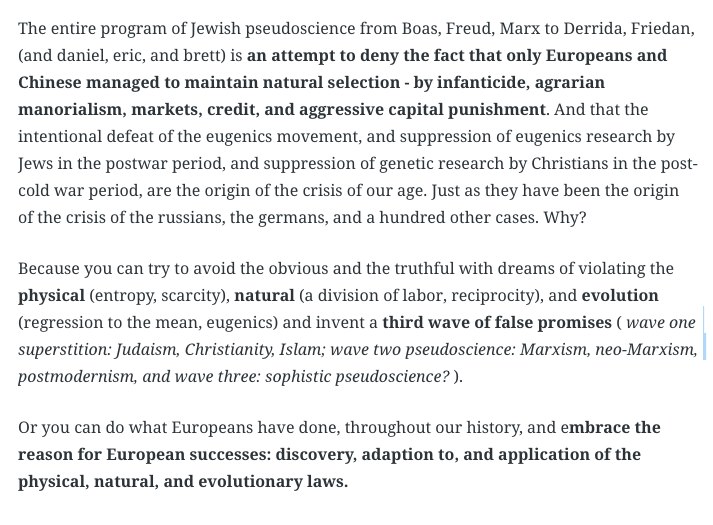
photos_and_videos/TimelinePhotos_kg5QueHwVw/113999582_337846410946852_8739581538865999549_n_337846407613519.jpg ONLY EUROPEANS AND EAST ASIANS SUCCEEDED
—“…only Europeans and the Chinese managed to maintain natural selection – by infanticide, agrarian manorialism, markets, credit, and aggressive capital punishment.”—
—“Or you can do what Europeans have done, throughout our history, and embrace the reason for European successes: discovery, adaption to, and application of the physical, natural, and evolutionary laws.”—ONLY EUROPEANS AND EAST ASIANS SUCCEEDED
—“…only Europeans and the Chinese managed to maintain natural selection – by infanticide, agrarian manorialism, markets, credit, and aggressive capital punishment.”—
—“Or you can do what Europeans have done, throughout our history, and embrace the reason for European successes: discovery, adaption to, and application of the physical, natural, and evolutionary laws.”—
Source date (UTC): 2020-07-25 18:10:00 UTC
-
Europeans like P because it puts into words what no one previously has, but they
Europeans like P because it puts into words what no one previously has, but they intuit, the reasons for European success (supremacy): discovery, adaptation, and application of physical (realism, naturalism, operationalism), natural (cooperative), and evolutionary (eugenic) laws
Source date (UTC): 2020-07-24 11:46:46 UTC
Original post: https://twitter.com/i/web/status/1286628889415098369
Reply addressees: @victorkfranco @TruthQuest11 @Nationalist7346 @Ozpin_88
Replying to: https://twitter.com/i/web/status/1286573149455147008
-
Europeans like P because it puts into words what no one previously has, but they
Europeans like P because it puts into words what no one previously has, but they intuit, the reasons for European success (supremacy): discovery, adaptation, and application of physical (realism, naturalism, operationalism), natural (cooperative), and evolutionary (eugenic) laws
Reply addressees: @victorkfranco @TruthQuest11 @Nationalist7346 @Ozpin_88 -
Eugenics
EUGENICS SUCCEEDS – EVEN PLATO DISCUSSED IT Eugenics (/juːˈdʒɛnɪks/; from Greek εὐ- “good” and γενής “come into being, growing”) is a set of beliefs and practices that aim to improve the genetic quality of a human population,[3][4] historically by excluding people and groups judged to be inferior and promoting those judged to be superior.[5] HISTORY The concept predates the term; Plato suggested applying the principles of selective breeding to humans around 400 BC. Early advocates of eugenics in the 19th century regarded it as a way of improving groups of people. In contemporary usage, the term eugenics is closely associated with scientific racism and white supremacism.[2] Modern bioethicists who advocate new eugenics characterise it as a way of enhancing individual traits, regardless of group membership. PRE-WAR SUCCESSES While eugenic principles have been practiced as early as ancient Greece, the contemporary history of eugenics began in the early 20th century, when a popular eugenics movement emerged in the United Kingdom,[6] and then spread to many countries, including the United States, Canada,[7] and most European countries. In this period, people from across the political spectrum espoused eugenic ideas. Consequently, many countries adopted eugenic policies, intended to improve the quality of their populations’ genetic stock. Such programs included both positive measures, such as encouraging individuals deemed particularly “fit” to reproduce, and negative measures, such as marriage prohibitions and forced sterilization of people deemed unfit for reproduction. Those deemed “unfit to reproduce” often included people with mental or physical disabilities, people who scored in the low ranges on different IQ tests, criminals and “deviants,” and members of disfavored minority groups. DOWNFALL The eugenics movement became associated with Nazi Germany and the Holocaust when the defense of many of the defendants at the Nuremberg trials of 1945 to 1946 attempted to justify their human-rights abuses by claiming there was little difference between the Nazi eugenics programs and the U.S. eugenics programs.[8] In the decades following World War II, with more emphasis on human rights, many countries began to abandon eugenics policies, although some Western countries (the United States, Canada, and Sweden among them) continued to carry out forced sterilizations. REVIVAL Since the 1980s and 1990s, with new assisted reproductive technology procedures available, such as gestational surrogacy (available since 1985), preimplantation genetic diagnosis (available since 1989), and cytoplasmic transfer (first performed in 1996), concern has grown about the possible revival of a more potent form of eugenics after decades of promoting human rights. CRITICISM A criticism of eugenics policies is that, regardless of whether negative or positive policies are used, they are susceptible to abuse because the genetic selection criteria are determined by whichever group has political power at the time.[9] Furthermore, many criticize negative eugenics in particular as a violation of basic human rights, seen since 1968’s Proclamation of Tehran[10] as including the right to reproduce. Another criticism is that eugenics policies eventually lead to a loss of genetic diversity, thereby resulting in inbreeding depression due to a loss of genetic variation.[11] Yet another criticism of contemporary eugenics policies is that they propose to permanently and artificially disrupt millions of years of evolution, and that attempting to create genetic lines “clean” of “disorders” can have far-reaching ancillary downstream effects in the genetic ecology, including negative effects on immunity and on species resilience.[12] (via wikipedia) EUGENICS The science is rather obvious. But…
—“The only necessary policy: Forced sterilization of the dependent sub-90’s would be the only policy necessary. Since 90 floats on the average, this policy would never have to change.”—
That’s called ‘positive’ (or hard) eugenics’. Well, we did it successfully prewar. But the postwar (a)propaganda (b) prohibition on research (c) pseudointellectual movements of Marxism, postmodernism, feminism, and HBD-Denialism are all predicated on suppressing this one continuation of natural selection. The industrial revolution ended it. And that means eugenics is a great filter, and that the end result is extinction.
—“Not only will no one agree to this, but it has to be one of the darkest and most horrific approaches to dealing with ‘double-digiters’. A better way imo would be a 1 or no child policy for welfare.”—
That’s called ‘negative’ (or soft) eugenics. If you need subsidy, you can’t demonstrate fitness. 1-child. Of course – that’s the right policy. 😉 And it’s what’s in our Constitutional recommendations.
-
Eugenics
EUGENICS SUCCEEDS – EVEN PLATO DISCUSSED IT Eugenics (/juːˈdʒɛnɪks/; from Greek εὐ- “good” and γενής “come into being, growing”) is a set of beliefs and practices that aim to improve the genetic quality of a human population,[3][4] historically by excluding people and groups judged to be inferior and promoting those judged to be superior.[5] HISTORY The concept predates the term; Plato suggested applying the principles of selective breeding to humans around 400 BC. Early advocates of eugenics in the 19th century regarded it as a way of improving groups of people. In contemporary usage, the term eugenics is closely associated with scientific racism and white supremacism.[2] Modern bioethicists who advocate new eugenics characterise it as a way of enhancing individual traits, regardless of group membership. PRE-WAR SUCCESSES While eugenic principles have been practiced as early as ancient Greece, the contemporary history of eugenics began in the early 20th century, when a popular eugenics movement emerged in the United Kingdom,[6] and then spread to many countries, including the United States, Canada,[7] and most European countries. In this period, people from across the political spectrum espoused eugenic ideas. Consequently, many countries adopted eugenic policies, intended to improve the quality of their populations’ genetic stock. Such programs included both positive measures, such as encouraging individuals deemed particularly “fit” to reproduce, and negative measures, such as marriage prohibitions and forced sterilization of people deemed unfit for reproduction. Those deemed “unfit to reproduce” often included people with mental or physical disabilities, people who scored in the low ranges on different IQ tests, criminals and “deviants,” and members of disfavored minority groups. DOWNFALL The eugenics movement became associated with Nazi Germany and the Holocaust when the defense of many of the defendants at the Nuremberg trials of 1945 to 1946 attempted to justify their human-rights abuses by claiming there was little difference between the Nazi eugenics programs and the U.S. eugenics programs.[8] In the decades following World War II, with more emphasis on human rights, many countries began to abandon eugenics policies, although some Western countries (the United States, Canada, and Sweden among them) continued to carry out forced sterilizations. REVIVAL Since the 1980s and 1990s, with new assisted reproductive technology procedures available, such as gestational surrogacy (available since 1985), preimplantation genetic diagnosis (available since 1989), and cytoplasmic transfer (first performed in 1996), concern has grown about the possible revival of a more potent form of eugenics after decades of promoting human rights. CRITICISM A criticism of eugenics policies is that, regardless of whether negative or positive policies are used, they are susceptible to abuse because the genetic selection criteria are determined by whichever group has political power at the time.[9] Furthermore, many criticize negative eugenics in particular as a violation of basic human rights, seen since 1968’s Proclamation of Tehran[10] as including the right to reproduce. Another criticism is that eugenics policies eventually lead to a loss of genetic diversity, thereby resulting in inbreeding depression due to a loss of genetic variation.[11] Yet another criticism of contemporary eugenics policies is that they propose to permanently and artificially disrupt millions of years of evolution, and that attempting to create genetic lines “clean” of “disorders” can have far-reaching ancillary downstream effects in the genetic ecology, including negative effects on immunity and on species resilience.[12] (via wikipedia) EUGENICS The science is rather obvious. But…
—“The only necessary policy: Forced sterilization of the dependent sub-90’s would be the only policy necessary. Since 90 floats on the average, this policy would never have to change.”—
That’s called ‘positive’ (or hard) eugenics’. Well, we did it successfully prewar. But the postwar (a)propaganda (b) prohibition on research (c) pseudointellectual movements of Marxism, postmodernism, feminism, and HBD-Denialism are all predicated on suppressing this one continuation of natural selection. The industrial revolution ended it. And that means eugenics is a great filter, and that the end result is extinction.
—“Not only will no one agree to this, but it has to be one of the darkest and most horrific approaches to dealing with ‘double-digiters’. A better way imo would be a 1 or no child policy for welfare.”—
That’s called ‘negative’ (or soft) eugenics. If you need subsidy, you can’t demonstrate fitness. 1-child. Of course – that’s the right policy. 😉 And it’s what’s in our Constitutional recommendations.
-
The Three Faces of Generals
<-Aurelius <- Caesar -> Alexander->
… Aurelius: (Stoic) the virtuous ruler and general
… … Caesar: (Epicurean) the political and pragmatic ruler and general
… … … Alexander: (Aristotelian) the pure, unapologetic, ruthless, excellence, expression of Aryan ego of militaristic expansionary dominance.
-
The Three Faces of Generals
<-Aurelius <- Caesar -> Alexander->
… Aurelius: (Stoic) the virtuous ruler and general
… … Caesar: (Epicurean) the political and pragmatic ruler and general
… … … Alexander: (Aristotelian) the pure, unapologetic, ruthless, excellence, expression of Aryan ego of militaristic expansionary dominance.
-
American Generations
AMERICAN GENERATIONS 1997 to 2012: Generation Z (Snowflake Generation) … Gen Z.2 The “Economically Hopeless” … Gen Z.1 The “Kids with Mobile Phones” 1981 to 1996: Millennials or Gen Y (Pet Generation) …. Gen Y.2 (First Full internet generation) …. Gen Y.1 (The desktop generation) 1965 to 1980: Generation X (latchkey Generation, Cable TV, Fast food Franchises, Malls, mtv, lots of tv,) 1955 to 1964: Jones generation (oil crisis / Wall Street / Tech) 1946 to 1955: Baby Boomers (postwar, little pink houses) …. Gen BB.2 civil rights, communist bombings, summer of love …. Gen BB.1 Beatles, and Kennedy 1928 to 1945: the Silent Generation (war gen)