—“What is often forgotten is Britain’s responsibility. Islam prior to 1918 was centralized and centred in Istanbul – it was being codified there (and in Ottoman Cairo) and was modernizing. … When Britain backed the Arabs in 1915, they also backed the Saud family and, intententionally, the reactionary Islam of the Arab peninsular to use against the Ottomans – as a consequence we’ve seen the rise to prominence of Wahabbist Islam.”—Aaron Kahland Yes, I think it’s not understood that they Koran in use today was written in the 1920’s.
Category: Civilization, History, and Anthropology
-
British Responsibility for Islam.
—“What is often forgotten is Britain’s responsibility. Islam prior to 1918 was centralized and centred in Istanbul – it was being codified there (and in Ottoman Cairo) and was modernizing. … When Britain backed the Arabs in 1915, they also backed the Saud family and, intententionally, the reactionary Islam of the Arab peninsular to use against the Ottomans – as a consequence we’ve seen the rise to prominence of Wahabbist Islam.”—Aaron Kahland Yes, I think it’s not understood that they Koran in use today was written in the 1920’s.
-
The Dirty Secret of Western Civilization
The dirty secret of western civilization is that while we invented Sovereignty, Reciprocity, Natural Law,and Market Politics that gave us reason and science, we started out as cattle raiders, pirates, and conquerors, and all the ‘goods’ that we gave the world were an accidental byproduct of the only means of governing voluntary organizations of warriors, raiders, pirates, and conquerors: entrepreneurs.
-
The Dirty Secret of Western Civilization
The dirty secret of western civilization is that while we invented Sovereignty, Reciprocity, Natural Law,and Market Politics that gave us reason and science, we started out as cattle raiders, pirates, and conquerors, and all the ‘goods’ that we gave the world were an accidental byproduct of the only means of governing voluntary organizations of warriors, raiders, pirates, and conquerors: entrepreneurs.
-
Four Africas
FOUR AFRICAS If you look at Africa, North Africa developed rapidly under the Egyptians and Phoenicians, and only failed under islam. If you look at west africa, it sure looks like civilization should have taken off there, and the only thing I can see so far is (a) limited productivity of the territory meaning high cost of administration, (b) lack of eurasian or south american domesticated animals and vegetables, (c) painful disease gradients, and (d) isolation from trade once they reached sufficient scale, that they needed eurasian technology from others to continue scale. I’m just too ignorant still to understand. But it looks like a ‘Jared Diamond’ argument there. If you look at east africa, the two red sea routes (the isthmus across the south, and the river at the north) this territory was ‘hostile and unexplored’ and the trade route poorly usd until roman times (and was prime booty for islam). If you look at the territory between east and west africa, and between east africa and the highlands of southern africa, these regions are just too costly to transit for trade – especially in comparison to the mediterranean. I mean, geography is just … damn, africa is HUGE. The route across the isthmus like that between alaska and siberia was walkable or at least open to simple migration out of africa. The semitic peoples (i think) developed out of west eurasians on this land bridge route, then moved north, and once the semitic peoples developed they migrated southward and established kingdoms in the horn of africa. (the one that is now slowly splitting off of africa to form a large island as big as the british isles.) Even once horses were introduced, the climate is not beneficial for raising horses (especially compared to mongolia or the european plain). Trade tended to round the west coast rather than cross the center. Meaning that trade with west africa was prohibitively distant until the age of sail. —“cavalryman in West Africa ultimately lost out to the musketeer. Firearms were not only, eventually, a more efficient arm of warfare: they were also very much cheaper than horses. The same happened in Asia, of course: but perhaps not quite so inevitability. For a very long time firearms were inferior both in range and rate of fire to the Turkish compound bow. The Tatars of the Crimea were still, in the seventeenth century, raiding effectively in Eastern Europe against the opposition of field artillery and troops armed with muskets. And western writers on Ottoman expansion have tended to lay too much emphasis on the Janissaries – infantry musketeers – as against the Ottomans’ more significant light cavalry. But gunpowder had nevertheless sounded the death-knell of the mounted archer’s invincibility. In West Africa the heyday of the cavalryman lasted for a much shorter period than in Asia – not more than five centuries”— Still have to study each of these west african empires, because it sure looks like there was sufficient mass there.Apr 04, 2018 6:30pm -
Four Africas
FOUR AFRICAS If you look at Africa, North Africa developed rapidly under the Egyptians and Phoenicians, and only failed under islam. If you look at west africa, it sure looks like civilization should have taken off there, and the only thing I can see so far is (a) limited productivity of the territory meaning high cost of administration, (b) lack of eurasian or south american domesticated animals and vegetables, (c) painful disease gradients, and (d) isolation from trade once they reached sufficient scale, that they needed eurasian technology from others to continue scale. I’m just too ignorant still to understand. But it looks like a ‘Jared Diamond’ argument there. If you look at east africa, the two red sea routes (the isthmus across the south, and the river at the north) this territory was ‘hostile and unexplored’ and the trade route poorly usd until roman times (and was prime booty for islam). If you look at the territory between east and west africa, and between east africa and the highlands of southern africa, these regions are just too costly to transit for trade – especially in comparison to the mediterranean. I mean, geography is just … damn, africa is HUGE. The route across the isthmus like that between alaska and siberia was walkable or at least open to simple migration out of africa. The semitic peoples (i think) developed out of west eurasians on this land bridge route, then moved north, and once the semitic peoples developed they migrated southward and established kingdoms in the horn of africa. (the one that is now slowly splitting off of africa to form a large island as big as the british isles.) Even once horses were introduced, the climate is not beneficial for raising horses (especially compared to mongolia or the european plain). Trade tended to round the west coast rather than cross the center. Meaning that trade with west africa was prohibitively distant until the age of sail. —“cavalryman in West Africa ultimately lost out to the musketeer. Firearms were not only, eventually, a more efficient arm of warfare: they were also very much cheaper than horses. The same happened in Asia, of course: but perhaps not quite so inevitability. For a very long time firearms were inferior both in range and rate of fire to the Turkish compound bow. The Tatars of the Crimea were still, in the seventeenth century, raiding effectively in Eastern Europe against the opposition of field artillery and troops armed with muskets. And western writers on Ottoman expansion have tended to lay too much emphasis on the Janissaries – infantry musketeers – as against the Ottomans’ more significant light cavalry. But gunpowder had nevertheless sounded the death-knell of the mounted archer’s invincibility. In West Africa the heyday of the cavalryman lasted for a much shorter period than in Asia – not more than five centuries”— Still have to study each of these west african empires, because it sure looks like there was sufficient mass there.Apr 04, 2018 6:30pm -
photos_and_videos/TimelinePhotos_43196237263/29694489_10156264709207264_61685063
photos_and_videos/TimelinePhotos_43196237263/29694489_10156264709207264_6168506320564518912_o_10156264709202264.jpg FOUR AFRICAS
If you look at Africa, North Africa developed rapidly under the Egyptians and Phoenicians, and only failed under islam.
If you look at west africa, it sure looks like civilization should have taken off there, and the only thing I can see so far is (a) limited productivity of the territory meaning high cost of administration, (b) lack of eurasian or south american domesticated animals and vegetables, (c) painful disease gradients, and (d) isolation from trade once they reached sufficient scale, that they needed eurasian technology from others to continue scale. I’m just too ignorant still to understand. But it looks like a ‘Jared Diamond’ argument there.
If you look at east africa, the two red sea routes (the isthmus across the south, and the river at the north) this territory was ‘hostile and unexplored’ and the trade route poorly usd until roman times (and was prime booty for islam).
If you look at the territory between east and west africa, and between east africa and the highlands of southern africa, these regions are just too costly to transit for trade – especially in comparison to the mediterranean. I mean, geography is just … damn, africa is HUGE.
The route across the isthmus like that between alaska and siberia was walkable or at least open to simple migration out of africa. The semitic peoples (i think) developed out of west eurasians on this land bridge route, then moved north, and once the semitic peoples developed they migrated southward and established kingdoms in the horn of africa. (the one that is now slowly splitting off of africa to form a large island as big as the british isles.)
Even once horses were introduced, the climate is not beneficial for raising horses (especially compared to mongolia or the european plain).
Trade tended to round the west coast rather than cross the center. Meaning that trade with west africa was prohibitively distant until the age of sail.
—“cavalryman in West Africa ultimately lost out to the musketeer. Firearms were not only, eventually, a more efficient arm of warfare: they were also very much cheaper than horses. The same happened in Asia, of course: but perhaps not quite so inevitability. For a very long time firearms were inferior both in range and rate of fire to the Turkish compound bow. The Tatars of the Crimea were still, in the seventeenth century, raiding effectively in Eastern Europe against the opposition of field artillery and troops armed with muskets. And western writers on Ottoman expansion have tended to lay too much emphasis on the Janissaries – infantry musketeers – as against the Ottomans’ more significant light cavalry. But gunpowder had nevertheless sounded the death-knell of the mounted archer’s invincibility. In West Africa the heyday of the cavalryman lasted for a much shorter period than in Asia – not more than five centuries”—
Still have to study each of these west african empires, because it sure looks like there was sufficient mass there.William L. BengeThe space race has money flowing into whether or not and then how to teraform Mars, while there’s an entire continent on earth that could benefit from a similar tecnnological push for teraforming: Africa. Except, very unlike Mars, there’d be scores of corrupt governments on the continent to have to contend with at every turn. Definitely prohibitive. Unfortunate.Apr 05, 2018 1:44amWilliam L. BengeLushness from coast to coast on the continent, along with robust agg, would be the next wonder of the world.Apr 05, 2018 1:47amWilliam L. BengeWould make the great pyramids of Egypt look like child’s play, Panama canal too.Apr 05, 2018 1:49amWilliam L. BengeNevermind, the mohammedans would have to be domesticated first. Idea wrecked.Apr 05, 2018 1:52amJames HarroldThough wouldn’t terraforming a subsection of the planet have possible unforeseen consequences for the whole planet. At least on mars, there’s no life (that we’ve detected) so theres little collateral damage if we attempt to terraform it.Apr 06, 2018 9:09amWilliam L. BengeYes, seems undeniable would offer surprises but since my expertise here is nil have to say IDHDC as to what a reasonable purview looks like on the topic. I mean, the fact that actual scientists are conversing about terraforming a planet and even conducting field research for it has me, well it’s surreal my man.Apr 06, 2018 9:37amJames HarroldOh yeah definitely. And usually they start with smaller scale proof of concept and for the most part I think Africa has parts that could be interesting to experiment with. I was just kind of running that simulation in my head and remembering some case studies of even much smaller changes completely changing ecosystems for better or for worse.Apr 06, 2018 9:48amFOUR AFRICAS
If you look at Africa, North Africa developed rapidly under the Egyptians and Phoenicians, and only failed under islam.
If you look at west africa, it sure looks like civilization should have taken off there, and the only thing I can see so far is (a) limited productivity of the territory meaning high cost of administration, (b) lack of eurasian or south american domesticated animals and vegetables, (c) painful disease gradients, and (d) isolation from trade once they reached sufficient scale, that they needed eurasian technology from others to continue scale. I’m just too ignorant still to understand. But it looks like a ‘Jared Diamond’ argument there.
If you look at east africa, the two red sea routes (the isthmus across the south, and the river at the north) this territory was ‘hostile and unexplored’ and the trade route poorly usd until roman times (and was prime booty for islam).
If you look at the territory between east and west africa, and between east africa and the highlands of southern africa, these regions are just too costly to transit for trade – especially in comparison to the mediterranean. I mean, geography is just … damn, africa is HUGE.
The route across the isthmus like that between alaska and siberia was walkable or at least open to simple migration out of africa. The semitic peoples (i think) developed out of west eurasians on this land bridge route, then moved north, and once the semitic peoples developed they migrated southward and established kingdoms in the horn of africa. (the one that is now slowly splitting off of africa to form a large island as big as the british isles.)
Even once horses were introduced, the climate is not beneficial for raising horses (especially compared to mongolia or the european plain).
Trade tended to round the west coast rather than cross the center. Meaning that trade with west africa was prohibitively distant until the age of sail.
—“cavalryman in West Africa ultimately lost out to the musketeer. Firearms were not only, eventually, a more efficient arm of warfare: they were also very much cheaper than horses. The same happened in Asia, of course: but perhaps not quite so inevitability. For a very long time firearms were inferior both in range and rate of fire to the Turkish compound bow. The Tatars of the Crimea were still, in the seventeenth century, raiding effectively in Eastern Europe against the opposition of field artillery and troops armed with muskets. And western writers on Ottoman expansion have tended to lay too much emphasis on the Janissaries – infantry musketeers – as against the Ottomans’ more significant light cavalry. But gunpowder had nevertheless sounded the death-knell of the mounted archer’s invincibility. In West Africa the heyday of the cavalryman lasted for a much shorter period than in Asia – not more than five centuries”—
Still have to study each of these west african empires, because it sure looks like there was sufficient mass there.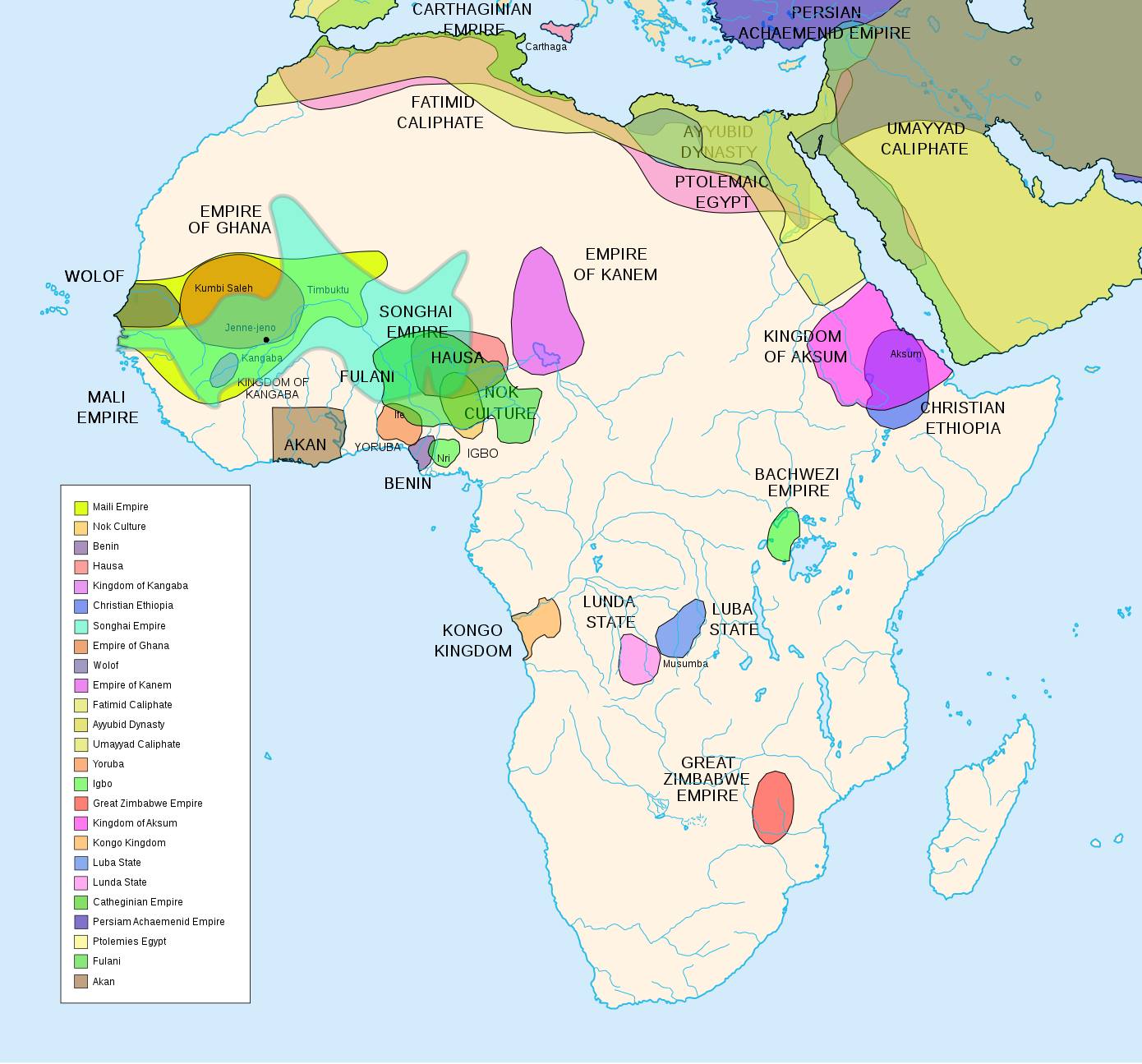
Source date (UTC): 2018-04-04 18:30:00 UTC
-
The united states was (and is not any longer) a great experiment that was ended
The united states was (and is not any longer) a great experiment that was ended in the 1960’s because of vast underclass immigration. Most of the ‘good’ was from german and dutch immigrants. I admire the swiss and japanese. The rest are all ‘less’. I dislike chinese dishonesty.
Source date (UTC): 2018-04-04 17:20:10 UTC
Original post: https://twitter.com/i/web/status/981582211966226433
Reply addressees: @Superhero_sky
Replying to: https://twitter.com/i/web/status/981581422963109888
IN REPLY TO:
Unknown author
@Superhero_sky I prefer Corporate government in the Chinese (or German) model, insular strategy in the Han model, but northern european ethics, legal system, value of human life, arts – particularly our speaking the truth regardless of impact on the status hierarchy – and Slavic family culture.
Original post: https://x.com/i/web/status/981581422963109888
IN REPLY TO:
@curtdoolittle
@Superhero_sky I prefer Corporate government in the Chinese (or German) model, insular strategy in the Han model, but northern european ethics, legal system, value of human life, arts – particularly our speaking the truth regardless of impact on the status hierarchy – and Slavic family culture.
Original post: https://x.com/i/web/status/981581422963109888
-
THE DIRTY SECRET OF WESTERN SUCCESS #Trump #NewRight #Conservative
THE DIRTY SECRET OF WESTERN SUCCESS
#Trump #NewRight #Conservative https://t.co/OAij5QBanE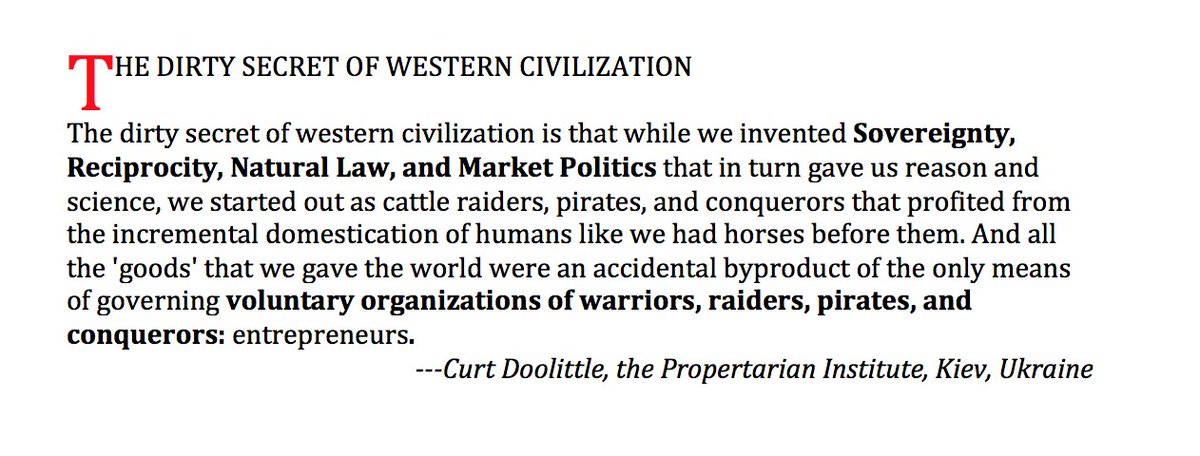
Source date (UTC): 2018-04-04 16:30:55 UTC
Original post: https://twitter.com/i/web/status/981569814715092995
-
4 – While the french, spanish and british were exploitative the english, left be
4 – While the french, spanish and british were exploitative the english, left behind a great work unfinished because of the russian vs german competition over the Intermarium.That said,had england completed her mission it would have been the greatest achievement in human history.
Source date (UTC): 2018-04-04 16:14:15 UTC
Original post: https://twitter.com/i/web/status/981565620830515200
Reply addressees: @JulesWarr @neovictorian23
Replying to: https://twitter.com/i/web/status/981565027219050496
IN REPLY TO:
Unknown author
@JulesWarr @neovictorian23 3 -The dirty secret of western civilization is that while we invented Sovereignty, Reciprocity, Natural Law,and Market Politics that gave us reason and science, we started out as cattle raiders, pirates, and conquerors, and all the ‘goods’ that we gave the world were a byproduct.
Original post: https://x.com/i/web/status/981565027219050496
IN REPLY TO:
@curtdoolittle
@JulesWarr @neovictorian23 3 -The dirty secret of western civilization is that while we invented Sovereignty, Reciprocity, Natural Law,and Market Politics that gave us reason and science, we started out as cattle raiders, pirates, and conquerors, and all the ‘goods’ that we gave the world were a byproduct.
Original post: https://x.com/i/web/status/981565027219050496