RT @StevePender: Wow. In the age group 15-24, Black males are almost 25x as murderous as White males.
Source date (UTC): 2024-01-01 04:20:09 UTC
Original post: https://twitter.com/i/web/status/1741675652955177194
RT @StevePender: Wow. In the age group 15-24, Black males are almost 25x as murderous as White males.
Source date (UTC): 2024-01-01 04:20:09 UTC
Original post: https://twitter.com/i/web/status/1741675652955177194
RACIAL COMPOSITION OF PUERTO RICO
The racial composition of Puerto Rico is diverse and has been shaped by native American settlement, European colonization, slavery, and economic migration. Here’s a breakdown based on various sources:
According to a 2023 report, the distribution of Puerto Rico’s population by self identified race is as follows:
– “White”: 51.15%
– Some other race: 21.59%
– Multiracial: 16.95%
– Black or African American: 9.96%
Genetic Studies have shown that the racial ancestry mixture of the average Puerto Rican (regardless of racial self-identity) is about
– European: 64%
– African: 21%
– Native Taino: 15%
CD: I didn’t know the native population was so high, otherwise it’s about what I expect.
Source date (UTC): 2023-12-31 23:09:43 UTC
Original post: https://twitter.com/i/web/status/1741597530813513729
THE NORTH-SOUTH DIVIDE IS A WORLD NORM – WE AREN’T SPECIAL
Just as northern italy is middle class germanic and southern italy is underclass greek, just as canada is a soft war between the underclass catholic french of quebec, and the middle class protestant english in the rest of the country, or in the UK the scotts in the north, and the english in the south, the USA is, at least on the north south divide, a soft war between the middle class culture of the english in the north and working class culture of the scotts irish in the south, with the germans more often than not split between them.
The nine (or eleven) nations of north america is about right. But more than that, we are now in a position where the basic political structures necessary for urban centers vs suburban and rural territories is such that we require city states to divorce from territorial states in addition to dividing into sub-nations.
So while there was value in a central government in order to conquer the territory and drive out the europeans so that we would be militarily safe (one of the smart moves in human history) and this is the purpose of empires, at this point there is far less value in the central government for other than it’s original intent as defense, trade policy, dispute resolution between states. So just as say, in china and russia, south america, and the middle east, people want smaller governments with shorter power distance, that more directly address their wants and needs – americans want local control of social policy even if strategic and military policy (as well as emergency services) are centralized. After all, the sole purpose of Republican (rule of law) government is the insurer of last resort.
Cheers
Reply addressees: @Flavus59
Source date (UTC): 2023-12-31 14:46:30 UTC
Original post: https://twitter.com/i/web/status/1741470892834643968
Replying to: https://twitter.com/i/web/status/1741460280721182748
RT @ernunnos: Everybody knew everybody. Or at least everybody who was anybody. In an age of manual labor, the upper class in any area was s…
Source date (UTC): 2023-12-31 14:37:24 UTC
Original post: https://twitter.com/i/web/status/1741468600857145652
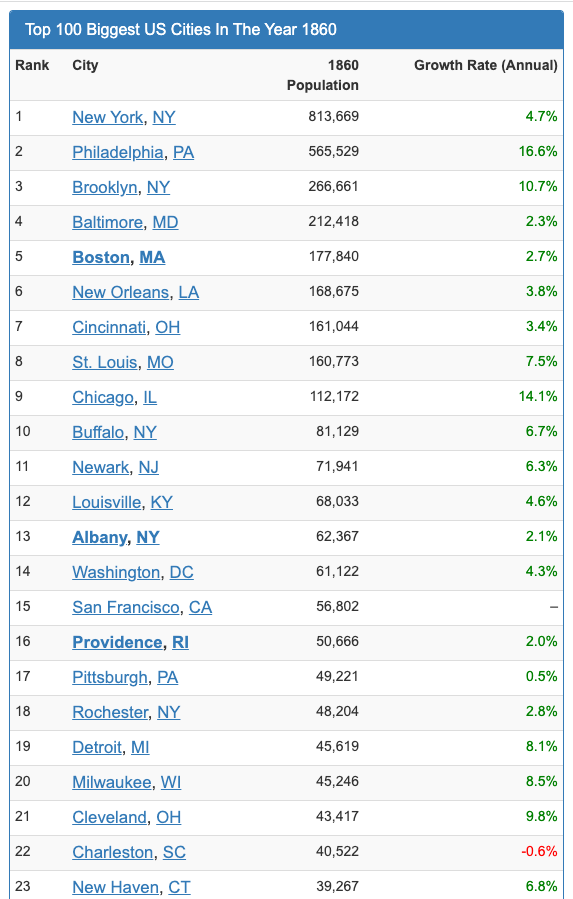
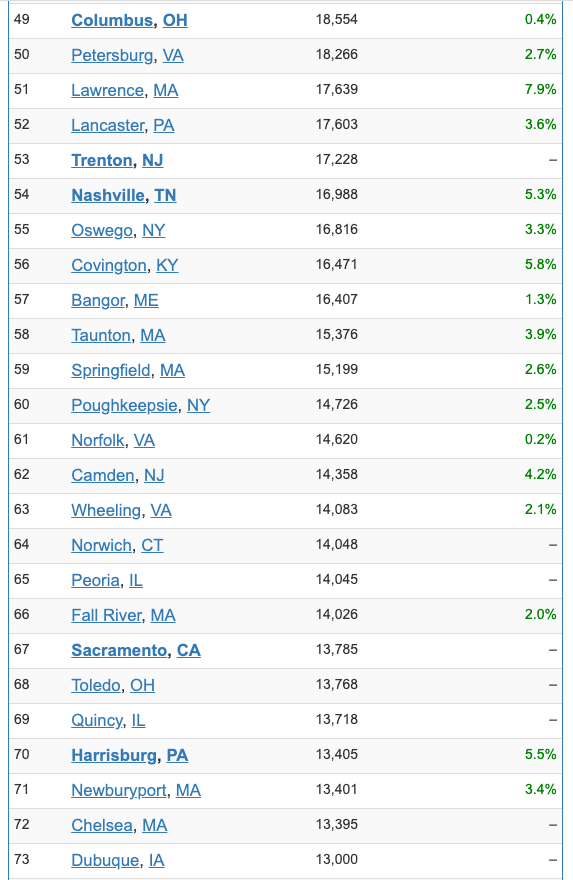
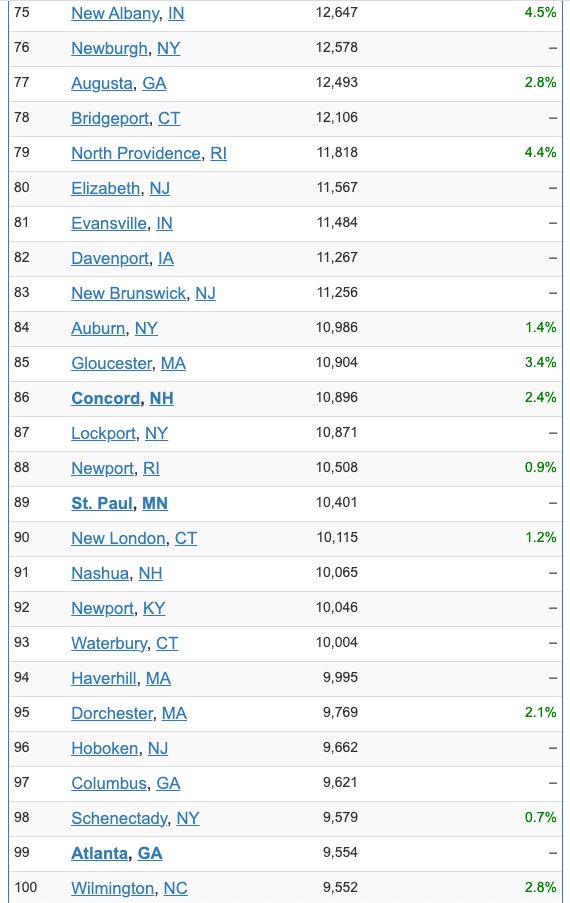
The Population of American “Cities” in 1860
Note that most of these would barely qualify for towns and villages.
from: https://www.biggestuscities.com/1860 https://t.co/tGRifNV2vh

Source date (UTC): 2023-12-31 13:29:32 UTC
Original post: https://twitter.com/i/web/status/1741451525384221139
The Population of American “Cities” in 1860
Note that most of these would barely qualify for towns and villages.
from: https://t.co/G9RjMhEC41
Source date (UTC): 2023-12-31 13:29:32 UTC
Original post: https://twitter.com/i/web/status/1741451525249966080
The Anglosphere: The West’s Last Hope
https://www.youtube.com/watch?v=syx6rkcII7E
Source date (UTC): 2023-12-30 23:08:22 UTC
Original post: https://twitter.com/i/web/status/1741234802831802829
–“the tariff thesis for southern secession point to the nullification crisis that grew out of a protective tariff of 1828, known by the South as the “Tariff of Abominations.” As I discussed in the podcast, John C. Calhoun secretly wrote the South Carolina Exposition and Protest, which argued that individual states have the right to nullify federal laws that they deemed unconstitutional. In 1832, after a new tariff bill was passed (which actually lowered duties, but was still criticized for being protectionist), South Carolina passed a nullification act and started mobilizing troops to defend against the threatened aggression by the Andrew Jackson administration, which came in the form of a “Force Bill” passed by Congress to empower the president to use the military against the nullifying state.
The crisis was averted after Henry Clay stepped up with a compromise tariff that offered to lower duties gradually over a period of years (the new bill, interestingly, never addressed the conflict between a “protectionist” and a “revenue” tariff, the latter of which was considered to be constitutional by southerners).
In the early 1830s, it is fair to say that tariffs were a legitimate cause of controversy between the North and the South (or, at least, South Carolina, which was the only state that took real action in response to the tariff). But even in these years, there is reason to question whether tariffs were the sole reason for the dispute.”— Calton
Source date (UTC): 2023-12-30 01:27:08 UTC
Original post: https://twitter.com/i/web/status/1740907337940881408
–“the North never made slavery the issue upon which to rally public opinion in support of the war. Quite the opposite was true, as Lincoln made clear himself that the goal was to maintain the union, and that he had no desire to end the institution of slavery. In fact, even though anti-slavery sentiments had become more common among northerners, such views were still held by a small enough percentage of the population that appeals against slavery would never have been successful in gaining support for the war effort. This is an argument that is designed to appeal to modern sentiments (and ignorance), but depends on the complete denial of historic fact.”—Chris Calton, Phd, The Indpendent Institute
Source date (UTC): 2023-12-30 01:26:04 UTC
Original post: https://twitter.com/i/web/status/1740907070524649475
RT @pmarca: History is, largely, fake.
Source date (UTC): 2023-12-29 23:53:09 UTC
Original post: https://twitter.com/i/web/status/1740883685677871373