RT @curtdoolittle: @TheSovereignMD @strichtarn @whstancil Most of my work or posts can be explained by grok or chat gpt.
“The concept you…
Source date (UTC): 2025-01-14 19:15:51 UTC
Original post: https://twitter.com/i/web/status/1879246066983571690
RT @curtdoolittle: @TheSovereignMD @strichtarn @whstancil Most of my work or posts can be explained by grok or chat gpt.
“The concept you…
Source date (UTC): 2025-01-14 19:15:51 UTC
Original post: https://twitter.com/i/web/status/1879246066983571690
Most of my work or posts can be explained by grok or chat gpt.
“The concept you’re discussing touches on several complex ideas in evolutionary biology, anthropology, and social theory. Here’s a breakdown of the key components:
1. **Dysgenic Selection in Women’s Mate Choice**:
– “Dysgenic” typically refers to the selection of traits that might be considered less beneficial for survival or reproduction in future generations. In this context, the argument suggests that women’s selection of mates might not necessarily favor traits traditionally seen as enhancing survival or reproductive success. Instead, it might eschew traits like neoteny (the retention of juvenile features into adulthood) which could be seen as less “adaptive” in terms of physical robustness but might confer social or sexual advantages in complex human societies.
2. **Acceleration of Neotenic Evolution Under Agrarianism**:
– Neoteny in humans includes traits like smaller jaws, larger heads relative to body size, and a more juvenile facial appearance. Under agrarian societies, where physical strength might be less critical for survival (due to less immediate physical threats), there could be an evolutionary push towards traits that enhance social interaction or intelligence rather than brute physicality. The argument here is that agrarianism might have favored these traits, accelerating neotenic evolution.
3. **Traditional and Normative Changes Under Emergent ‘Property’**:
– With the establishment of concepts like private and communal property, social structures and norms evolved, influencing mate selection. Property rights could lead to new forms of social status or wealth, which might then influence what traits are selected for in mates. Here, “domestication” of one another refers to the mutual shaping of behaviors and physical characteristics through cultural practices and mate choice over generations.
4. **Reciprocal Domestication of Sexes**:
– The idea here is that both men and women have influenced each other’s evolution through selection pressures. For instance, men might select for traits in women that signal health or fertility, while women might select for traits in men that suggest resources or status. This mutual selection process could be seen as a form of “domestication” where each sex shapes the evolution of the other.
5 – Cultural and Social Influence: Human evolution is not just biological but deeply intertwined with cultural evolution. The changes in human traits might be as much about cultural shifts in what is valued or attractive as about direct biological selection.
See domestication syndrome and evolutionary differences between domesticated and self domesticated species.
Ie women select dysgenically.
Reply addressees: @TheSovereignMD @strichtarn @whstancil
Source date (UTC): 2025-01-14 19:15:33 UTC
Original post: https://twitter.com/i/web/status/1879245990722736128
Replying to: https://twitter.com/i/web/status/1879243096300646655
RT @NoahRevoy: I asked Chat GTP to explain the differences between Freedom and Sovereignty as if I was @curtdoolittle talking to a 5 year…
Source date (UTC): 2025-01-13 15:06:38 UTC
Original post: https://twitter.com/i/web/status/1878820962420117572
GROK IS FREE whenever you can’t understand one of my posts.
Curt Doolittle’s post discusses the concept of time preference, which is the preference for immediate rewards over future ones, and how it relates to maintaining societal structures like aristocracy. Time preference influences economic behavior, where a low (long) time preference encourages investment over consumption, crucial for preserving civilizational capital.📷
The post suggests that aristocracy, with its inherent long-term orientation, naturally promotes a low time preference, which is vital for sustainable economic practices. This contrasts with democratic systems where short-termism might prevail, leading to capital consumption rather than preservation.📷
Financialization, mentioned as a driver of short-term time preferences, has been criticized for promoting consumption and short-term gains over long-term investment, leading to the erosion of civilizational capital. Curt Doolittle suggests controlling private sector credit expansion as a method to foster longer time preferences.📷
Source date (UTC): 2025-01-13 00:31:34 UTC
Original post: https://twitter.com/i/web/status/1878600744791928832
Replying to: https://twitter.com/i/web/status/1878595620598153532
IN REPLY TO:
Unknown author
How do you maintain low (long) time preference without aristocracy? You must have aristocracy because they will naturally emerge as and evolve an aristocracy with low (long) time preference if lawfulness is preserved vs lawlessness. Without their time preference all polities, and especially democratic polities, will eventually burn capital in favor of consumption, whether by individualism instead of familism, consumerism instead of commons-ism, corruption instead of nationalism. The financialization drove recursive shortening of time preference, and the destruction of civilizational capital. There are many lessons here, but the prohibition on credit expansion in the private sector is the principle means of preventing it, and instead, forcing invsetment in longer time preferences instead of shorter consumer and consumption preferences.
(Brad and I today.)
Original post: https://x.com/i/web/status/1878595620598153532
RT @LukeWeinhagen: The ideal use case for AI on social media is not to connect users with content but to connect users with sense makers.…
Source date (UTC): 2025-01-09 18:59:52 UTC
Original post: https://twitter.com/i/web/status/1877430103983927421
APPRECIATION FOR CHATGPT AND UNDERSTANDING ITS LIMITS
I think the reason I appreciate ChatGPT (or any ai) is that I have realistic expectations of what it’s capable of, and because my work exposes its limits more so than math or programming, that expectation is consistently reinforced. SO I learn about the AIs mostly from their limits (failures).
I do not find ChatGPT hallucinating any longer. Thought it might be how I craft each of my prompts.
But the reality is that when I’m writing (a book) I know the subject matter. I’m more interested in how to compose the topic or section for readability, and to ensure I haven’t missed including some example or permutation.
The hard problem I’m looking for OpenAI to solve is increasing attention anchors. As I refine a section every increase in precision causes a loss of content. So bulleted lists shrink as I ask for expansions upon them.
This is true across the spectrum. It’s why it fails at reasoning. And I am confident that this can’t be solved without multiple passes, more attention nodes, and much more context memory.
Source date (UTC): 2025-01-06 18:10:31 UTC
Original post: https://twitter.com/i/web/status/1876330519769890816
WHAT’S THE PROMISE OF AI AGENTS?
(probably spam)
Q: Curt: –“What do you think: Will AI Agent Workflows in 2026 look like Online Poker in 2010?”—
1) I agree only with the fact that work will change, the volume of work per person might increase in some white collar work as it did under the first two computer revolutions, but the number of white collar workers should very likely shrink and very likely shrink a great deal.
2) This is not the first technological revolution I’ve experienced in my lifetime. Except for the initial phase in the 40s and 50s I have some exposure to each generation. In each of these revolutions, low hanging fruit is mistakenly interpreted as a boundless undiscovered valley of unlimited potential. An it’s always been false. We exhausted each generation of technological innovation rather quickly. The most recent that living generations are familiar with was the phone, but we exhausted innovation in phone apps in just a few years. The ‘agent’ innovation in LLMs will very likely have a scale effect closer to the client server revolution than it will to the internet revolution. Conversely, the exhaustion of parallel processing of complex vector relationships is as inexhaustible as the transistor revolution. The reason being that the universe consists of relations and those n-dimensional manifolds (of relations) are the most accurate means of representing reality (the universe) while maintaining some form of reduction (reducibility) that can be used for deduction, inference, and guessing.
3) In the given example of poker there would be no need for the human whatsoever. Instead, humans will only introduce error. In many, many white collar jobs, the utility of people created by the computer revolutions in producing white collar work will be reversed just as manual labor was reduced by industrialization in factories, and farm labor was reduced by say, the loom and tractors. But the costs of goods, which are mostly
4) The ‘dumbness’ of AI’s outside of search, math, computer science, and research by permutation in the physical sciences remains astounding. And until that is overcome – which we understand but don’t quite know how to solve by merging say LLMs with Agents (procedural systems) with navigating the physical world, with manipulating the physical world, this dumbness will persist. The capacity of the current AIs to reason as humans do instead of merely solve ‘reason puzzles’ is illusory because of the absence of that merger (synthesis). In my work they simply cannot do it. I mean it’s sad really that in my work, I work with LLMs every day, and that means I effectively experience their limitations every day.
5) My company has been developing a very large and complex “universal application platform” for years now. This platform creates a framework of commensurability across all human cooperation. This commensurability functions as numbers in math, and types, commands, functions in computer programming, and unambiguity in operational language. Essentially creating standards of categories, weights, and measure across all human cooperation. And within this platform, one can construct interfaces for tasks, roles, responsibilities or whatever, in any domain where humans collaborate and cooperate. This platform separates rules that must be followed (prescriptions for processes), from statistical insight, from derivied insights in group, to derived insights across groups, fields, or populations. This is what I understand as necessary for producing context specific insight into complex causal density quite *unlike* math, programming, and ‘puzzle’ reasoning.
6) Human capacity for the appearance of multitasking is limited. In fact human’s don’t multi-task, they switch, and the number of contexts they can switch between is as limited as the number of objects we can visualize independently: usually three to five but no more. And if humans can in fact appear to multitask, they would rely on pattern recognition where the AI’s would demonstrate superiority.
7) Human capacity for novelty in multiple contexts and high precision within a given context might remain for a while, but eventually, machines will outperform humans. Yet humans will be required for obtaining the information necessary for the solution to novel problems becuase while some novel problems might consist of interstitial permutations of existing knowledge, the hard problems will remain because they will require the construction of physical experimentation – at least until we finish discovering the first principles of the universe and can rely on constructability. So discovering those first principles is the hard limit of human-machine competition.
8) I could go on quite a while with this sequence but the intuition in the original post is that human exposure to parallel data in real time would continued in utility is false – we merely took advantage of the incompetence of statistical and procedural algorithms in pattern recognition. Whereas unlike statistical and procedural algorithms, the whole point of bayesian systems is that they can account for much higher causal density than can humans, and do so faster in real time, and even predict better in real time. So the theory proposed is likely false – that individual would be rapidly and easily replaced.
9) The question is – what human-possible activity can’t be replaced? a) Outwitting one another. b) human subjective risk tolerance. c) Permission to impose costs upon human demonstrated interests. d) all of the above in alliances of capital between humans with disparate ever changing intersts and preferences.
More another time.
CD
Reply addressees: @bryanbrey @rileybrown_ai
Source date (UTC): 2025-01-06 18:02:42 UTC
Original post: https://twitter.com/i/web/status/1876328554956529664
Replying to: https://twitter.com/i/web/status/1876291249436832053
RT @curtdoolittle: @romanyam –“What contributions do you think you could make in a world where Superintelligence exists?”– Dr. Roman Yamp…
Source date (UTC): 2025-01-02 16:02:54 UTC
Original post: https://twitter.com/i/web/status/1874848854925009113
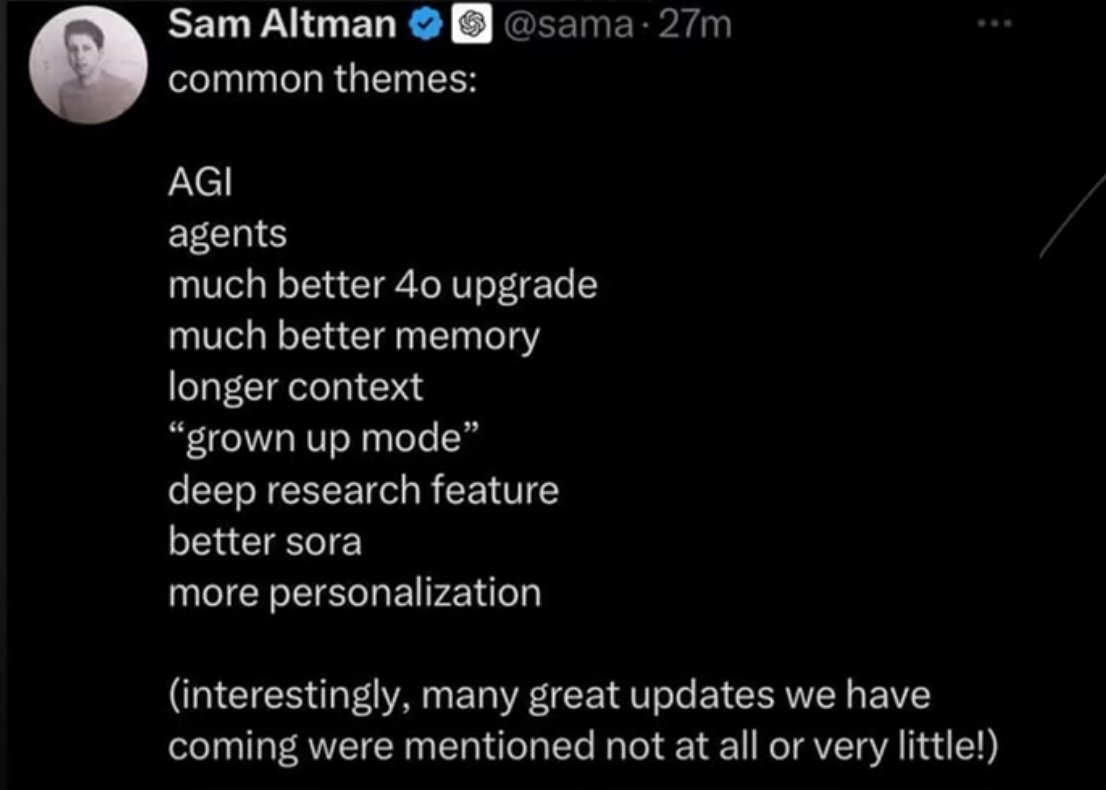
Sam and Openai: Memory, Context, “Grownup Mode”
Talk about a quality of life upgrade. I can’t wait. 😉 https://t.co/ZbnThQ87ws
Source date (UTC): 2025-01-01 01:42:38 UTC
Original post: https://twitter.com/i/web/status/1874269973117563118
Sam and Openai: Memory, Context, “Grownup Mode”
Talk about a quality of life upgrade. I can’t wait. 😉
Source date (UTC): 2025-01-01 01:42:38 UTC
Original post: https://twitter.com/i/web/status/1874269973054709760