RT @JoshuaLisec: @ThruTheHayes It takes me 2x times to read or watch to understand 50%. That said, it seems to me you guys figured it out.
Source date (UTC): 2025-01-02 21:15:16 UTC
Original post: https://twitter.com/i/web/status/1874927465602421175
RT @JoshuaLisec: @ThruTheHayes It takes me 2x times to read or watch to understand 50%. That said, it seems to me you guys figured it out.
Source date (UTC): 2025-01-02 21:15:16 UTC
Original post: https://twitter.com/i/web/status/1874927465602421175
Yes.
Source date (UTC): 2025-01-02 21:14:14 UTC
Original post: https://twitter.com/i/web/status/1874927205639495754
Reply addressees: @JRuebl47185
Replying to: https://twitter.com/i/web/status/1874926900910637178
(Philosophers)
WHY DO WE NEED NEW DEFINITIONS AND TERMS?
1) Every philosopher must and does both add terms and alter the properties of terms. Otherwise the function of a philosopher, which is the reorganization of existing categories, relations, operations, and values is impossible. The question is only whether we are increasing precision or decreasing precision. In our case we are increasing precision in order to prevent deceptions.
2) We remove misrepresentation from terminology by the use of deflation, series, and operational definitions. This means that many terms, when placed in series with related terms, can only ‘fit’ (avoid conflation and misrepresentation) if properties that cause conflation are attributed to one term and not another. By the combination of deflation, isolation of properties, and operational language we all but remove fungibility (use in deception) from terms. Moreover, we eliminate the ability to use deception in the most common manner it is used: the pretense of knowledge where the speaker lacks the knowledge to make the claims he does. Or where he has identified and is making use of a loose relation for the purpose of argument or deduction that does not hold under scrutiny.
3) All pretense of knowledge and deception is caused by hiding information, partial information, embellishment of information, or incorrect information, causing demand for substitution on the part of the audience, and thereby causing suggestion in the audience.
4) Suggestion can be used to transfer meaning, which we can then deflate (limit) to truthful propositions. Or suggestion can be used to transfer partial meaning, which we let perform suggestion, or which we expand into falsehood. In other words, we can communicate then limit or we can communication and let the audience expand an idea to unlimited form. Or we can communicate and suggest other limits. And various permutations thereof. So we cannot communicate truthfully without supplying both via positiva (meaning) and via-negativa (limits) so that the competition between meaning and limits allows only potentially true information to survive.
5) The most successful methods of deception are caused by increasingly *indirect* means of suggestion that cause the audience to perform substitution (fill in the blanks). Advertising (commercial), propaganda(political), and theology(religious) saturation of the environment produces suggestion by deception by the use of overloading the environment. And humans are not able even intentionally to insulate themselves from the free association caused by experiential phenomenon (information). So Advertising, Propaganda, and Theology are methods of deception through deception and overloading.
6) The use of “-isms”. An “-ism” refers to a portfolio of categories, values, relations that provide decidability within a domain. So an ism is a ‘name’ for an algorithm providing some form of decidability. This ism can be very narrow (Platonism) or very broad (Marxism). The decidability offered can be true, undecidable, or false, or moral, amoral or immoral. But without referring to ‘-ism’s’ one must list the sometimes long sets of arguments (categories, values, and relations) within them.
So it is ‘shorthand’ to use those terms, just like it is shorthand to use math, logic, geometry, calculus, or family, genus, species, race. And yes, it is burdensome on the reader who is ignorant of the subject – but it is comfortable for both the author and the reader who are knowledgeable.
The strange question we should contemplate is, “Why do people read other technical literature, which they must look up and understand terms, yet people who will read technical literature – analytic philosophy, making use of law, economics, science, and mathematics – and expect NOT to look up a lot of terms?”
The answer of course is that we have no choice but to participate in that science we call cooperation: ethics, morality, and politics. While we have the choice to participate in every other scientific discipline.
Source date (UTC): 2025-01-02 21:01:59 UTC
Original post: https://twitter.com/i/web/status/1874924122691805184
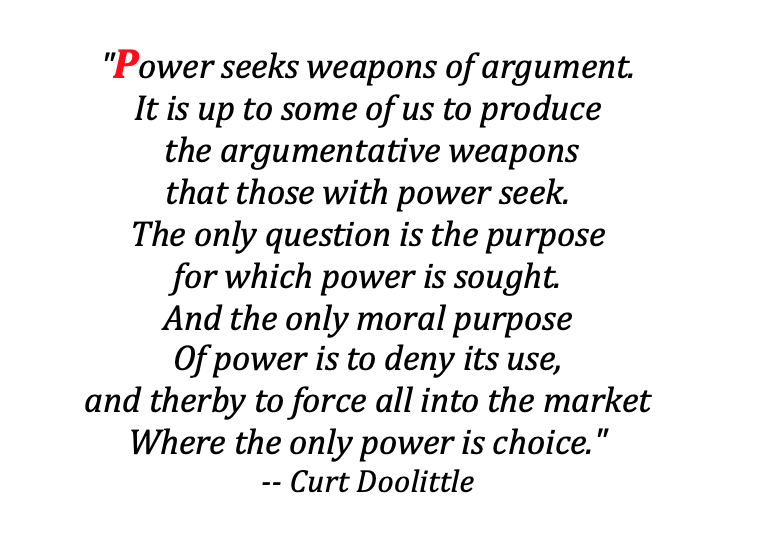
(Power Seeks Weapons of Argument) https://t.co/OR580CfCvZ
Source date (UTC): 2025-01-02 20:56:07 UTC
Original post: https://twitter.com/i/web/status/1874922642991698371
A DIFFERENCE ENGINE? OR A PREDICTION ENGINE?
RELATIONS
EPISODES (INDICES)
COMPARISONS (TRANSFORMATIONS, OPERATIONS)
FIELD
DIMENSION
PARADIGM
GRAMMAR
LOGIC MEANS PREDICTION
The difference between correct inference and correct prediction lies primarily in context, scope, and explicitness of the reasoning process. At their core, both involve the brain’s predictive mechanisms, as the neural structure fundamentally operates on associative and predictive processing. However, their roles and applications differ in significant ways.
1. Definitions
Correct Inference:
Definition: A logical conclusion drawn from existing premises or relations, consistent with the rules of a defined system.
Key Features:Explicit reasoning process.
Relies on known information (premises) and applies transformations or rules.
Often operates in closed, deterministic systems (e.g., deduction, formal logic).
Output: A conclusion that must follow logically from the premises.
Example: If all humans are mortal and Socrates is a human, then Socrates is mortal.
Correct Prediction:
Definition: A forecast about future states or outcomes based on patterns, relations, or probabilistic models.
Key Features:Implicit or explicit reasoning process.
Uses incomplete or probabilistic information.
Operates in open systems with potential variability or uncertainty.
Output: An anticipated result that may or may not occur as expected.
Example: Based on dark clouds, predicting that it will rain.
2. Neural Basis of Inference and Prediction
The neural structure of the brain is fundamentally predictive:
Associative Learning:Neural pathways form by strengthening connections between co-occurring stimuli or actions and outcomes.
Example: Associating a certain smell with food.
Wayfinding and Spatial Cognition:The brain predicts paths and outcomes based on spatial and environmental cues.
Example: Navigating a forest by anticipating landmarks.
How This Relates:
Inference: When premises and relations are clearly structured, the brain’s predictive mechanisms process them deterministically.
Prediction: In less structured or open systems, the brain generalizes patterns to anticipate outcomes probabilistically.
In essence, inference is a subset of prediction, applied in highly structured contexts.
3. Key Differences
AspectCorrect InferenceCorrect PredictionSystem TypeOperates in closed, rule-defined systems.Operates in open, probabilistic systems.Input RequirementsRequires explicit premises and clear rules.Requires patterns and probabilistic data.OutputA deterministic conclusion that must follow.An anticipatory outcome with potential variability.Neural ProcessDeterministic, rule-based transformations.Probabilistic pattern recognition and generalization.CertaintyHigh (within the given system).Lower, as outcomes may deviate from the forecast.
4. Overlap and Integration
Inference as Structured Prediction:Inference is a formalized form of prediction constrained by rules, ensuring deterministic outcomes.
Example: A logical syllogism uses explicit premises to predict the necessary conclusion.
Prediction as Generalized Inference:Prediction extends inference into open systems, where outcomes depend on probabilistic patterns and uncertainty.
Example: Weather forecasting uses past data (premises) to infer future weather states probabilistically.
Shared Basis in Neural Processing:Both inference and prediction rely on the brain’s ability to process relations, test outcomes, and adapt pathways.
Example: A chess player uses inference (rules of the game) and prediction (opponent’s likely moves).
5. Implications
For Neural Structure:The brain’s predictive framework suggests that logical inference is a formalization of an underlying predictive mechanism.
Simple association (e.g., Pavlovian conditioning) evolves into complex inference (e.g., deductive reasoning) through layering of patterns and relations.
For Understanding Reasoning:Viewing inference as structured prediction bridges the gap between deterministic and probabilistic reasoning.
This perspective aligns with operationalism: both inference and prediction depend on relations, intelligibility, and closure within the system or field.
Conclusion
There is no fundamental distinction between correct inference and correct prediction; they are two expressions of the same underlying predictive mechanism. Inference operates within deterministic, closed systems, while prediction handles probabilistic, open systems. This neural perspective unifies both processes, highlighting that even abstract reasoning (inference) is rooted in the brain’s evolved capacity to predict and adapt.
CLOSURE
Source date (UTC): 2025-01-02 20:29:25 UTC
Original post: https://x.com/i/articles/1874915926774255616
(Fall 2024 Conference)
Introduction. Brandon Hayes, President NLI, Doing his thing with the usual excellence. 😉
Source date (UTC): 2025-01-02 19:39:16 UTC
Original post: https://twitter.com/i/web/status/1874903302548410540
OK. The whole staff loves Josh Lisec. And we got a chuckle out of this one.. 😉 https://twitter.com/JoshuaLisec/status/1874812957294837995
Source date (UTC): 2025-01-02 16:41:09 UTC
Original post: https://twitter.com/i/web/status/1874858480718524902
OMG. lol. Love you man. 😉
Source date (UTC): 2025-01-02 16:39:13 UTC
Original post: https://twitter.com/i/web/status/1874857995160727677
Reply addressees: @JoshuaLisec
Replying to: https://twitter.com/i/web/status/1874812957294837995
RT @Suffragent_: The ‘far-right’ doesn’t drive into crowds.
The ‘far-right’ doesn’t target Christmas markets.
The ‘far-right’ doesn’t blo…
Source date (UTC): 2025-01-02 16:36:48 UTC
Original post: https://twitter.com/i/web/status/1874857384033882614
RT @curtdoolittle: @romanyam –“What contributions do you think you could make in a world where Superintelligence exists?”– Dr. Roman Yamp…
Source date (UTC): 2025-01-02 16:02:54 UTC
Original post: https://twitter.com/i/web/status/1874848854925009113