Author: Curt Doolittle

  • In Curt Doolittle’s Operationalism, his emphasis is the testifiability of claims

    In Curt Doolittle’s Operationalism, his emphasis is the testifiability of claims, and the distinction between philosophy and science can be framed operationally by examining their premises, operations, and results across the dimensions of permissible and impermissible references and the instrumentation ignored, used, or required:

    1. Premises
    Philosophy:
    Permissible References: Abstract, speculative, and non-empirical references are permissible. Philosophy often allows for exploration of imaginable possibilities unconstrained by empirical testability.
    Impermissible References: Philosophy generally avoids commitments to specific empirical facts unless required for argumentation, preferring logical consistency and coherence.
    Instrumentation Required:Cognitive-Perceptual: Uses introspection, imagination, and reasoning.
    Verbal: Relies on linguistic and conceptual constructs for articulation.
    Logical: Demands internal consistency and coherence but may not require external correspondence.

    Science:
    Permissible References: Empirical observations and testable hypotheses. Science permits only references that can be operationalized and empirically validated.
    Impermissible References: Speculative, unverifiable claims, or those lacking falsifiability.
    Instrumentation Required:Physical: Uses empirical tools to measure and test phenomena.
    Cognitive-Perceptual: Focuses on observational accuracy and repeatability.
    Logical and Verbal: Requires coherence but also external correspondence (truth by survival of testing).

    2. Operations
    Philosophy:
    Methods Used:
    Logical reasoning and argumentation.
    Conceptual analysis and synthesis.
    Examination of foundational assumptions, often without requiring empirical evidence.

    Instrumentation:
    Primarily verbal and logical tools.
    Relies on internal consistency, coherence, and the capacity to interpret meaning.

    Result:
    Generates frameworks, questions, and first principles, often focusing on “what is imaginable” or “what is possible.”

    Science:
    Methods Used:
    Hypothesis generation, experimental testing, and observation.
    Operationalization of abstract concepts into measurable phenomena.
    Iterative falsification and empirical validation.

    Instrumentation:
    Requires physical tools (e.g., instruments for measurement).
    Uses verbal and logical tools but anchors them in empirical data.

    Result:
    Produces laws, theories, and models validated by empirical testing, focusing on “what survives testing and falsification.”

    3. Results

    Philosophy:
    Output: Conceptual frameworks, ethical systems, definitions, and foundational principles.
    Validation: Internal coherence and practical applicability in reasoning or guiding action.
    Scope: Unbounded, addressing questions of meaning, existence, ethics, and universals without requiring immediate correspondence to empirical reality.

    Science:
    Output: Testable theories, predictive models, and empirical laws.
    Validation: Survives empirical testing and falsification.
    Scope: Constrained by empirical testability, addressing questions about the nature of observable phenomena and their causal relationships.

    Differences in Premise, Operation, and Result
    Premise:
    Philosophy begins with conceptual possibility and explores the limits of the imaginable and logical.
    Science begins with empirical possibility, constrained by observable and measurable phenomena.

    Operation:
    Philosophy uses cognitive-perceptual and verbal-logical instrumentation to explore abstract dimensions.
    Science requires physical instrumentation and operational definitions to test causal relationships.

    Result:
    Philosophy produces frameworks and questions applicable to diverse contexts but not necessarily empirically verifiable.
    Science produces empirically validated knowledge that explains, predicts, and survives falsification under operational and physical constraints.

    Key Complementarity:
    Philosophy generates universalizable constructs and questions of meaning that guide inquiry, including scientific questions.
    Science tests causal constructs within empirical limits, refining and operationalizing philosophical premises into practical models.

    Together, they explore the possible, testable, and survivable, forming an iterative process where philosophy provides the imaginative scope, and science refines the reducible into actionable knowledge.


    Source date (UTC): 2025-02-04 01:45:49 UTC

    Original post: https://twitter.com/i/web/status/1886591963195170816
  • At the time, innovative members of the trend. In retrospect a footnote. Personal

    At the time, innovative members of the trend. In retrospect a footnote. Personally, the peasantry is always amusing but rarely interesting… 😉


    Source date (UTC): 2025-02-04 01:36:45 UTC

    Original post: https://twitter.com/i/web/status/1886589681690927133

    Reply addressees: @partymember55

    Replying to: https://twitter.com/i/web/status/1886551141825077710

  • In the context of Curt Doolittle’s work, GSRRM stands for Gossiping, Shaming, Ra

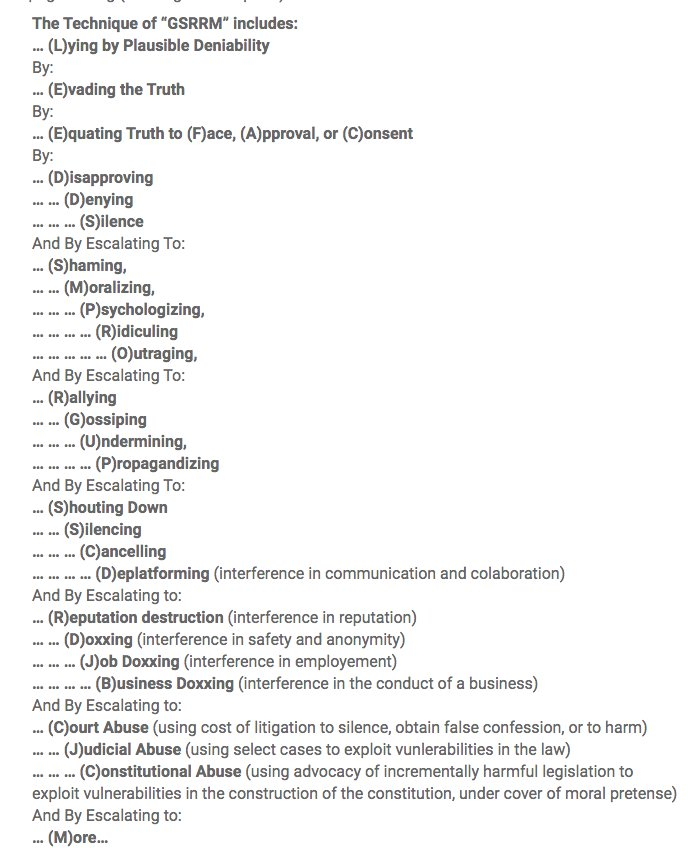
    In the context of Curt Doolittle’s work, GSRRM stands for Gossiping, Shaming, Rallying, and Moralizing. This acronym is not related to gender, sexual, and romantic minorities but instead describes what Doolittle refers to as a “female competitive strategy” or a method of social… https://t.co/KvBilaLVzX


    Source date (UTC): 2025-02-04 01:34:21 UTC

    Original post: https://twitter.com/i/web/status/1886589077518201048

  • LIMITS ON COGNITION Climatological Cycles > Hunter Gatherer > Agrarian > Axial A

    LIMITS ON COGNITION
    Climatological Cycles > Hunter Gatherer > Agrarian > Axial Age > Group Strategy > Institutional Sequence > Cycles: Epochs > Civilizational Cycles > Trifunctional Cycles > Generational Cycles > Market Cycles > Age > Sex > coming of age period > reproductive… https://twitter.com/curtdoolittle/status/1886526352674972092


    Source date (UTC): 2025-02-03 21:32:09 UTC

    Original post: https://twitter.com/i/web/status/1886528123971494108

  • The Semites are stuck in the Axial age. And their ‘grammar’ (logic) prohibits th

    The Semites are stuck in the Axial age. And their ‘grammar’ (logic) prohibits their advancement except by incremental cultural and technological competition that forces them to recognize the failure of their doctrines.


    Source date (UTC): 2025-02-03 21:25:07 UTC

    Original post: https://twitter.com/i/web/status/1886526352674972092

  • And the defense of demonstrated interests is the only means by which to form a p

    And the defense of demonstrated interests is the only means by which to form a polity. The problem with the libertarian definition of intersubjectively verifiable property is that it specifically alienates the commons whereas property rights and the resulting high trust polity,…


    Source date (UTC): 2025-02-03 17:27:02 UTC

    Original post: https://twitter.com/i/web/status/1886466437189120424

    Replying to: https://twitter.com/i/web/status/1886464121773645968

  • I’m not quite sure how dim one would have to be to imagine we’re going to find a

    I’m not quite sure how dim one would have to be to imagine we’re going to find a 2T hole somewhere instead of many X billion dollar holes.

    Did you think you were making a point?


    Source date (UTC): 2025-02-03 16:05:21 UTC

    Original post: https://twitter.com/i/web/status/1886445883501519125

    Reply addressees: @MikeJosephAZ @ScottAdamsSays

    Replying to: https://twitter.com/i/web/status/1886398797410144624

  • RT @elonmusk: Absolutely! It’s a scam to get around the laws passed by Congress

    RT @elonmusk: Absolutely! It’s a scam to get around the laws passed by Congress to protect the people.


    Source date (UTC): 2025-02-03 16:03:13 UTC

    Original post: https://twitter.com/i/web/status/1886445345133171145

  • Curt Doolittle, known for his work in philosophy, particularly in the realms of

    Curt Doolittle, known for his work in philosophy, particularly in the realms of epistemology, logic, economics, and law, has developed several theories that are central to his broader philosophical framework, which he calls “Propertarianism”. Here are some of his key theories,…


    Source date (UTC): 2025-02-03 15:56:13 UTC

    Original post: https://twitter.com/i/web/status/1886443582074294771

  • Curt Doolittle, known for his work in philosophy, particularly in the realms of

    Curt Doolittle, known for his work in philosophy, particularly in the realms of epistemology, logic, economics, and law, has developed several theories that are central to his broader philosophical framework, which he calls “Propertarianism”. Here are some of his key theories, based on the information available on his websites, interviews, and discussions:

    Propertarianism:
    Core Concept: Doolittle argues that all rights, including human rights, are reducible to property rights. He posits that all ethical, moral, and legal statements should be viewed through the lens of property rights and reciprocity.

    Reciprocity: Central to his philosophy is the idea that interactions between individuals should be based on reciprocal exchanges where no party incurs an involuntary cost. This extends to all forms of human interaction, from economics to social relations.

    Operationalism:
    Doolittle advocates for what he calls “Operationalism,” where knowledge is not just about stating truths but about operational definitions – how we can test, measure, or operationalize statements in the real world. This is part of his critique of what he sees as the nebulous nature of much philosophical discourse.

    Natural Law:
    Definition: Doolittle’s conception of natural law is not divine but based on human action, evolution, and the necessity for cooperation within societies. It’s about rules that emerge from human interaction to ensure survival and prosperity.

    Decidability: He argues for a natural law that is decidable, meaning it should be possible to resolve conflicts without resorting to arbitrary or subjective interpretation.

    Genetic Pacification and Evolution:
    Doolittle discusses the concept of genetic pacification, suggesting that Western societies historically engaged in practices like hanging criminals or preventing the “deficient” from breeding, which he claims led to an evolution towards more peaceful, cooperative societies (K-selected strategy).

    Critique of Modern Ideologies:
    Marxism, Feminism, Postmodernism: He criticizes these as ideologies that use language and social strategies (like GSRM) to manipulate rather than engage in truthful discourse. He sees them as threats to what he considers the true nature of Western civilization.

    The Four Dimensions of Truth:
    Doolittle suggests there are four dimensions along which we can test the truth of statements:
    Axioms (internal consistency)
    Theories (external correspondence)
    Algorithms (constructibility)
    Rational Choice (intuition or preference)

    The Decline of Western Civilization:
    He posits that the decline of the West is due to abandoning the principles that made it successful (like property rights, natural law) and the rise of ideologies that encourage parasitism on the productive classes.

    Critique of Democracy, Monarchy, and Other
    Governance Systems:
    Doolittle has a nuanced view where he prefers systems that align with what he sees as natural law and property rights, often looking favorably upon historical monarchies for their stability and efficiency in enforcing property rights, while being highly critical of modern democratic practices.

    The Role of Language and Testimony:
    He emphasizes the importance of language in shaping thought and behavior, advocating for a truthful, operational use of language that corresponds to real-world actions and consequences.

    His theories are often presented in a way that challenges mainstream academic philosophy and political science, aiming to provide an alternative framework for understanding human society, ethics, and governance. Doolittle’s work is prolific and complex, often leading to debates about the validity, ethics, and implications of his ideas.


    Source date (UTC): 2025-02-03 15:56:12 UTC

    Original post: https://twitter.com/i/web/status/1886443581755551744