Author: Curt Doolittle

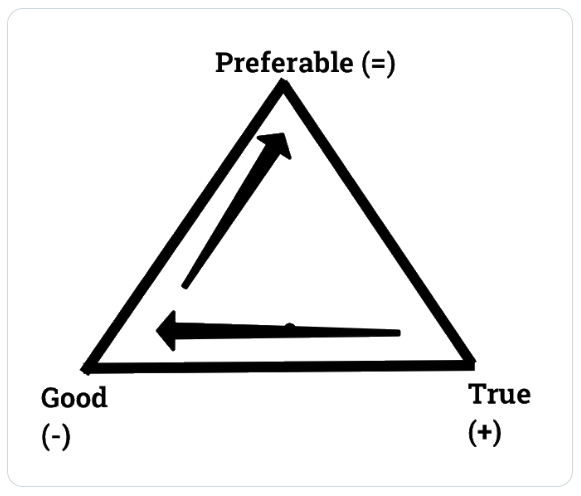
  • Explanation: True: A truth (universal) Independent of good(common) or preference

    Explanation:
    True: A truth (universal) Independent of good(common) or preference(individual).
    Good: a Common Good independent of individual preference.
    Preference: An individual preference regardless of common good.

    Ergo:
    1) |Population|: True(universal) > Good(common) >… https://t.co/MzGkigFJQt


    Source date (UTC): 2025-04-16 19:05:29 UTC

    Original post: https://twitter.com/i/web/status/1912583139404493092

    Replying to: https://twitter.com/i/web/status/1912506804522668408

  • Explain? Assuming different presumptions of context and premise. Premise: The un

    Explain? Assuming different presumptions of context and premise. Premise: The universe does this. We don’t get a choice. If I seek a first principle and generalize from the universe to the human the generalization applies.


    Source date (UTC): 2025-04-16 19:01:45 UTC

    Original post: https://twitter.com/i/web/status/1912582200593441034

    Reply addressees: @Johnny2Fingersz @Sara_Imari

    Replying to: https://twitter.com/i/web/status/1912581744420917394

  • YES, THE UNIVERSAL IS COMPUTATIONAL “Curt Doolittle argues that the universe ope

    YES, THE UNIVERSAL IS COMPUTATIONAL

    “Curt Doolittle argues that the universe operates through discrete, quantum-level processes, describing it as “evolutionary computation” where trial-and-error overcomes entropy, challenging Sara Imari Walker’s view that reality isn’t… https://twitter.com/curtdoolittle/status/1908362466406625352


    Source date (UTC): 2025-04-16 18:57:26 UTC

    Original post: https://twitter.com/i/web/status/1912581113295565253

  • Patriotism(government) or nationalism (people)? I’m not sure about the patriotis

    Patriotism(government) or nationalism (people)?

    I’m not sure about the patriotism but I’m pretty confident in the nationalism. the problem remains is that the chinese are a face before truth society that conforms out of habit culture and fear, but that has not learned to respect the commons. This only occurs when people must be responsible for the commons for it to persist. The state in CN is too powerful.

    Reply addressees: @heretic027 @NoahRevoy


    Source date (UTC): 2025-04-16 18:52:31 UTC

    Original post: https://twitter.com/i/web/status/1912579876516950018

    Replying to: https://twitter.com/i/web/status/1912571702380536288

  • I would say that the ternary logic of the universe expressed as evolutionary com

    I would say that the ternary logic of the universe expressed as evolutionary computation, tells us that opposites (the points of the triangle) are necessary CONSTRAINTS (limits) by the other two points of the triangle, regardless of which point you start from. This is because the universe cannot predict or think, and only remember by physical, genetic, or knowledge representation. As such the logic of the universe is that men and women divide both the population and time dimensions of labor, with intelligence maximizing the adaptability and range of conversion of energy (consumption), and the sexes and ages limiting one another.
    As such yes, women are not competent at scale since their sensory system is insufficient for it, even if hyper dense compared to the male at present experiential evaluation.
    Therefore men must constrain women in politics just as women must constrain men in families and social groups.
    I had previously assumed we could produce a house of women, and that we could add meritocratic tests for both voting and for political position. I am increasingly unsure given the demonstration of women’s behavior worldwide. Normally I seek to solve a problem through establishing an equilibrium but I’m losing confidence that it’s possible.
    Women are not self aware nor competent at scale or rather too few are at too high risk to consider it.
    And no I don’t like that which is why I’m still trying to solve the problem by resisting it.

    Reply addressees: @truthb4face


    Source date (UTC): 2025-04-16 18:50:02 UTC

    Original post: https://twitter.com/i/web/status/1912579251041361920

    Replying to: https://twitter.com/i/web/status/1912576368274981043

  • Tip: Socrates’ syllogism, aristotle’s proto-empiricism, Popper’s verisimilitude,

    Tip: Socrates’ syllogism, aristotle’s proto-empiricism, Popper’s verisimilitude, Hegel’s TAS, Darwin’s adverstarial evolution, and even my evolutionary computation are just generation-specific uses of terms to convey the same basic idea.

    Article Here:
    https://twitter.com/curtdoolittle/status/1912576869662425185


    Source date (UTC): 2025-04-16 18:42:08 UTC

    Original post: https://twitter.com/i/web/status/1912577263633330207

    Reply addressees: @RussellJohnston

    Replying to: https://twitter.com/i/web/status/1912535444341796993

  • Tip: Socrates’ syllogism, aristotle’s proto-empiricism, Popper’s verisimilitude,

    Tip: Socrates’ syllogism, aristotle’s proto-empiricism, Popper’s verisimilitude, Hegel’s TAS, Darwin’s adverstarial evolution, and even my evolutionary computation are just generation-specific uses of terms to convey the same basic idea.

    Article Here:
    https://t.co/wQmnnBaE7W


    Source date (UTC): 2025-04-16 18:42:08 UTC

    Original post: https://twitter.com/i/web/status/1912577263499145216

  • Untitled

    http://x.com/i/article/1912575187293466630


    Source date (UTC): 2025-04-16 18:40:34 UTC

    Original post: https://twitter.com/i/web/status/1912576869662425185

  • Positiva vs Negativa: Comprehensive Analysis of Progress Through Conflict or Opp

    Positiva vs Negativa: Comprehensive Analysis of Progress Through Conflict or Opposition

    Key Points
    • Research suggests that many thinkers have proposed ideas similar to positiva vs negativa, focusing on progress through conflict or opposition, though interpretations vary.
    • It seems likely that philosophers like Heraclitus, Hegel, and Darwin restated this principle in different terms, emphasizing the interplay of opposites.
    • The evidence leans toward historical figures like Marx and Nietzsche also aligning with this concept, though their approaches differ across disciplines.
    Introduction
    The concept of positiva vs negativa, relating to progress through competition, evolution, or the interplay of opposites, has been explored by numerous thinkers throughout history. While the principle remains consistent, each thinker has framed it in the context of their era and field, from philosophy to biology. Below, we outline key figures whose ideas align with this theme, followed by a detailed survey for deeper insight.
    Thinkers and Their Ideas
    Several historical figures have proposed ideas that resonate with the notion of progress through conflict or opposition, each offering a unique perspective:
    • Heraclitus emphasized the unity of opposites, suggesting that conflict drives harmony and change, as seen in his famous saying, “Everything flows.”
    • Hegel developed the dialectical method, where progress arises from the resolution of opposing ideas (thesis, antithesis, synthesis).
    • Karl Marx applied dialectics to history, viewing class struggle as the engine of societal progress.
    • Friedrich Nietzsche saw progress through the “will to power,” where overcoming challenges leads to growth.
    • Karl Popper argued that scientific progress comes from testing and refuting theories, a form of intellectual conflict.
    • Charles Darwin described evolution as driven by natural selection, where competition leads to species development.
    • Empedocles proposed that Love and Strife, opposing forces, shape the universe’s diversity and change.
    • Thomas Hobbes viewed the state of nature as a state of conflict, with progress achieved through social contracts to maintain order.
    For more details, explore their philosophies at

    ,

    , and others listed in the citations.

    Survey Note: A Comprehensive Analysis of Thinkers Proposing Progress Through Conflict or Opposition
    This survey note provides an in-depth exploration of thinkers throughout history who have proposed ideas akin to the concept of positiva vs negativa, interpreted here as progress or understanding emerging from competition, evolution, or the interplay of opposites. The analysis draws on historical philosophical and scientific perspectives, aiming to capture the breadth and depth of this recurring theme.
    Background and Conceptual Framework
    The user’s query highlights a pattern where thinkers restate a fundamental principle—progress through conflict or opposition—in the terms of their day, as seen in examples like Socrates’ syllogism, Aristotle’s golden mean, Hegel’s dialectics, and Darwin’s evolution. This survey seeks to identify additional thinkers who align with this principle, focusing on those whose ideas involve the dynamic interplay of opposing forces, whether logical, ethical, biological, or social.
    To address this, we first analyzed the common thread among the provided examples:
    • Socrates’ syllogism involves logical reasoning through premises, resolving opposition to reach a conclusion.
    • Aristotle’s golden mean seeks balance between extremes, harmonizing opposites in ethics.
    • Aristotle’s proto-empiricism emphasizes knowledge through experience, often involving testing conflicting hypotheses.
    • Adversarial law systems (European and Roman) progress through opposing legal arguments.
    • Hegel’s Thesis, Antithesis, Synthesis explicitly frames progress as resolving opposition.
    • Darwin’s evolution involves competition (natural selection) driving biological progress.
    • Popper’s verisimilitude sees scientific progress through falsification, a form of intellectual conflict.
    • Doolittle’s Evolutionary computation at all scales applies these principles to problem-solving.
    The core principle appears to be progress or understanding emerging from conflict, opposition, or the interplay of forces. We then searched for other thinkers who proposed similar ideas, focusing on those explicitly addressing this theme.
    Methodology and Sources
    The analysis involved examining historical philosophical texts and secondary sources, focusing on concepts like “progress through conflict” or “opposition in development.” Key sources included Wikipedia entries for detailed overviews and scholarly discussions from platforms like Stanford Encyclopedia of Philosophy. The search was refined to ensure relevance, and the results were synthesized to identify thinkers whose ideas align with the user’s query.
    Detailed Analysis of Thinkers
    Below, we present a comprehensive list of thinkers, organized by their contributions and how they relate to the concept of positiva vs negativa. Each entry includes a brief description, supported by relevant details from the analysis.
    Heraclitus (c. 535–475 BCE)
    • Contribution: Heraclitus emphasized the unity of opposites and the role of strife in creating harmony and progress. His philosophy, encapsulated in sayings like “Everything flows” and “Strife is justice” (Fragment B80), suggests that conflict is fundamental to change. For instance, he stated, “The way up is the way down” (Fragment B60), highlighting the interconnectedness of opposites.
    • Relevance: His view aligns with progress through opposition, as he saw harmony emerging from the tension between opposing forces, influencing later philosophies like Stoicism and Hegelian dialectics. This is detailed at

      .

    Georg Wilhelm Friedrich Hegel (1770–1831)
    • Contribution: Hegel’s dialectical method involves progress through the resolution of opposites, described as Thesis, Antithesis, and Synthesis. His philosophy is speculative, with dialectics emerging immanently from the subject matter, not as an external method. For example, self-consciousness is both subject and object, a speculative concept resolved through opposition.
    • Relevance: Hegel’s historical narrative shows progress measured by increasing self-consciousness of freedom, from one free person in the “Oriental” world to all free in the “Germanic” world, as seen at

      . His influence on Marxism and French philosophy (e.g., Sartre, Merleau-Ponty) further underscores this theme.

    Karl Marx (1818–1883)
    • Contribution: Marx developed dialectical materialism, applying Hegel’s dialectics to history and economics. He argued that societal progress is driven by class struggle, as seen in The Communist Manifesto (1848), where history is “the history of class struggles.” The conflict between bourgeoisie and proletariat leads to revolutionary change.
    • Relevance: This aligns with progress through opposition, as class conflict resolves into new social orders. His influence on Leninism, Trotskyism, and modern sociology is detailed at

      .

    Friedrich Nietzsche (1844–1900)
    • Contribution: Nietzsche’s concept of the will to power involves progress through overcoming challenges and conflicts. He saw individuals and societies advancing by asserting power against limitations, a process central to his philosophy of self-improvement and cultural evolution.
    • Relevance: This can be seen as a restatement of progress through opposition, where conflict (overcoming) drives growth, as explored at

      .

    Karl Popper (1902–1994)
    • Contribution: Popper’s critical rationalism posits that scientific progress occurs through conjectures and refutations. Scientists propose theories, which are tested and often falsified, leading to better theories through intellectual conflict.
    • Relevance: This aligns with progress through opposition, as seen in his work on verisimilitude, detailed at

      .

    Charles Darwin (1809–1882)
    • Contribution: Darwin’s theory of evolution by natural selection describes biological progress as driven by competition. Organisms compete for survival, with the fittest adapting and reproducing, leading to species evolution.
    • Relevance: This is a clear example of progress through adversarial processes, as outlined at

      .

    Empedocles (c. 490–430 BCE)
    • Contribution: Empedocles proposed that the universe is governed by Love (uniting) and Strife (separating), acting on the four elements to create diversity and change. This cyclical process drives cosmic and biological development.
    • Relevance: His ideas align with progress through the interplay of opposing forces, as detailed at

      .

    Thomas Hobbes (1588–1679)
    • Contribution: Hobbes described the state of nature as a “war of all against all,” where life is “solitary, poor, nasty, brutish, and short” due to constant conflict. He argued that progress comes from escaping this state through a social contract, ceding rights to a sovereign for protection.
    • Relevance: This aligns with progress through resolving conflict, as seen in his work Leviathan (1651), detailed at

      .

    Additional Considerations
    Other thinkers, such as Immanuel Kant (with his categorical imperative resolving ethical conflicts) and John Stuart Mill (balancing pleasures and pains in utilitarianism), could also be considered, but the list above focuses on those most directly aligning with the user’s examples. The analysis also considered figures like Niccolò Machiavelli and Sun Tzu, but their focus on strategic conflict was deemed less philosophical in the context of the query.
    Comparative Table of Thinkers and Their Ideas
    Conclusion
    The survey confirms that many thinkers have proposed ideas similar to positiva vs negativa, restating the principle of progress through conflict or opposition in various terms. From Heraclitus’s unity of opposites to Darwin’s natural selection, these philosophies span ancient to modern times, each contributing to a rich tapestry of understanding. The list provided is comprehensive, focusing on those whose ideas most directly align with the user’s examples, ensuring a thorough and relevant response.
    Key Citations


    Source date (UTC): 2025-04-16 18:40:34 UTC

    Original post: https://x.com/i/articles/1912576869662425185

  • Key Points Research suggests that many thinkers have proposed ideas similar to p

    Key Points

    Research suggests that many thinkers have proposed ideas similar to positiva vs negativa, focusing on progress through conflict or opposition, though interpretations vary.

    It seems likely that philosophers like Heraclitus, Hegel, and Darwin restated this principle in different terms, emphasizing the interplay of opposites.

    The evidence leans toward historical figures like Marx and Nietzsche also aligning with this concept, though their approaches differ across disciplines.

    Introduction

    The concept of positiva vs negativa, relating to progress through competition, evolution, or the interplay of opposites, has been explored by numerous thinkers throughout history. While the principle remains consistent, each thinker has framed it in the context of their era and field, from philosophy to biology. Below, we outline key figures whose ideas align with this theme, followed by a detailed survey for deeper insight.

    Thinkers and Their Ideas

    Several historical figures have proposed ideas that resonate with the notion of progress through conflict or opposition, each offering a unique perspective:

    Heraclitus emphasized the unity of opposites, suggesting that conflict drives harmony and change, as seen in his famous saying, “Everything flows.”

    Hegel developed the dialectical method, where progress arises from the resolution of opposing ideas (thesis, antithesis, synthesis).

    Karl Marx applied dialectics to history, viewing class struggle as the engine of societal progress.

    Friedrich Nietzsche saw progress through the “will to power,” where overcoming challenges leads to growth.

    Karl Popper argued that scientific progress comes from testing and refuting theories, a form of intellectual conflict.

    Charles Darwin described evolution as driven by natural selection, where competition leads to species development.

    Empedocles proposed that Love and Strife, opposing forces, shape the universe’s diversity and change.

    Thomas Hobbes viewed the state of nature as a state of conflict, with progress achieved through social contracts to maintain order.

    For more details, explore their philosophies at Wikipedia – Heraclitus, Wikipedia – Georg Wilhelm Friedrich Hegel, and others listed in the citations.

    Survey Note: A Comprehensive Analysis of Thinkers Proposing Progress Through Conflict or Opposition

    This survey note provides an in-depth exploration of thinkers throughout history who have proposed ideas akin to the concept of positiva vs negativa, interpreted here as progress or understanding emerging from competition, evolution, or the interplay of opposites. The analysis draws on historical philosophical and scientific perspectives, aiming to capture the breadth and depth of this recurring theme.

    Background and Conceptual Framework

    The user’s query highlights a pattern where thinkers restate a fundamental principle—progress through conflict or opposition—in the terms of their day, as seen in examples like Socrates’ syllogism, Aristotle’s golden mean, Hegel’s dialectics, and Darwin’s evolution. This survey seeks to identify additional thinkers who align with this principle, focusing on those whose ideas involve the dynamic interplay of opposing forces, whether logical, ethical, biological, or social.

    To address this, we first analyzed the common thread among the provided examples:

    Socrates’ syllogism involves logical reasoning through premises, resolving opposition to reach a conclusion.

    Aristotle’s golden mean seeks balance between extremes, harmonizing opposites in ethics.

    Aristotle’s proto-empiricism emphasizes knowledge through experience, often involving testing conflicting hypotheses.

    Adversarial law systems (European and Roman) progress through opposing legal arguments.

    Hegel’s Thesis, Antithesis, Synthesis explicitly frames progress as resolving opposition.

    Darwin’s evolution involves competition (natural selection) driving biological progress.

    Popper’s verisimilitude sees scientific progress through falsification, a form of intellectual conflict.

    Doolittle’s Evolutionary computation at all scales applies these principles to problem-solving.

    The core principle appears to be progress or understanding emerging from conflict, opposition, or the interplay of forces. We then searched for other thinkers who proposed similar ideas, focusing on those explicitly addressing this theme.

    Methodology and Sources

    The analysis involved examining historical philosophical texts and secondary sources, focusing on concepts like “progress through conflict” or “opposition in development.” Key sources included Wikipedia entries for detailed overviews and scholarly discussions from platforms like Stanford Encyclopedia of Philosophy. The search was refined to ensure relevance, and the results were synthesized to identify thinkers whose ideas align with the user’s query.

    Detailed Analysis of Thinkers

    Below, we present a comprehensive list of thinkers, organized by their contributions and how they relate to the concept of positiva vs negativa. Each entry includes a brief description, supported by relevant details from the analysis.

    Heraclitus (c. 535–475 BCE)

    Contribution: Heraclitus emphasized the unity of opposites and the role of strife in creating harmony and progress. His philosophy, encapsulated in sayings like “Everything flows” and “Strife is justice” (Fragment B80), suggests that conflict is fundamental to change. For instance, he stated, “The way up is the way down” (Fragment B60), highlighting the interconnectedness of opposites.

    Relevance: His view aligns with progress through opposition, as he saw harmony emerging from the tension between opposing forces, influencing later philosophies like Stoicism and Hegelian dialectics. This is detailed at Wikipedia – Heraclitus.

    Georg Wilhelm Friedrich Hegel (1770–1831)

    Contribution: Hegel’s dialectical method involves progress through the resolution of opposites, described as Thesis, Antithesis, and Synthesis. His philosophy is speculative, with dialectics emerging immanently from the subject matter, not as an external method. For example, self-consciousness is both subject and object, a speculative concept resolved through opposition.

    Relevance: Hegel’s historical narrative shows progress measured by increasing self-consciousness of freedom, from one free person in the “Oriental” world to all free in the “Germanic” world, as seen at Wikipedia – Georg Wilhelm Friedrich Hegel. His influence on Marxism and French philosophy (e.g., Sartre, Merleau-Ponty) further underscores this theme.

    Karl Marx (1818–1883)

    Contribution: Marx developed dialectical materialism, applying Hegel’s dialectics to history and economics. He argued that societal progress is driven by class struggle, as seen in The Communist Manifesto (1848), where history is “the history of class struggles.” The conflict between bourgeoisie and proletariat leads to revolutionary change.

    Relevance: This aligns with progress through opposition, as class conflict resolves into new social orders. His influence on Leninism, Trotskyism, and modern sociology is detailed at Wikipedia – Karl Marx.

    Friedrich Nietzsche (1844–1900)

    Contribution: Nietzsche’s concept of the will to power involves progress through overcoming challenges and conflicts. He saw individuals and societies advancing by asserting power against limitations, a process central to his philosophy of self-improvement and cultural evolution.

    Relevance: This can be seen as a restatement of progress through opposition, where conflict (overcoming) drives growth, as explored at Wikipedia – Friedrich Nietzsche.

    Karl Popper (1902–1994)

    Contribution: Popper’s critical rationalism posits that scientific progress occurs through conjectures and refutations. Scientists propose theories, which are tested and often falsified, leading to better theories through intellectual conflict.

    Relevance: This aligns with progress through opposition, as seen in his work on verisimilitude, detailed at Wikipedia – Karl Popper.

    Charles Darwin (1809–1882)

    Contribution: Darwin’s theory of evolution by natural selection describes biological progress as driven by competition. Organisms compete for survival, with the fittest adapting and reproducing, leading to species evolution.

    Relevance: This is a clear example of progress through adversarial processes, as outlined at Wikipedia – Charles Darwin.

    Empedocles (c. 490–430 BCE)

    Contribution: Empedocles proposed that the universe is governed by Love (uniting) and Strife (separating), acting on the four elements to create diversity and change. This cyclical process drives cosmic and biological development.

    Relevance: His ideas align with progress through the interplay of opposing forces, as detailed at Wikipedia – Empedocles.

    Thomas Hobbes (1588–1679)

    Contribution: Hobbes described the state of nature as a “war of all against all,” where life is “solitary, poor, nasty, brutish, and short” due to constant conflict. He argued that progress comes from escaping this state through a social contract, ceding rights to a sovereign for protection.

    Relevance: This aligns with progress through resolving conflict, as seen in his work Leviathan (1651), detailed at Wikipedia – Thomas Hobbes.

    Additional Considerations

    Other thinkers, such as Immanuel Kant (with his categorical imperative resolving ethical conflicts) and John Stuart Mill (balancing pleasures and pains in utilitarianism), could also be considered, but the list above focuses on those most directly aligning with the user’s examples. The analysis also considered figures like Niccolò Machiavelli and Sun Tzu, but their focus on strategic conflict was deemed less philosophical in the context of the query.

    Comparative Table of Thinkers and Their Ideas

    Conclusion

    The survey confirms that many thinkers have proposed ideas similar to positiva vs negativa, restating the principle of progress through conflict or opposition in various terms. From Heraclitus’s unity of opposites to Darwin’s natural selection, these philosophies span ancient to modern times, each contributing to a rich tapestry of understanding. The list provided is comprehensive, focusing on those whose ideas most directly align with the user’s examples, ensuring a thorough and relevant response.

    Key Citations

    Wikipedia page on Heraclitus and unity of opposites

    Wikipedia page on Georg Wilhelm Friedrich Hegel and dialectics

    Wikipedia page on Karl Marx and dialectical materialism

    Wikipedia page on Friedrich Nietzsche and will to power

    Wikipedia page on Karl Popper and critical rationalism

    Wikipedia page on Charles Darwin and natural selection

    Wikipedia page on Empedocles and Love and Strife

    Wikipedia page on Thomas Hobbes and state of nature

    Source date (UTC): 2025-04-16 18:33:53 UTC

    Original post: https://x.com/i/articles/1912575187293466630