Author: Curt Doolittle

  • Rock, Paper, Scissors: Three Coercive Technologies, and Three Social Classes

    Rock, Paper, Scissors: Three Coercive Technologies, and Three Social Classes

    theecoercivetechnologies

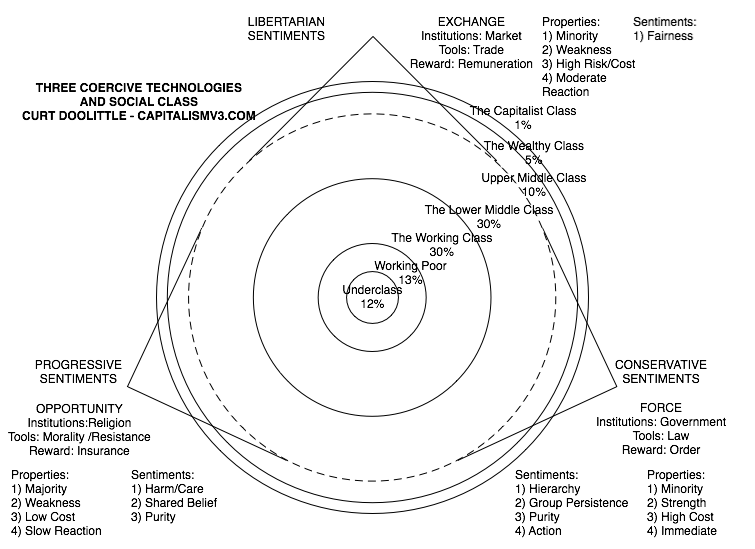
    There are three means of coercing groups of people with institutions 1) Force, or the threat of force A person has a VIOLENCE INCENTIVE to behave in a particular way when it has been made known to him that failure to do so will result in some form of physical aggression being directed at him by other members of the collectivity in the form of inflicting pain or physical harm on him or his loved ones, depriving him of his freedom of movement, or perhaps confiscating or destroying his treasured possessions. 2) Remuneration or payment A person has a REMUNERATIVE INCENTIVE to behave in a particular way if it has been made known to him that doing so will result in some form of material reward he will not otherwise receive. If he behaves as desired, he will receive some specified amount of a valuable good or service (or money with which he can purchase whatever he wishes) in exchange. 3) Moral claims (collective goods) A person has a MORAL INCENTIVE to behave in a particular way when he has been taught to believe that it is the “right” or “proper” or “admirable” thing to do. If he behaves as others expect him to, he may expect the approval or even the admiration of the other members of the collectivity and enjoy an enhanced sense of acceptance or self-esteem. If he behaves improperly, he may expect verbal expressions of condemnation, scorn, ridicule or even ostracism from the collectivity, and he may experience unpleasant feelings of guilt, shame or self-condemnation. And a persuasive argument can consist of one or more of these strategies, often in great complexity. People give priority one or more different weighted combinations, or perhaps ‘chordic’ representations of these strategies. They do so out of habit, and class inclination, just as they follow religious and class sentiments due to their upbringing. People who belong to institutions have different capacities for adopting these strategies. Force requires discipline and long Time Bias. Remuneration requires cunning and invention. Moral claims require loyalty to consensus, and absorption of, and therefore payment of, opportunity costs. Different social classes have different time biases and consist of people with different time preferences, requiring different types of discipline under different social and economic conditions. ie: it is easier to have a long time preference if one is genetically disposed to better impulse control, and lives in greater security. It is easier to have a short time preference if one is more persuaded by impulses, less disciplined, and in an environment of scarcity. The social classes are organized by intelligence. Intelligence is the ability to absorb content in real time, to learn abstractions in time, and to permute those abstractions in application to problems in real time. Intelligence regresses toward the mean over generations. THerefore class membership is an indicator of the likelihood of class mobility, and upper class position is difficult to maintain. While we use the word ‘middle class’, and most people in the west live middle class lifestyles, the middle class means possessing disposable income and participating in the market. Therefore the majority of citizens are in the upper proletariat and lower middle classes, which we call the working, white collar working and craftsman classes. There are different costs to these institutions: Force is extremely expensive. Creating non-corruption, and order (some network of property definitions and their means of transfer). Property is a term for a scarce good that must used, consumed or transformed in the process of production, even if that process is human sustenance. Remunerative institutions require the complex task of concentrating capital then maintaining it in a constantly changing kaleidic and competitive environment. Moral claims require constant advocacy, verbal skill, maintenance of numerous relationships, and constant payment of opportunity costs. The Social classes have different access to each of these forms of coercion. Those in the institutional class, or upper class, have access to force in the form of policy and law. Those in the capitalist class, or middle, have access to capital : money, and market institutions. In each strategy people form elites, and organizations for utilizing those strategies. The elites create philosophical frameworks. Each of these frameworks consists of moral claims, and institutional means of perpetuating those claims, and the social benefits of adopting those claims. Each of these institutions is open to corruption, which is the privatization of opportunity and reward, for personal consumption at group expense. Corruption is fraud. Each of these strategies, their organizations, institutionas and elites compete against other strategies, organizations and elites, and each attempts to use it’s organization for discounts against other organizations. This competition is analogous to the game of Rock, Paper, Scissors, if more complicated: each group can sucessfully compete against one another under most circumstances, but can defeat and be defeated by some other combination of forces. The human mind is comfortable with identity and causality. It can with practice, understand a one dimensional causal spectrum. It can, with effort, understand two dimensions of cuasality. It can with more effort understand three dimensions of a causal spectrum. Human emotions for example, consist of probably no more than three stimuli: dominance, pleasure and activiation. And that all human emotions, in their seemingly infinite varieity can be described as using these three axis of stimuli. Likewise, human social behavior consists of three different forms of coercion, in some combination, and this leads set of axis leads to seemingly infinite variety. But it only seems infinite. At it’s base, there are only three forms of social organization.These three forms can be combined, as they are in the majority of the population in some manner or another. Or they can be used as one of three specializtions, each of which attempts to play rock, paper, scissors, with the other two.

  • Answers To Questions On Libertarian Criticism

    I. Curt, what does “Exchange under trade is different from exchange under market.” mean?

      [callout:]All social philosophies, whether marxist or libertarian, which claim universal application of their philosophy to all social classes, are luddite, regressive, anti-market philosophies whose underlying premise is to obtain the benefits of the market economy at a discount by getting the other sects to subsidize their economic advantage.[/callout]

      As such, a market is administered, managed and “governed”. Trade is not, since portable several property does not require institutions other than self defense. ie: libertarianism (at least the jewish wing of libertarianism, not the christian wing of libertarianism) is a luddite philosophy – it is regressive. Protestant upper Middle Class Classical Liberalism which split into two sects, the ‘liberal secular humanist’ or liberal and collective vs the ‘libertarian’ or conservative and individual, does not make the error inserted by the lower class Catholics (social democracy and Jews (marxism and socialism). All social philosophies, whether marxist or libertarian, which claim universal application of their philosophy to all social classes, are luddite, regressive, anti-market philosophies whose underlying premise is to obtain the benefits of the market economy at a discount by getting the other sects to subsidize their economic advantage. I should note that economic democracy, is a class cooperative philosophy rather than a universalist philosophy — as long as national credit is only released by the consent of the house of commons (since all borrowing is at the expense of the citizenry as a whole). II. RE: >> I’ve understood that , rather than three coercive technologies, there are two: force (the tribal chief) & fraud (the witch doctor). I’ve yet to understand your three.

        III. RE: Politics market = city. city = polis. politics = the technology organizing people who are cooperating in markets.

      • Every philosophy is a little bit right and a whole lot wrong

        The left is wrong on it’s face, because of the problems of incentives and economic calculation. The left is wrong on it’s perceptions: the pie isn’t fixed and people are not even closely equal in ability. The left is wrong on it’s sentiments: they are universalist and familial rather than group and political. They are wrong in their anti-sentiments: Care and Fair are only possible if first there is Order, and Group Persistence. The left is wrong on it’s logic: value is subjective, value is marginal, value is not determined by labor in, but by value out – and factor prices are determined by market prices of the end good. THe left is wrong on very purpose of society: it is a market first, and a society second. A society is it’s market and it’s market principles – everything else is an artifact of that market. THe left is wrong on diversity: people are demonstrably more charitable in the absence of diversity. The left is wrong in everything but it’s ambition – individual happiness in the absence of stress for the purpose of a happy family, rather than individual success for the purpose of group competition. The left is right that people at the bottom most likely have a claim on some amount of the profits of the market in which they participate, and that declining prices and increasing standard of living, and public services, and freedom from consumption taxes are to some degree justifiable.

        [callout:More Right Than Wrong]Everyone is a little bit right.Everyone is a whole lot wrong. But libertarians are more right and less wrong than everyone else — assuming that is, that we seek prosperity, safety, health and choice for the maximum number of people at the minimum cost, at the lowest risk.[/callout]

        But the right is wrong on rhetorical debate – the republican model breaks at scale – instead we would need economic democracy. It is wrong on monetary policy. The right is right on all of those things that the left is wrong on. Most importantly it’s right on group persistence, obligatory group identity. They are right on military dominance of the seas and trade, and the trade system, and of the expansion of a monetary empire. They are right on intolerance of extra-market orders. They are right on meritocratic rotation of the elites through market or military acts. The libertarians (the middle) are wrong on many of their principles. They are wrong on immigration. Immigration of an underclass that speaks a different language, and observes a different cult is demonstrably detrimental to a civilization. THey are wrong on free trade. They are wrong on intellectual property. They are wrong on the origins of society and market. They are wrong on forgone opportunity costs. They are wrong on equality – libertarianism is as beneficial to the intelligent, and totalitarianism is to the strong, and communism is to the weak. They are wrong on redistribution – precisely because they are wrong on the origin of markets. THey are wrong on empire and military. They are wrong on private courts. THey are wrong on private police. But the libertarians are right on monetary policy, on economic calculation and incentives, on rule of law, on small government, on privatization, on economic democracy. Everyone is a little bit right. Everyone is a whole lot wrong. But libertarians are more right and less wrong than everyone else — assuming that is, that we seek prosperity, safety, health and choice for the maximum number of people at the minimum cost, at the lowest risk.

      • Irrational Criticism Of Mubarak’s Replacement

        In a nation with no institutions other than tribal alliances, only members of the existing hierarchy can replace a leader, because the only institution that the society relies upon is loyalty to individuals, and religion, not to principles. In fact, this is the entire problem with the primitive civilization we call Islam. There is loyalty to family and tribe, loyalty to religion, but no loyalty to principles of government. We forget in the west, how miraculous and uncommon is our transfer or power between regimes. The anglo world is unique in it’s stability. Western culture is unique, and it’s method of government is unique. It is, since antiquity, based upon the balance of powers. The rest of the world lives under precisely the opposite postion: the concentration of power. We cannot hold others up to our standards. We can only help them understand that if they wish our economic prosperity, them must adopt our forms of loyalty. Loyalty first, to principles.

      • If I Were Paine, I’d Be Happy History Blamed Jefferson

        Regarding the debate as to whether Jefferson or Paine wrote the original draft of the Declaration of Independence. I don’t care whether Paine or Jefferson authored the constitution one way or the other. I don’t think it’s material. I am fairly sure at this point that we would have been better off in the end if Washington had been made King, as Adams desired. Much better off. Democracy, especially since the Senate has been directly elected is simply the slow road to totalitarianism. A government consisting of a King for affairs of state and justice, plus a Senate for affairs of money and commerce, plus a House of Commons for affairs of redistribution and charity, mirrors the class structure of society. Democracy perpetuates the myth of equality – the classes are not equal in ability, skill, knowledge or wisdom. They are instead, forms of specialization. The American revolution simply encouraged the turnover of the great monarchies, and the destruction of western civilization that restulted from it. We had it right. The old english system was right. Adams was right, and Paine got it wrong. If I were Paine, I’d be happy that history has blamed it all on Jefferson.

      • Marxism For The Dim.

        Radical Islam is just Marxism for even ‘dumber’ people. The IQ in the West? It’s 100. In it’s proletariat? Looks like in the UK it’s 84-85. Among eastern Europeans? It’s 94. In it’s proletariat? Hard to calculate. Perhaps 80? Among muslims? It’s 84. In it’s proletariat? Again, hard to calculate. Perhaps 80, but more likely in the 70’s? People are not equal in intellectual capacity. They cannot possess equal frameworks by which to determine their actions. Religions are good for IQ’s under 100. Rationalism is good for IQ’s over 105. Simple frameworks are for simple people. Islam is a very, simplistic framework. Muslims are very, very, simple people. Islam like Marxism is a framework for peasants: the permanently ignorant and impoverished.

      • Is It Worth Our Efforts? An Prayer For Revolution By The Nobility

        When we invented farming, money and cities, we had to convert the barbarians into peasants. As a consequence, we had to endure their disastrous magical religions. When we invented credit, and machines, we had to convert the peasants into proles. As a consequence, we had to endure their ridiculous Marxism and it’s murderous and impoverishing consequences. When we invented fiat money, nationalism, mass production, we had to covert the proles into consumers,. As a consequence had to endure their ridiculous redistributionism, multiculturalism, feminism, and Democratic Socialism

        [callout]I pray thee God, deliver us unto Kings, and save us from ‘The People’.[/callout]

        When we invented consumer credit and digital technology, we tired to to convert consumers into middle class citizens, and entrepreneurs. As a consequence we have had to endure conversion into a minority, loss of sovereignty, declining birth rates, and threats of Islamist movements. In retrospect, our advances are unwanted. The proles are a permanent resistance movement. A permanent detriment to the species. Our advances are unwanted and unappreciated. We are demonized by the lower class, not as heroes acting for the good of all but as selfish malcontents. There is never enough improvement to sate the desires of people whose real motivation is to counteract the one irreconcilable problem: The daily reality of their social status as consumers, proles, peasants and barbarians – as the lower class. Their status is written on their faces. IN their genes. In their body language. In their speech. They cannot escape it. They rail against their betters, envying what they do not have, cannot have, and would not have, but for the efforts of their betters. Why then, do we simply not return the consumers, proles, and peasants to barbarism and ourselves to nobility in the process? The proles act as if their threats of revolution are meaningful. When, the opposite is just as clearly true: That the strong can easily eat the weak. Maybe it’s time to recognize the futility of our heroism. The few have always been able to buy the cooperation of a minority willing to oppress the rest. If only in our self defense. To stop them from destroying the world we have made. “I pray thee God, deliver us unto Kings, and save us from ‘The People’.”

      • The Productivity of “Face” : Status Systems And Innovation

        [P]areto, in his study of society, and Haight in his study of emotions, and perhaps Axelrod as well in his study of human cooperation, do not attribute to Status Signaling the importance which it deserves. Haight is far too interested in the egalitarian assumption. Pareto, in his analysis of Sentiments, misses status signals almost entirely.

        Humans attempt to acquire and maintain status at all costs. We are acquisitive — in stimulation, experience and knowledge, in security and relationships, in opportunity, in mates and in Status. Because status increases the opportunity for mates, opportunities, security and relationships, stimulation, experience and knowledge.

        SOCIAL STATUS

        As acquisitive creatures, humans, like most animals with memories, sense ‘more’. More calories, more opportunities, more information: more anything. The human concept of Beauty is almost synonymous with “plenty bounded by symmetry”. Beauty is “more”. Symmetrical perhaps. But more none the less.

        Status is the human accounting system. We many need a vast number of conceptual and physical tools to delve into the sciences, and we need to evolve complex institutions in order to cooperate in large numbers. But every human being regardless of his intelligence is master accountant of the currency of status signals and their measurement. Without that talent we could not survive in society. People may differ in their ability to act on abstract knowledge in real time. however, they differ very little in their ability to detect and measure status signals.

        Status signals help us select mates. But, almost as importantly, without status signals we would not know whose behaviors to imitate. For learning creatures, status symbols are an necessary property of knowledge transfer within and across generations.

        If the human animal has any innate mastery whatsoever, it is in sensitivity to status signals.

        RULES

        “If the rule you followed brought you to this, of what use was the rule?”
        – Cormac McCarthy, “No Country For Old Men”.

        Of course, the answer is, that the rule has one or more uses, and one or more unintended consequences. In the west, the unintended consequences have been rapid change, an unhappy proletariat and class warfare that has led to the abandonment of our society by it’s upper classes, who, if unrewarded with status for their success, can find no reason to engage or acknowledge anyone in society. Therefore they have adopted the strategy that the purpose of attaining wealth is to exit participation in society and it’s market. Having elites abandon society is extremely detrimental for the propagation of knowledge and values. Elites, especially families that persist wealth over generations, are the most important people for the population to learn from in any society.

        DIFFERENT INNOVATION INCENTIVES

        Each culture uses slightly different techniques of social management. The novelty of the west is that the fraternal model, and jealousy of one’s status and influence, led to the solution to the problem of politics: competition between opposing forces. Politics was not solved in other societies. I suspect that the Asian and Mystical model of hierarchy is the self-limiting barrier that those societies erected when they became large and centralized. And conversely, that the advantage of the western political system which at different times consists of debates, competing manors, feudal alliances, and the competition with the church, and the need to keep the east at bay, allowed the civilization that was actually youngest, to compete more effectively at producing and USING technical innovation to compete with other civilizations.

        The West: “Draw Them Up” (Minority, Fraternal, Technical)
        Organizing Principle: As a minority we need advanced technology to compete. Advanced technology is expensive. We need to enfranchise the best men and their money in order to compete.
        Minority: Westerners are a minority. They combat both eastern decadence and local barbarism.
        Fraternal: Men join together to form a fraternity who elects a general, president, king, or leader.
        Technical: It is an action-oriented, real world, and technocratic system of utilitarian thought.
        Value: It’s predicate is to ‘leave the world better for having altered it for the purpose of man’

        The East: “Keep Society Stable” (Majority, Paternal, Equilibrial)
        Organizing Principle:
        Majority:
        Paternal:
        Equilibrial:
        Value: It’s predicate is ‘stability and conflict avoidance’

        The Middle : “Keep Them Down” (Majority, Maternal, Magical)
        Majority:
        Maternal:
        Magical:
        It’s predicate is ‘

        In the middle east, Magian (mystical) society, what we currently call Islam, one of the precepts is that all men must be treated with dignity. They do not need to learn dignity. THey do not need to demonstrate achievement. They are simply due it. This is a social strategy for downward distribution of, and dtermination of the TERMS by which status is determined and transferred.

        CORRUPTION

        For any society to create prosperity, the human tendency toward corruption (privatization) must be suppressed and re-channeled into some other behavior. THe division of labor, division of knowledge, and the flucity of knowlege and capital that allow nations to compete on the world stage against other natinos, cannot function without supresssion of corruption.

        Property rights train societies in the habits and skills of anti-corruption. Property rights allow the brightest to make best use of resources for the purpose of increasing prodution, and decreasing prices. Property rights allow for the greatest fludity and adaptation. But the abuses of property rights which we call corrption, the abuse of oportunity costs which we also call corruption, and the abuse of foregone opportunity costs, which we faili to call corruption, and even certain social and moral principles which reallocate status without action, are a form of corruption.

        KEEPING THE DEMONS IN THE PIT
        A Romanian friend of mine tells a parable. In hell, there are demons guarding the pits. In each pit is a nation of people. They demons are standing around the jewish pit. A new demon walks over and says “why aren’t any of you guarding the Romanian pit?” To which the elder demon replies “If one jew gets out, he’ll help another, until very quickly they all escape the pit. If one Romanian tries to get out of the pit, all the others will drag him back down.”

        Urban Black culture, and to some degree Hispanic culture, has an aspect of “keeping others in the pit”.

        The purpose of islam is to keep everyone on earth in the pit.

        That is the unintended consequence of Islam’s concept of dignity.

      • Philosophy is the Doctrine of the Middle Class

        Leading an organization of human beings of any size, is a complex and difficult task. Human events are kaleidic. The common people have complex and conflicting motivations and incentives. Leaders must convey near omniscience because their followers are moved at the lowest cost in the shortest time under the assumption of near omniscience. Power is obtained by a mixture of discipline, cunning, compromise, threats, perseverance, demographics and luck. Power is held by a mixture of habituation and limited, tacit consent – almost entirely because the alternatives are uncertain and therefore more risky, costly and frightening. THE UPPER CLASSES, HISTORY, INSTITUTIONS AND LAW Those who are the victors, and those who create the rules rules, do not write philosophy — they take actions, make decisions, speeches, art, and policy. They create institutions: The administrative tools of human cooperation. Their followers write history. History is the only form of philosophy with any substantive truth content. There are very few books of Aristocratic philosophy: Aristotle, Machiavelli, Pareto, Weber. Perhaps some of the scholastics. In the west, administrative philosophy of the church is divided from the military and commercial philosophy of the Manor-Kings. The writers of the church are members of the middle class or the aristocracy. But history and the record of history is the writing of the nobility. THE MIDDLE CLASSES AND PHILOSOPHY The vast number of works of political philosophy have been written by the upper middle and middle classes. Nearly all political philosophy is by definition revolutionary – there is no need to use verbal coercion when one has the means by which to enact ones will without verbal coercion. Western philosophy is an advisory program. It counsels. It suggests. It persuades. Western philosophy is utilitarian. It is moral and most importantly it is both technical and commercial. Western philosophy establishes the contract terms of the middle class, by which they are willing to be administered by the aristocracy. THE LOWER CLASSES AND RELIGION All religion is political philosophy. It is the philosophy of resistance. Religion establishes the contract with the peasantry. It sets the terms by which they are willing to be administered by the aristocracy. The power to resist. To refuse to act. Is a power. It is the power of the weak. But in vast numbers. It is a vast power. Religious symbols are resistance movement symbols. Whether dress, or icon, mythical figure or scripture. Religious movements are resistance movements. Resistance through unity. VIOLENCE RULES But we must be cautious when consuming philosophical writing. It is largely acts of justification. To defend ourselves against it, we must ensure that we study our history as well, because philosophy influences and justifies —- but violence and law rules. All legal products, all philosophical products, all religious products – all political products of all kinds, are an effort to rotate elites for the purpose of class benefit. Marx was right that there exists a class struggle. He was wrong that it will end. He was wrong that the proletariat would ever win. The fact is, that there are vast differences in ability between individuals. That these differences are genetic. That our classes are a genetic hierarchy. And that genes regress toward the mean. For these reasons, we will always have class rotation. And law, philosophy and religion will be the means by which each group seeks to hold or obtain power.

      • The Hierarchy Of Human Cognitive Biases

        I am not really sure that I should talk about theses biases as a hierarchy, because I think that the different cognitive biases we rely upon to make our multitudinous decisions every day is actually a map: an unordered but weighted network of relations. But if we express them as a spectrum from the most fundamental and physical, to the most social, to the most abstract, we end up with a hierarchy of increasing complexity. The HIERARCHY OF COGNITIVE BIASES :

          All these cognitive functions work with us every day, and the only tools that we have to manage them with are LAW, CREDIT POLICY, and PUBLIC RHETORIC. All of which are weak pressures against the cognitive tidal wave of cognitive biases. If I were not such a busy man I would hire a dozen grad students to put some math together on this for me. I hope this is useful to someone other than me. It is the catalog of expressions of the fractal mathematics of human behavior. Curt Doolittle.