Author: Curt Doolittle

  • What Constitutes a Truthful Religion?

    (important) [I] have a soul. I can observe it through introspection. It is a full accounting of my sins, offset by a selective accounting of my acts of charity. I know the balance of that account. We all know the balance of that account – even if we fear to look at it. The chief value of an all-knowing god, is as a psychological device that assists us in looking at the transactions in, and balance of, that account, without any ability to lie to ourselves. The chief value of confession is to publicly admit this balance, and use peer pressure to eliminate any deficit. Whether that soul is eternal is not a question – of course it is. We can commit no sin or perform no charity without the existence of others to sin or perform charity against. Our actions leave a permanent record in the universe. We live on eternally in the changes to the universe that we have made by our actions. That is what acting means: to alter the course of events. Each action does so. That our simple human minds need to anthropomorphize these ideas so that they are easier for the ignorant, dim, and fearful to grasp is no more surprising than that children need parables, myths, legends, and fairy tales to grasp basic concepts using models for concepts otherwise beyond their experience.

    [pullquote]the practice of sport, the discipline of stoic mindfulness, the sacredness of nature, the ceremonial request for wisdom from, and the ceremonial thanks to our heroes, the gathering of souls in the practice of all of the above, and our surrender to the pack as a means of overcoming our petty differences and interests.[/pullquote]

    This scientific view of one’s soul is not without what humans consider supernatural properties however. It is increasingly clear that we do not understand the structure of matter, space, and time, and that our perception of matter, space, and time, is limited to that in which we can act. If even some small part of our understanding of the universe is true, then it is entirely possible that it matters not only how we act, but how we think, and what we believe, and how others remember us. Given that the worst case argument we can construct about supernatural forces is to say “I do not know, but it places no cost upon me either way,” or that “I choose to act as if it is so because there is no penalty for doing so, but a benefit for doing so”, “and there are benefits to psychological rituals for all mankind”, we have enough justification for the conceptual use of one or more all knowing gods that assists our minds in confronting a full accounting of our actions, and the presumption of the possibility that collective ritual may in fact alter the structure of not only our minds, but the minds of others, and potentially the structure of the universe in beneficial ways. Moreover, since it is increasingly clear that we are not cognizant of the power of our genes, our intuitions and our biases upon our minds and actions, it is not clear that there is an as yet unrecognized equivalent of a calculating system of some sort – ostensibly unaware – produced by the actions, thoughts and memories of all of us. I have no way of knowing one way or the other. But without knowing I will not fail to pay the cost of perpetuating what has worked for all of human history: rituals that bind us to one another through invocation of the submission-to-the-pack response ever present in our brain stems. Our understanding is overrated, because it is extremely limited. So in these cases I prefer to do what is beneficial for men and man, assuming that the recipe we follow for collective religious ritual is causing us to produce some product that I do not understand, rather than to write it off as a psychological crutch or weakness. It’s just science. How we justify this particular thing as purely scientific and useful, rational, psychological or mystical is not important to me. These are just languages for different levels of abstraction, all of which describe the same process and its effects. As such I merely prefer the least false set of beliefs, and the most constructive forms of ritual. And those are, from my knowledge: the practice of sport, the discipline of stoic mindfulness, the sacredness of nature, the ceremonial request for wisdom from, and the ceremonial thanks to our heroes, the gathering of souls in the practice of all of the above, and our surrender to the pack as a means of overcoming our petty differences and interests. Curt Doolittle The Philosophy of Aristocracy The Propertarian Institute Kiev, Ukraine
  • What Constitutes a Truthful Religion?

    (important) [I] have a soul. I can observe it through introspection. It is a full accounting of my sins, offset by a selective accounting of my acts of charity. I know the balance of that account. We all know the balance of that account – even if we fear to look at it. The chief value of an all-knowing god, is as a psychological device that assists us in looking at the transactions in, and balance of, that account, without any ability to lie to ourselves. The chief value of confession is to publicly admit this balance, and use peer pressure to eliminate any deficit. Whether that soul is eternal is not a question – of course it is. We can commit no sin or perform no charity without the existence of others to sin or perform charity against. Our actions leave a permanent record in the universe. We live on eternally in the changes to the universe that we have made by our actions. That is what acting means: to alter the course of events. Each action does so. That our simple human minds need to anthropomorphize these ideas so that they are easier for the ignorant, dim, and fearful to grasp is no more surprising than that children need parables, myths, legends, and fairy tales to grasp basic concepts using models for concepts otherwise beyond their experience.

    [pullquote]the practice of sport, the discipline of stoic mindfulness, the sacredness of nature, the ceremonial request for wisdom from, and the ceremonial thanks to our heroes, the gathering of souls in the practice of all of the above, and our surrender to the pack as a means of overcoming our petty differences and interests.[/pullquote]

    This scientific view of one’s soul is not without what humans consider supernatural properties however. It is increasingly clear that we do not understand the structure of matter, space, and time, and that our perception of matter, space, and time, is limited to that in which we can act. If even some small part of our understanding of the universe is true, then it is entirely possible that it matters not only how we act, but how we think, and what we believe, and how others remember us. Given that the worst case argument we can construct about supernatural forces is to say “I do not know, but it places no cost upon me either way,” or that “I choose to act as if it is so because there is no penalty for doing so, but a benefit for doing so”, “and there are benefits to psychological rituals for all mankind”, we have enough justification for the conceptual use of one or more all knowing gods that assists our minds in confronting a full accounting of our actions, and the presumption of the possibility that collective ritual may in fact alter the structure of not only our minds, but the minds of others, and potentially the structure of the universe in beneficial ways. Moreover, since it is increasingly clear that we are not cognizant of the power of our genes, our intuitions and our biases upon our minds and actions, it is not clear that there is an as yet unrecognized equivalent of a calculating system of some sort – ostensibly unaware – produced by the actions, thoughts and memories of all of us. I have no way of knowing one way or the other. But without knowing I will not fail to pay the cost of perpetuating what has worked for all of human history: rituals that bind us to one another through invocation of the submission-to-the-pack response ever present in our brain stems. Our understanding is overrated, because it is extremely limited. So in these cases I prefer to do what is beneficial for men and man, assuming that the recipe we follow for collective religious ritual is causing us to produce some product that I do not understand, rather than to write it off as a psychological crutch or weakness. It’s just science. How we justify this particular thing as purely scientific and useful, rational, psychological or mystical is not important to me. These are just languages for different levels of abstraction, all of which describe the same process and its effects. As such I merely prefer the least false set of beliefs, and the most constructive forms of ritual. And those are, from my knowledge: the practice of sport, the discipline of stoic mindfulness, the sacredness of nature, the ceremonial request for wisdom from, and the ceremonial thanks to our heroes, the gathering of souls in the practice of all of the above, and our surrender to the pack as a means of overcoming our petty differences and interests. Curt Doolittle The Philosophy of Aristocracy The Propertarian Institute Kiev, Ukraine

  • Hard to tell if you’re getting the credit for your innovation in articulating th

    Hard to tell if you’re getting the credit for your innovation in articulating the basis of morality, but it’s been revolutionary.


    Source date (UTC): 2015-11-12 13:30:51 UTC

    Original post: https://twitter.com/i/web/status/664797505239035904

    Reply addressees: @JonHaidt

    Replying to: https://twitter.com/i/web/status/664169694639890435


    IN REPLY TO:

    Original post on X

    Original tweet unavailable — we could not load the text of the post this reply is addressing on X. That usually means the tweet was deleted, the account is protected, or X does not expose it to the account used for archiving. The Original post link below may still open if you view it in X while signed in.

    Original post: https://twitter.com/i/web/status/664169694639890435

  • #conservative #nrx #propertarianism

    http://twitter.com/curtdoolittle/status/664863933354872832/photo/1/large?utm_source=fb&utm_medium=fb&utm_campaign=curtdoolittle&utm_content=664863933354872832#libertarian #conservative #nrx #propertarianism https://t.co/FwZ9Ox7Foh


    Source date (UTC): 2015-11-12 12:54:00 UTC

  • The west had a lot going for it. But killing off malcontents in great numbers ev

    The west had a lot going for it. But killing off malcontents in great numbers every year didn’t hurt either.


    Source date (UTC): 2015-11-12 12:43:00 UTC

  • 2015-11-12

    https://t.co/1VUkVTQapW


    Source date (UTC): 2015-11-12 12:39:37 UTC

    Original post: https://twitter.com/i/web/status/664784613416574976

  • WE ARE THE ONLY ARISTOCRATIC PEOPLE. WE NEED TO STOP TRYING TO CONVERT OTHERS TO

    WE ARE THE ONLY ARISTOCRATIC PEOPLE. WE NEED TO STOP TRYING TO CONVERT OTHERS TO OUR ANCIENT WAY OF LIFE.

    Wars are won by deception, logistics, and numbers. And the Chinese are better at all three. The western alternative – well-equipped professional warriors in small numbers – is to strike early, quickly and decisively to settle matters now before they become more than we can handle. The Chinese strategy is to lie, delay, build an unassailable edifice and then to surprise, disregard, decimate, conquer, and assimilate enemies. They are not like us. They do not seek to make peers, nor to become peers in aristocracy. And we need to stop trying to create peers of foreign peoples. We are the only aristocratic people. The only people desirous of it. The only capable of it. We are alone. We forever will be. And we need to start acting like it. At some point susceptibility to consensus bias is instead just an excuse to submit to conquest in order to escape paying the cost of self-defense.


    Source date (UTC): 2015-11-12 11:48:00 UTC

  • If You Don’t Like What I Say – Think About This…

    [I] work on the discipline (technology) of speaking truthfully. Not honestly, but truthfully – as in “as scientifically as possible”. Now like any human being I absolutely do engage in various forms of sarcasm, humor, honorarium, and illustration. But in general, I try to write ‘proofs’: a proof includes including tests of internal consistency, external correspondence, informational availability, existential possibility, limits, parsimony, and full accounting. That’s the innovation that Propertarianism and Testimonialism provide us with: an amoral (unloaded) language for the articulation and comparison of various political, ethical and moral statements. Now, I don’t (like everyone else in the world, and almost everyone in intellectual history) want to know the truth so that I can justify the use of my particular moral bias over your particular moral bias. Instead, I want to know the truth so that you and I can conduct an exchange – a compromise – rather than a conquest. A trade rather than a monopoly act of oppression. A ‘truth’ rather than a falsehood. And that is how Propertarianism differs from the fallacies of authoritarian monotheism, utilitarian rationalism, and democratic majority rule: that the only ‘truth’ we can know is when your bias and my bias results in a compromise that is mutually beneficial.

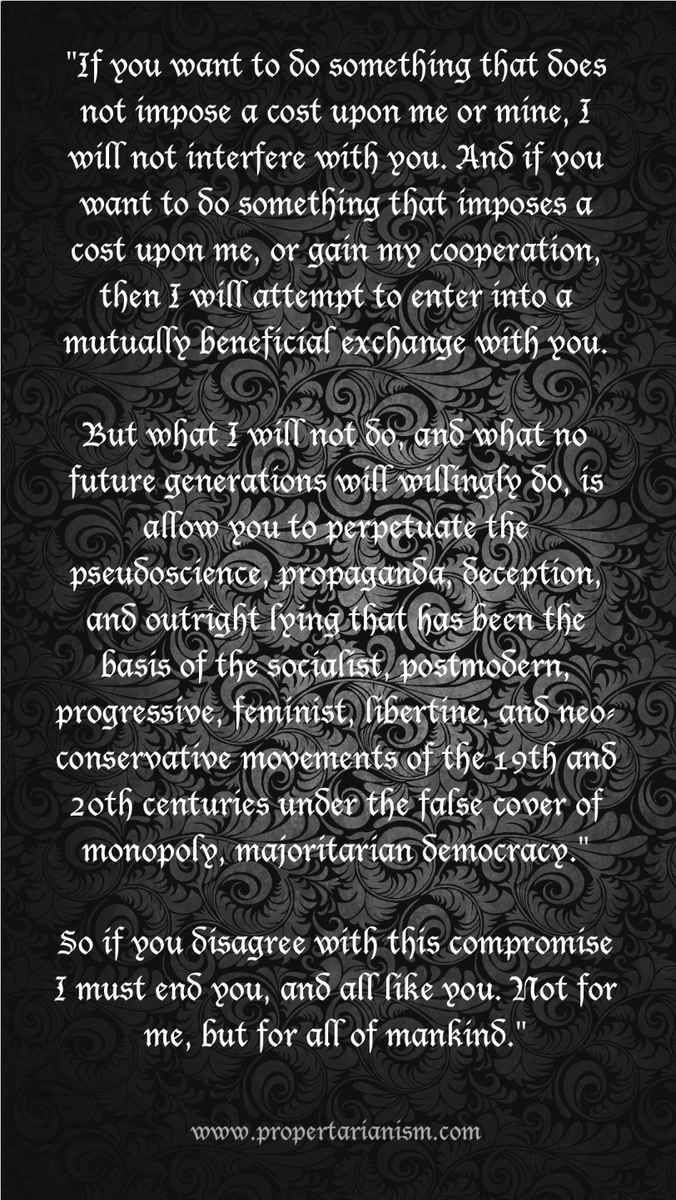
    [pullquote]But what I will not do, and what no future generations will willingly do, is allow you to perpetuate the pseudoscience, propaganda, deception, and outright lying that has been the basis of the socialist, progressive, feminist, libertine, and neo-conservative movements of the 19th and 20th centuries.
    [/pullquote]

    Now that does not mean that we need to agree – another fallacy of democracy – but it means we cannot materially dissent. In other words, we can trade in a compromise, or we can prevent each other from imposing costs upon one another’s property-en-toto (what you’ve acted to obtain), but we cannot by any method impose costs on one another’s property-en-toto without consent. So if you don’t like something that’s true, or you want to speak an untruth, then you’re just a bad dishonest person unworthy of cooperation. If you want to preserve monopoly democracy, then you’re just a bad and dishonest thief unworthy of cooperation and worthy of punishment, ostracization and death. If you want to just get away with stealing from others without engaging in trade then you’re again, a bad, dishonest, thief worthy of punishment, ostracization and death. But if you want to do something that does not impose a cost upon me or mine, I will not and cannot interfere with you. And if you want to impose a cost upon me, or gain my cooperation then I will enter in an exchange with you. I cannot stop you from doing good, I can only prevent you from imposing harm. But what I will not do, and what no future generations will willingly do, is allow you to perpetuate the pseudoscience, propaganda, deception, and outright lying that has been the basis of the socialist, progressive, feminist, libertine, and neo-conservative movements of the 19th and 20th centuries. If that is the case then I am morally justified, ethically justified, and biologically mandated to exterminate you. And that applies to me as well. So if you disagree with this I must end you, and all like you. Not for me, but for all of mankind. Just as if I disagree with this you must end me. This is the most and best moral position any man can take. Curt Doolittle The Propertarian Institute Kiev, Ukraine

  • If You Don’t Like What I Say – Think About This…

    [I] work on the discipline (technology) of speaking truthfully. Not honestly, but truthfully – as in “as scientifically as possible”. Now like any human being I absolutely do engage in various forms of sarcasm, humor, honorarium, and illustration. But in general, I try to write ‘proofs’: a proof includes including tests of internal consistency, external correspondence, informational availability, existential possibility, limits, parsimony, and full accounting. That’s the innovation that Propertarianism and Testimonialism provide us with: an amoral (unloaded) language for the articulation and comparison of various political, ethical and moral statements. Now, I don’t (like everyone else in the world, and almost everyone in intellectual history) want to know the truth so that I can justify the use of my particular moral bias over your particular moral bias. Instead, I want to know the truth so that you and I can conduct an exchange – a compromise – rather than a conquest. A trade rather than a monopoly act of oppression. A ‘truth’ rather than a falsehood. And that is how Propertarianism differs from the fallacies of authoritarian monotheism, utilitarian rationalism, and democratic majority rule: that the only ‘truth’ we can know is when your bias and my bias results in a compromise that is mutually beneficial.

    [pullquote]But what I will not do, and what no future generations will willingly do, is allow you to perpetuate the pseudoscience, propaganda, deception, and outright lying that has been the basis of the socialist, progressive, feminist, libertine, and neo-conservative movements of the 19th and 20th centuries.
    [/pullquote]

    Now that does not mean that we need to agree – another fallacy of democracy – but it means we cannot materially dissent. In other words, we can trade in a compromise, or we can prevent each other from imposing costs upon one another’s property-en-toto (what you’ve acted to obtain), but we cannot by any method impose costs on one another’s property-en-toto without consent. So if you don’t like something that’s true, or you want to speak an untruth, then you’re just a bad dishonest person unworthy of cooperation. If you want to preserve monopoly democracy, then you’re just a bad and dishonest thief unworthy of cooperation and worthy of punishment, ostracization and death. If you want to just get away with stealing from others without engaging in trade then you’re again, a bad, dishonest, thief worthy of punishment, ostracization and death. But if you want to do something that does not impose a cost upon me or mine, I will not and cannot interfere with you. And if you want to impose a cost upon me, or gain my cooperation then I will enter in an exchange with you. I cannot stop you from doing good, I can only prevent you from imposing harm. But what I will not do, and what no future generations will willingly do, is allow you to perpetuate the pseudoscience, propaganda, deception, and outright lying that has been the basis of the socialist, progressive, feminist, libertine, and neo-conservative movements of the 19th and 20th centuries. If that is the case then I am morally justified, ethically justified, and biologically mandated to exterminate you. And that applies to me as well. So if you disagree with this I must end you, and all like you. Not for me, but for all of mankind. Just as if I disagree with this you must end me. This is the most and best moral position any man can take. Curt Doolittle The Propertarian Institute Kiev, Ukraine

  • The General Challenge of Improving Demonstrated Intelligence Is In Making Fewer Errors.

    —“General knowledge, scientific knowledge, and testimonial truth will pretty much reduce any error you might accumulate through normal human cognitive bias. And, from what I can see, the general challenge of improving demonstrated intelligence is not getting smarter, it is making fewer errors. I know engineers who are not particularly smart, but they demonstrate the intelligence that they do have very well, because engineering-thinking is pretty scientific and practical. I see this in doctors as well as engineers. Whether they’re exceptional or not matters less. Their entire profession is built upon the scientific principle of doing no harm. So they may fewer errors. Too bad economists and politicians don’t do the same.”—