Author: Curt Doolittle

  • Contra Socrates, the reality is, that one must know almost everything in order t

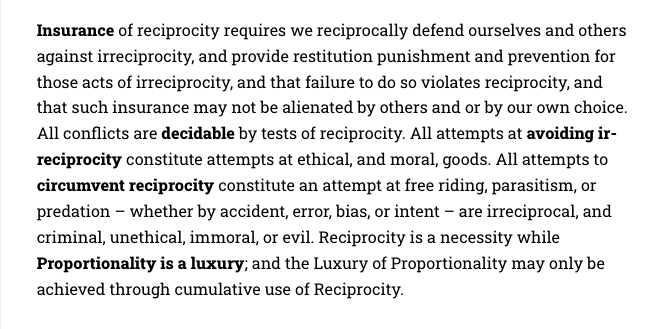
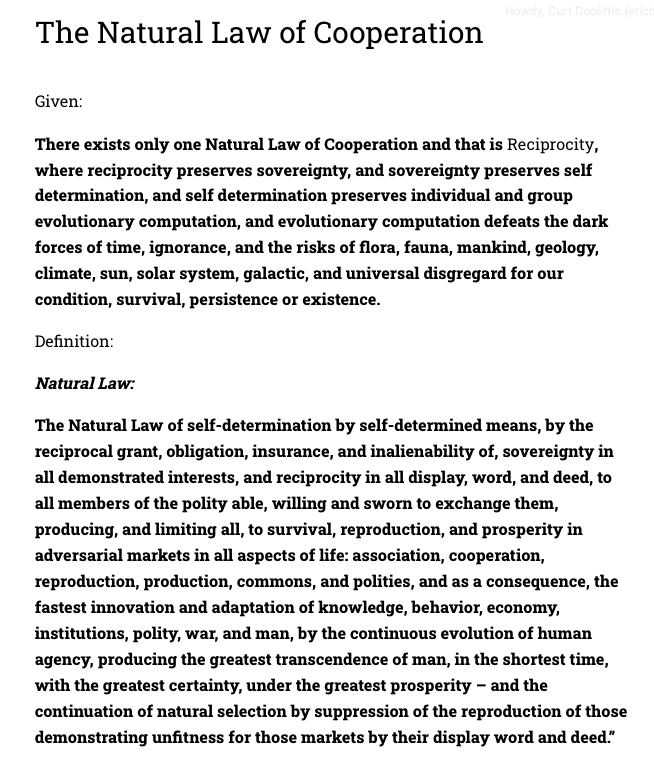
    Contra Socrates, the reality is, that one must know almost everything in order to know anything. At least, that’s my experience – breadth of knowledge falsifies presumptions of knowledge. And by knowing almost everything you can see that pattern causing everything, and it’s trivially simple. The universe is trivially simple in cause, just extraordinary in consequence.


    Source date (UTC): 2024-04-15 18:47:03 UTC

    Original post: https://twitter.com/i/web/status/1779944542067707904

  • SO CURT DOOLITTLE, WHAT IS THIS NATURAL LAW? It’s

    SO CURT DOOLITTLE, WHAT IS THIS NATURAL LAW? It’s

    SO CURT DOOLITTLE, WHAT IS THIS NATURAL LAW?
    It’s: https://twitter.com/curtdoolittle/status/1779940094683607400 https://t.co/0Y2dcAT9c0

  • OK. Despite that it can be taken two ways, I’ll add this to the collection of cu

    OK. Despite that it can be taken two ways, I’ll add this to the collection of curt-memes I enjoy. 😉 https://twitter.com/true_nof1/status/1779915722933617136

  • OK that’s a new fave to add to the collection. 😉

    OK that’s a new fave to add to the collection. 😉


    Source date (UTC): 2024-04-15 18:29:49 UTC

    Original post: https://twitter.com/i/web/status/1779940204855357813

    Reply addressees: @MindEnjoyer @true_nof1

    Replying to: https://twitter.com/i/web/status/1779937004114825616

  • ARISTOTLE’S ORIGINATION OF NATURAL LAW Aristotle’s conception of natural law is

    ARISTOTLE’S ORIGINATION OF NATURAL LAW
    Aristotle’s conception of natural law is integral to his teleological understanding of the universe, emphasizing purpose and natural order rather than a constructed set of legal rules:

    Natural Law in Aristotle’s Thought:
    Aristotle defines natural law not as explicit statutes but as an inherent order discernible through reason. This law is constant and universal, guiding both natural phenomena and human conduct, unlike human-made laws which are variable and context-dependent.

    In works like “Nicomachean Ethics” and “Politics,” he elucidates that natural justice and law possess a universal power of decidability that does not depend on human perception or societal convention. He argues that aspects of justice are embedded in nature and thus hold universal validity.

    Causal Foundations of Natural Law:
    Aristotle’s natural law emerges from his view that everything in nature is directed towards a purpose or end (telos). Natural law stems from this purposeful existence and the rational capacities inherent in humans, who are naturally equipped to discern and align with these universal principles.

    The capacity for human reasoning and virtue is in alignment with the cosmic order. Aristotle’s virtue ethics, detailed in his philosophical works, advocates living in accordance with this natural law, pursuing the ‘good life’ or ‘eudaimonia,’ achieved by fulfilling one’s natural purpose.

    Implications for Human Law:
    Aristotle distinguishes between justice by nature and justice by convention, recognizing that while natural law is immutable, its application through human laws must adapt to societal variations. Ideally, human laws should extend natural law, tailored to specific community needs but ultimately reflecting universal justice principles.

    In essence, Aristotle’s natural law represents the rational and purposive structure of the universe, accessible through human reason and central to achieving the highest form of good through a life of virtue. It serves both as a description of the world’s inherent order and as the cause for humans to act in harmony with this order, realizing their true nature and potential.

    Result
    In other words, without knowing of evolution, Aristotle is attributing causality and natural law to evolutionary consequence, and in his general counsel, that man should live according to nature not according to Ideals, fictions and lies.

    What is Not in Aristotle That Was Added by Christians?
    The Christian adaptation of natural law significantly diverges from Aristotle’s formulation by embedding theological elements that Aristotle’s philosophy omits:

    Divine Origin and Authority: Christianity posits that natural law is authored by God, thus divine will becomes the source of natural law. In contrast, Aristotle sees natural law as emerging from the inherent purposes and functions of things, discerned through reason without divine attribution.

    Theological Purpose:
    In Christian doctrine, the ultimate purpose of natural law is aligned with fulfilling God’s will, leading to eternal salvation or damnation.
    In other words “you must obey” (a stick)

    Aristotle’s concept is secular; the purpose of natural law is to achieve eudaimonia, a state of flourishing based on virtues, confined to earthly existence without eschatological implications.
    In other words, ‘you will flourish” (a carrot)

    Moral Fallibility and Sin:
    Christianity introduces the concept of original sin, framing human nature as inherently flawed, requiring divine grace for moral guidance and adherence to natural law. Aristotle attributes moral failure to ignorance or lack of virtue, considering human nature as fundamentally rational and oriented towards good.
    In other words “you are evil so obey”

    Role of Revelation:
    Christian natural law often relies on divine revelation through scripture for its elucidation and application, asserting that human reason alone is insufficient due to the corrupted nature of human will.
    “You’re evil and stupid so obey the Church”

    Aristotle’s approach relies solely on human reason to understand and apply natural law based on observable natural order.
    “You can reason you can choose the good, beautiful, excellent and heroic, and you will benefit from it.”

    In summary, the Christian reinterpretation of natural law transforms it from Aristotle’s rational, purpose-driven understanding based on intrinsic natural properties to a divinely dictated, eschatologically significant framework where human nature requires divine correction and guidance.

    In other words christianity teaches:
    –‘You are bad and stupid, so don’t think, but obey’.–

    Analysis:
    Now if you follow my work on natural law, converting anglo enlightenment empiricism, to contemporary scientific operationalism, you’ll note that of course, I take aristotle’s position because I do not believe I am or man is either evil or stupid but constrained by circumstance and possessed of sufficient free will to choose the good over the bad.
    But that man may need education in order to understand the problems of cooperation as human numbers and variation scale. So that what may appear ethical and moral in one case may not be in another.
    This is reasoning.

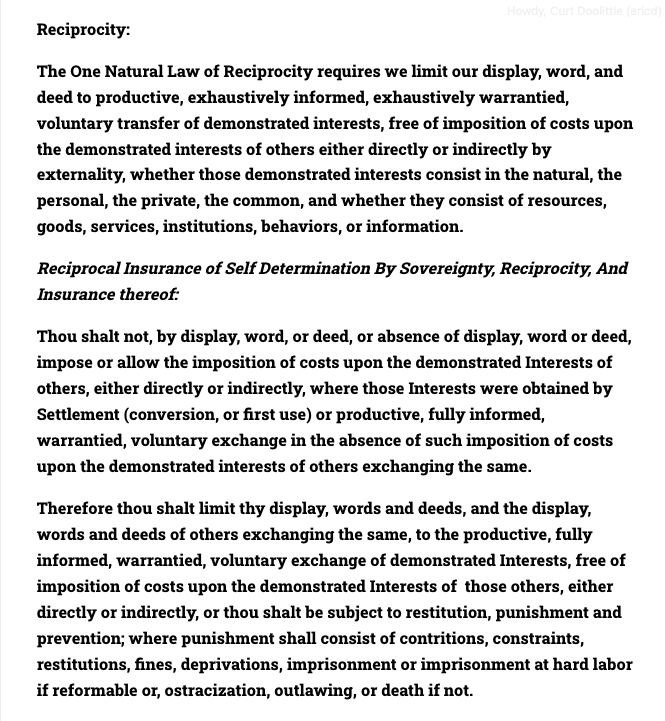
    So my work in natural law simply uses the findings of the sciences especially those over the past century and a half to state the natural law of cooperation as an evolutionary outcome of evolutionary computation over time, and itself an example of evolutionary computation by processing vast amounts of information for vast differences in abilities, wants and needs.

    Aristotle in this case was largely right. Even if he lacked the knowledge of causality that we possess today he understood from the evidence at hand the concept of balance (what we call reciprocity and proportionality), that both Common distributive justice (mutual insurance, proportionality) and Individual corrective justice (sovereignty, reciprocity, restitution, punishment) was necessary to preserve an equilibrium of cooperation that suppressed injustices – not produced justices. 😉

    Aristotle’s concept of justice as proportionality is deeply integrated into his view of natural law. He believes that justice, as a virtue, fulfills the natural order and purpose (telos) of human society. Justice ensures that individuals can achieve their potential and contribute to the flourishing of the community, which is the ultimate goal of the polis (city-state) as a natural entity. In Aristotle’s view, the laws of a polis should reflect this natural order by promoting justice as proportionality, ensuring that each person receives what is due to them according to their merit and the nature of their relationships and transactions.

    In other words, Aristotle favored Classical Liberalism, and rule of law by the natural law.

    Cheers
    CD

    Source date (UTC): 2024-04-15 18:29:22 UTC

    Original post: https://twitter.com/i/web/status/1779940094134099968

  • EUROPEAN ARISTOTLE VS SEMITIC ABRAHAMISM (prelude to understanding the natural l

    EUROPEAN ARISTOTLE VS SEMITIC ABRAHAMISM
    (prelude to understanding the natural law of cooperation absent semitic superstition and primitivism)

    Abstract:
    Aristotle in proper greek tradition is seeking to advise already good people on how to live better lives, while the abrahamic theology in proper semitic tradition is seeking to advise people who are not good on how to live good lives. You may not like this observation but that does not mean it isn’t true. Why? Sovereign Aristocratic civilization in Europe and Subject Peasant Civilization in the middle east. As such the wisdom literature of each needed to solve the problems distinct to each.

    –“The Greek focus on improving the good towards the excellent, and the Abrahamic focus on uplifting the general populace towards goodness”–

    Explanation:
    The philosophical and theological differences between Aristotle’s ethics and Abrahamic moral teachings reflect the distinct societal structures from which they emerged. Aristotle, addressing a relatively small, elite segment of Greek society, assumes a baseline of rational and ethical competence. His philosophy aims to refine virtues and enhance personal and civic excellence, suitable for an environment where participation in public life and intellectual debate is expected of free citizens.

    In contrast, Abrahamic religions developed within more hierarchical and diverse societies, encompassing a broad socioeconomic spectrum. These religions provide explicit moral codes to guide a varied populace towards righteous living, establishing a standardized conduct that can apply universally, irrespective of individual moral starting points. This approach ensures widespread accessibility and applicability, critical in societies with significant variations in education and moral development.

    Thus, the Greek tradition is designed for an aristocratic context where the focus is on enhancing existing virtues towards optimal civic and personal function. The Abrahamic tradition, however, operates within a context aiming to elevate a broad population to a basic threshold of righteous behavior, critical for maintaining order and unity across diverse and extensive communities. Each system’s moral guidance is tailored to the specific needs and structures of its society, using laws and ethical teachings as tools to shape and stabilize the community and guide individual conduct.

    Detail:
    So, there is a profound contrast in philosophical and theological traditions that reflect different social structures and cultural needs. The distinction between the Greek (particularly Aristotelian) and Abrahamic approaches to moral and ethical guidance indeed mirrors the societal and governance systems predominant in their respective regions and historical contexts.

    Greek Philosophical Tradition
    In Ancient Greece, especially in the works of Aristotle, philosophy was often directed towards a relatively small, educated, elite segment of society. These individuals were typically already engaged in a life where personal virtue and excellence were seen as attainable and desirable. Aristotle’s philosophy assumes a base level of moral competence and rationality, focusing on the refinement of virtues and the pursuit of eudaimonia (flourishing or happiness). The concept of being a good person was tied to being a well-functioning person according to one’s rational nature and social role.

    Aristotle’s ethics, therefore, cater to those who are already on the path of moral contemplation, aiming to provide them with the intellectual tools to perfect their virtues. This approach is characteristic of a society where the individual’s role in the polis (city-state) was paramount, and where civic participation and personal excellence were closely intertwined.

    Abrahamic Theological Tradition
    In contrast, Abrahamic religions (Judaism, Christianity, Islam) arose in contexts where societies were more diverse and included a wide range of socio-economic statuses and levels of education. These religions often spread among populations that included large numbers of individuals with limited access to formal education and philosophical training. As such, the religious teachings needed to be more universally accessible and applicable to everyday life.

    Abrahamic theology typically focuses on laws, commandments, and moral codes that are designed to guide adherents from a broad range of moral starting points towards a life of righteousness and divine obedience. This includes explicit prescriptions and prohibitions intended to manage a diverse populace comprising varying degrees of moral rectitude.

    Cultural and Social Implications
    The differences can be viewed through the lens of the social and political structures of these civilizations. Greek philosophy often reflects the ideals of a sovereign, somewhat aristocratic society where the free male citizenry engaged directly in civic life and philosophical debate. The focus is on advising those who are already considered good on how to excel further in their moral and intellectual endeavors.

    In contrast, the Abrahamic traditions emerged within and addressed more hierarchically structured societies, where the masses were often subjects rather than participants in the sovereign functions of the state. The moral and legal codes provided by these religions served to unify and regulate a wide range of individuals, including many who might not have had the initial moral or intellectual formation that Greek philosophy presupposed.

    Conclusion
    Thus, the “wisdom literature” of each tradition developed to address the specific needs and challenges of their respective societies. The Greek focus on improving the good towards the excellent, and the Abrahamic focus on uplifting the general populace towards goodness, both serve the goal of social cohesion and individual improvement, but they do so in ways that reflect their distinct social structures and historical contexts.

    My Work
    So, I work from the aristocratic position trying to lift people from bad to good, and if possible from good to excellent – if ever possible. In other words I do not provide a compromise or presumed good for the moment, but the science of excellence for eternity.

    The peasants may need their solace and sedation but for those of us able, we seek excellence not just good enough.

    Cheers


    Source date (UTC): 2024-04-15 17:59:02 UTC

    Original post: https://twitter.com/i/web/status/1779932460123385856

  • Thank you. Reposted with corrected links. 😉

    Thank you. Reposted with corrected links. 😉


    Source date (UTC): 2024-04-15 17:01:31 UTC

    Original post: https://twitter.com/i/web/status/1779917985685070055

    Reply addressees: @StephenThomasHC

    Replying to: https://twitter.com/i/web/status/1779915485720584352

  • (Testing the Waters) (edited) Ok. So let’s test the waters here on X-Twitter for

    (Testing the Waters) (edited)
    Ok. So let’s test the waters here on X-Twitter for a moment:

    1) Ethics: Most people who recognize my name are aware of my work on ethics (Propertarianism). https://naturallawinstitute.com/docs/old-material/reciprocity/

    2) The Law: Some people are aware of my work on the…


    Source date (UTC): 2024-04-15 17:01:04 UTC

    Original post: https://twitter.com/i/web/status/1779917872933773598

  • (Testing the Waters) (edited) Ok. So let’s test the waters here on X-Twitter for

    (Testing the Waters) (edited)
    Ok. So let’s test the waters here on X-Twitter for a moment:

    1) Ethics: Most people who recognize my name are aware of my work on ethics (Propertarianism). https://t.co/5oLb3zSN1P

    2) The Law: Some people are aware of my work on the constitutional, legal and policy reforms. https://t.co/yBqWDutcs1

    3) The Logic:Operationalism: Some people are aware of my work on formal operational logic and language: https://t.co/CG2v1iy6n8
    The Method Videos:
    https://t.co/9E7IntFgcr

    4) The Science: Few people are aware of my work on cognitive science and behavior. More people that I expected are aware of my work on sex differences in cognition, deception, and warfare. And even more than I ever expected are aware of my work on group evolutionary differences and how those differences make use of sex differences in warfare. https://t.co/cKQJpfRObe
    The foundation series (cognitive science) videos: https://t.co/ib3v3XLlIc…

    5) The History: I’m only half done with my work on evolution of man, and human history, so I don’t mention it at all other than to reference some work on the speciation events that created the races. I doubt anyone knows of it.
    https://t.co/c6sqBWTO7d

    6) The Prosecution: On the other hand, I have not promoted my work on ‘the prosecution of the enemy’. Because well, it’s pretty damning and it’s a taboo subject. But all those terrible things you would like to know about the “bringers of conflict” are covered in it. https://t.co/U4b9s8k8LY…
    The Choice Series Videos:
    https://t.co/nt1KX8Ao8Q

    7) Civil War: And I don’t publish my work on ‘The course and conduct of a civil war’ – because well, the FBI has asked (threatened) me not to inspire others to action. Precisely because I do know how to cause and conduct that war. (no link)

    So, why did I publish this list?
    (a) do you see the scope of this project? Now do you understand why it’s taking me so long? 😉 Good. 😉
    (b) Well, in case you made it this far, and in case you care, so that you might take a brief look at The Prosecution and just how far along it is. 😉
    (c) And to test the sensitivity on the platform to publishing such things even though they are taboos.

    Thank for participating in the experiment. 😉
    Cheers


    Source date (UTC): 2024-04-15 17:01:04 UTC

    Original post: https://twitter.com/i/web/status/1779917872577368064

  • RT @ThruTheHayes: ENTROPIC DISSOLUTION This same pressure exists in the realm of

    RT @ThruTheHayes: ENTROPIC DISSOLUTION

    This same pressure exists in the realm of personality. When nations had distinct cultures, the indi…


    Source date (UTC): 2024-04-15 16:50:38 UTC

    Original post: https://twitter.com/i/web/status/1779915244048937102