photos_and_videos/TimelinePhotos_dJ9jhts2Ng/75258567_495466877716874_5454514509215432704_o_495466867716875.jpg CLICK YOUR HEELS DOROTHY, WE FOUND HOME. 😉
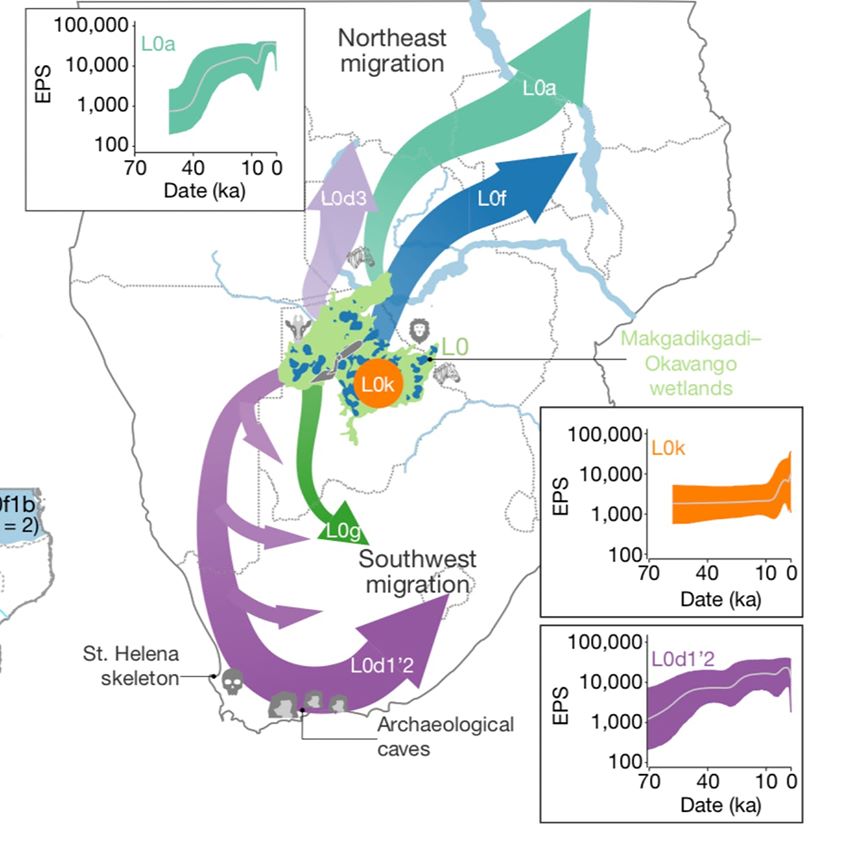
—“By establishing mitogenomic timelines, frequencies and dispersals, we show that the L0 lineage emerged within the residual Makgadikgadi–Okavango palaeo-wetland of southern Africa7, approximately 200 ka (95% confidence interval, 240–165 ka). Genetic divergence points to a sustained 70,000-year-long existence of the L0 lineage before an out-of-homeland northeast–southwest dispersal between 130 and 110 ka. Palaeo- climate proxy and model data suggest that increased humidity opened green corridors, first to the northeast then to the southwest. Subsequent drying of the homeland corresponds to a sustained effective population size (L0k), whereas wet–dry cycles and probable adaptation to marine foraging allowed the southwestern migrants to achieve population growth (L0d1’2), as supported by extensive south-coastal archaeological evidence8–10. Taken together, we propose a southern African origin of anatomically modern humans with sustained homeland occupation before the first migrations of people that appear to have been driven by regional climate changes.”—CLICK YOUR HEELS DOROTHY, WE FOUND HOME. 😉
—“By establishing mitogenomic timelines, frequencies and dispersals, we show that the L0 lineage emerged within the residual Makgadikgadi–Okavango palaeo-wetland of southern Africa7, approximately 200 ka (95% confidence interval, 240–165 ka). Genetic divergence points to a sustained 70,000-year-long existence of the L0 lineage before an out-of-homeland northeast–southwest dispersal between 130 and 110 ka. Palaeo- climate proxy and model data suggest that increased humidity opened green corridors, first to the northeast then to the southwest. Subsequent drying of the homeland corresponds to a sustained effective population size (L0k), whereas wet–dry cycles and probable adaptation to marine foraging allowed the southwestern migrants to achieve population growth (L0d1’2), as supported by extensive south-coastal archaeological evidence8–10. Taken together, we propose a southern African origin of anatomically modern humans with sustained homeland occupation before the first migrations of people that appear to have been driven by regional climate changes.”—
Source date (UTC): 2019-10-29 15:46:00 UTC
Leave a Reply